5S for GCC Workspace and Digital Hygiene
October 15, 2026
Like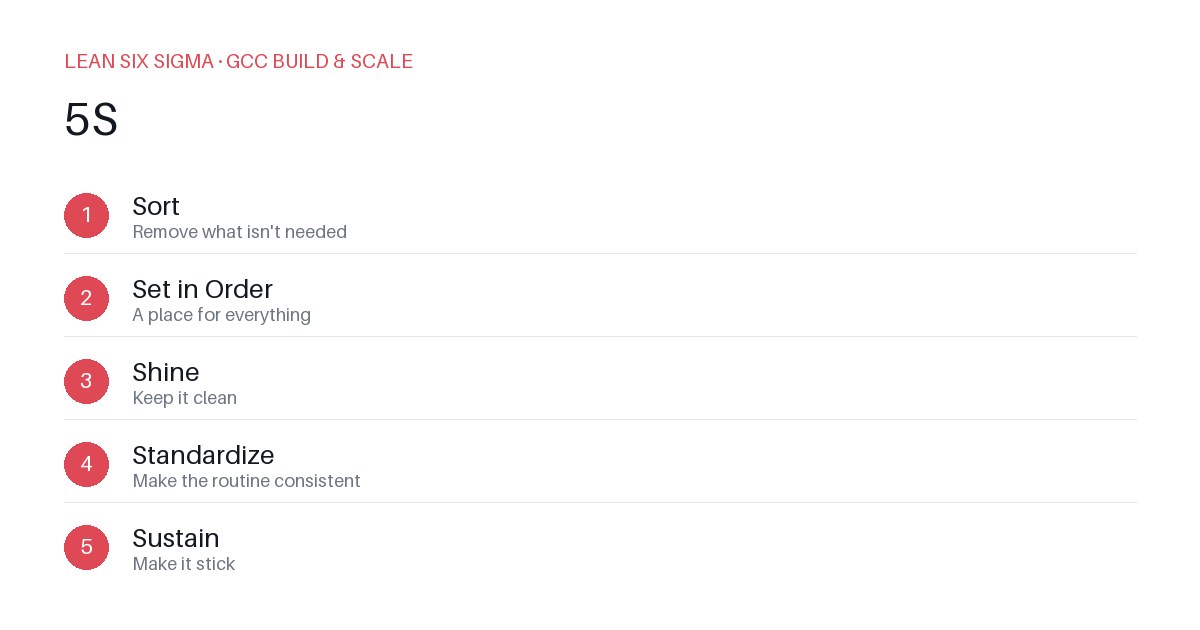
Downloadable templates
A practical walkthrough of applying 5S to real GCC build-and-scale work.
Why 5S Matters for GCC Teams
Scaling a Global Capability Center means standardizing work across sites, handoffs, and teams that have never worked together before. 5S gives you a shared vocabulary and a repeatable sequence for doing that. In a GCC context, where processes are often inherited, fragmented, or heavily reliant on tribal knowledge, 5S acts as an operational reset button. It forces teams to confront clutter — whether physical, digital, or procedural — and replace ad-hoc habits with intentional design.
The 5S Sequence
- Sort — Remove what isn't needed
- Set in Order — A place for everything
- Shine — Keep it clean
- Standardize — Make the routine consistent
- Sustain — Make it stick
Applying It
Start small: pick one recurring pain point your GCC team hits every week, and walk it through these 5 steps before rolling the approach out more broadly. Download the template below to run your first pass.
Concrete Examples of 5S in GCC Environments
Sort: Audit your shared drive, ticketing backlog, or meeting cadence. How many documents are outdated? How many Slack channels are dead? How many approval steps don’t add value? Remove or archive them. In one GCC, teams reduced their project repository from 4,200 files to 800 by deleting duplicates and deprecated templates.
Set in Order: If a team member has to search across three different platforms to find the latest SOP, that’s a design flaw. Create clear folder structures, naming conventions, and access rules. For example, use a “Live / Archive / Draft” structure in your knowledge base, and assign ownership for each document.
Shine: Cleanliness isn’t just aesthetic — it’s cognitive. A cluttered dashboard, a messy Jira board, or a disorganized onboarding checklist increases friction. Schedule 15-minute “reset” sessions at the start of sprints to tidy up workspaces, close stale tabs, and update status fields.
Standardize: Document the “one right way” for recurring tasks. Create checklists, runbooks, and decision trees. Train new hires using the same materials you use daily. When everyone follows the same sequence, handoffs become predictable and quality becomes measurable.
Sustain: 5S fails without accountability. Assign 5S champions per team, tie hygiene metrics to performance reviews, and conduct monthly audits. Celebrate improvements publicly. Without reinforcement, teams will drift back to chaos.
Digital Hygiene as 5S
In modern GCCs, 5S isn’t just about physical desks — it’s about digital workflows. Apply the same principles to:
- Communication: Consolidate tools, define response SLAs, and archive inactive channels.
- Documentation: Version-control SOPs, set review cycles, and retire obsolete guides.
- Metrics: Simplify dashboards, remove vanity metrics, and align KPIs with business outcomes.
Getting Started
- Pick one high-friction process (e.g., onboarding, incident response, sprint planning).
- Map the current state — where does work stall? Where is information lost?
- Run a 90-minute 5S workshop with cross-functional members.
- Implement changes incrementally — don’t boil the ocean.
- Measure before and after: cycle time, error rate, satisfaction score.
Next Steps
Use the 5S template to document your baseline, identify quick wins, and assign owners. Revisit the process quarterly. Over time, 5S becomes less of a project and more of a mindset — a cultural operating system that keeps your GCC lean, predictable, and scalable.
Comments
Be the first to comment on this post.
Sign in to leave a comment.