5S for GCC Workspace and Digital Hygiene
October 27, 2026
Like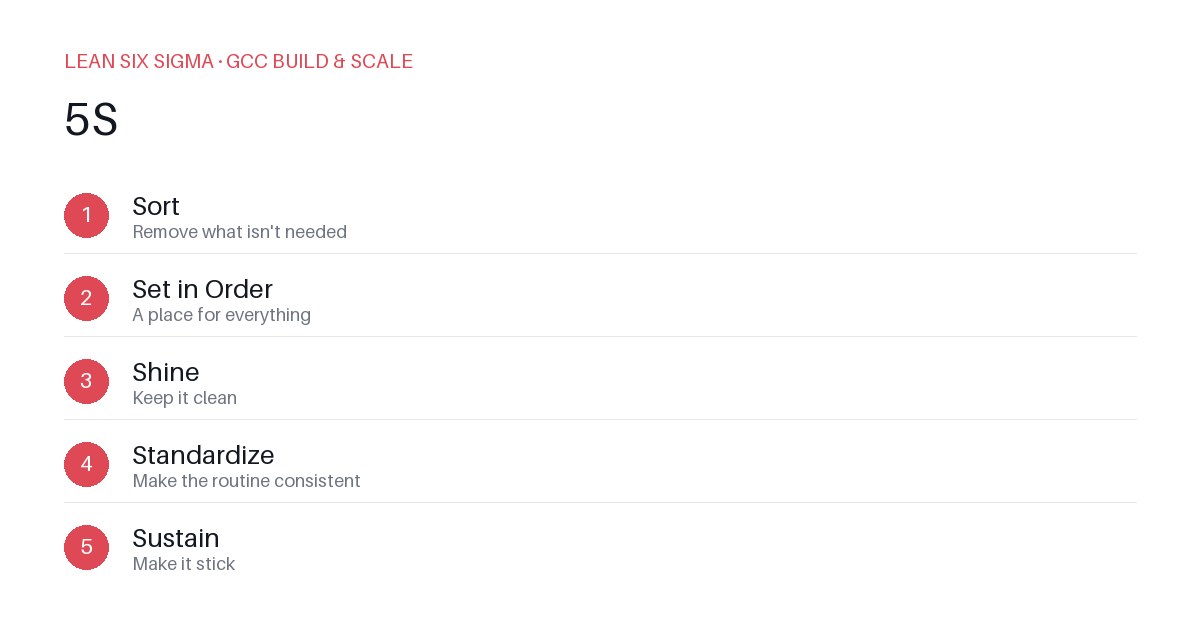
Downloadable templates
A practical walkthrough of applying 5S to real GCC build-and-scale work.
Why 5S Matters for GCC Teams
Scaling a Global Capability Center (GCC) means standardizing work across sites, handoffs, and teams that have never worked together before. 5S gives you a shared vocabulary and a repeatable sequence for doing that. In a GCC environment, where processes are often inherited from legacy systems or built in silos, 5S acts as a foundational discipline that bridges cultural and operational gaps. It’s not just about tidying up a desk; it’s about designing workflows that reduce friction, eliminate ambiguity, and empower teams to self-correct. When applied consistently, 5S becomes a catalyst for operational excellence — turning chaos into clarity, one process at a time.
The 5S Sequence
-
Sort — Remove what isn't needed
This step is about ruthless prioritization. In a GCC context, “what isn’t needed” might mean obsolete documentation, redundant approval layers, or tools that no longer serve the current process. Ask: Does this step add value? Who actually uses it? If not, archive or eliminate it. For example, a GCC team might discover that three different templates are used for the same type of client report — consolidating to one eliminates confusion and saves hours of rework. -
Set in Order — A place for everything
Once you’ve removed the unnecessary, assign a logical, consistent location for every remaining item. This includes physical items (like whiteboards or reference guides) and digital assets (like shared drives, Confluence pages, or Jira boards). The goal is intuitive navigation: if a new team member joins, they should find what they need without asking. In a GCC, this might mean standardizing folder structures across regions or creating a central “process library” with clear ownership and version control. -
Shine — Keep it clean
“Shine” goes beyond cleaning — it’s about inspecting and maintaining quality. Regularly audit your workflows for errors, outdated information, or inconsistencies. In digital hygiene terms, this means purging stale links, updating metadata, and ensuring permissions are correctly assigned. A GCC team might schedule a monthly “shine” session where members review and correct documentation, flag broken integrations, or update runbooks based on recent incidents. This proactive maintenance prevents small issues from becoming systemic failures. -
Standardize — Make the routine consistent
Standardization turns good practices into repeatable habits. Document the “how” and “why” behind every step, then train teams to follow the same method. Use checklists, SOPs, or automated workflows to enforce consistency. For instance, a GCC might standardize how tickets are triaged, how feedback is collected, or how handoffs between regions are documented. The key is not just creating standards — but embedding them into daily rituals so they become second nature. -
Sustain — Make it stick
Sustainability is where most 5S initiatives fail. Without ongoing reinforcement, teams revert to old habits. To sustain 5S in a GCC, assign ownership, track metrics, and celebrate wins. Integrate 5S principles into performance reviews, onboarding, and continuous improvement cycles. Use visual management — like dashboards or process maps — to keep standards visible. Regular audits and peer reviews help catch drift early. Remember: 5S isn’t a one-time project; it’s a mindset that requires leadership commitment and team buy-in.
Applying It
Start small: pick one recurring pain point your GCC team hits every week, and walk it through these 5 steps before rolling the approach out more broadly. Download the template below to run your first pass. Consider starting with a high-friction process — like onboarding new analysts, managing cross-site handoffs, or updating client deliverables. Document the current state, apply 5S rigorously, measure the impact, and share the results. Over time, you’ll build a culture where continuous improvement is expected, not exceptional. And that’s how GCCs scale without losing their edge.
Comments
Be the first to comment on this post.
Sign in to leave a comment.