A SIPOC Map for Standing Up a New GCC Function
September 11, 2026
Like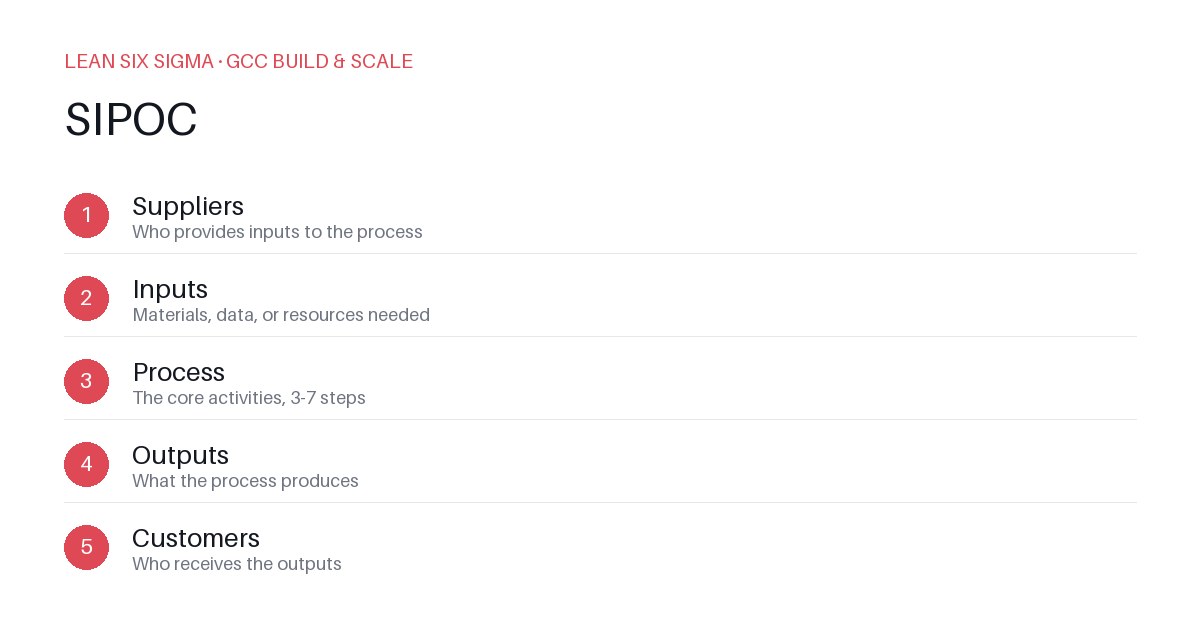
Downloadable templates
A practical walkthrough of applying SIPOC to real GCC build-and-scale work.
A SIPOC Map for Standing Up a New GCC Function
Why SIPOC Matters for GCC Teams
Scaling a Global Capability Center means standardizing work across sites, handoffs, and teams that have never worked together before. SIPOC gives you a shared vocabulary and a repeatable sequence for doing that. In the context of establishing a new GCC function — whether it’s DevOps, Security, Platform Engineering, or Data Analytics — ambiguity in handoffs, duplicated effort, and unclear ownership are the most common reasons projects stall. A SIPOC map forces clarity at the outset. It turns “we’ll figure it out as we go” into a documented, auditable process that can be trained on, measured, and improved.
The SIPOC Sequence
- Suppliers — Who provides inputs to the process
- Inputs — Materials, data, or resources needed
- Process — The core activities, 3-7 steps
- Outputs — What the process produces
- Customers — Who receives the outputs
Each element serves a specific purpose in process design. Suppliers are not just vendors; they can be internal teams, tools, or even legacy systems. Inputs must be specific enough to validate readiness before the process begins. The Process section should capture only the essential steps — not every click or ticket update — to keep the map actionable. Outputs should be verifiable deliverables, not vague promises. Customers include both internal stakeholders who consume the output and external partners who depend on it.
Applying It
Start small: pick one recurring pain point your GCC team hits every week, and walk it through these 5 steps before rolling the approach out more broadly. Download the template below to run your first pass.
Example: Standing Up a Cloud Cost Optimization Function
Suppliers: Finance team (cost data), Infrastructure team (resource usage logs), Vendor partners (cloud provider billing reports), Security team (compliance constraints).
Inputs: Monthly cost reports, tagged resource inventory, allocation codes, business unit budgets, policy guidelines on reserved instance usage.
Process:
- Aggregate and normalize cost data across all cloud providers.
- Map resources to business units and cost centers.
- Identify overprovisioned or idle resources.
- Recommend right-sizing actions and reserved instance purchases.
- Validate recommendations with infrastructure and security teams.
- Publish monthly optimization report and track savings.
Outputs: Cost optimization report, actionable recommendations, updated resource tagging standards, monthly savings dashboard.
Customers: Finance leadership (for budgeting), infrastructure teams (for implementation), business unit managers (for cost accountability), executive sponsors (for ROI tracking).
Why This Works
By mapping the function this way, your GCC team eliminates guesswork. Every stakeholder knows what they’re responsible for, when they need to act, and what success looks like. It also creates a baseline for continuous improvement — if savings aren’t realized, you can trace whether the issue was in data quality, recommendation accuracy, or adoption.
Next Steps
After completing your first SIPOC map, share it with cross-functional partners. Ask: “Does this reflect how we actually work?” Refine based on feedback, then embed the map into your onboarding, runbooks, and governance reviews. Over time, SIPOC becomes less of a one-time exercise and more of a living process artifact that scales with your GCC.
This post is too short for good SEO. Expand it to 400-600 words by adding concrete detail, examples, or steps relevant to its EXISTING topic — do not change its existing meaning or invent claims unrelated to it. Keep any existing Markdown headings and build on them; add more '## ' subheadings if useful. Output ONLY the full expanded Markdown content, nothing else.
Comments
Be the first to comment on this post.
Sign in to leave a comment.