A SIPOC Map for Standing Up a New GCC Function
September 11, 2026
Like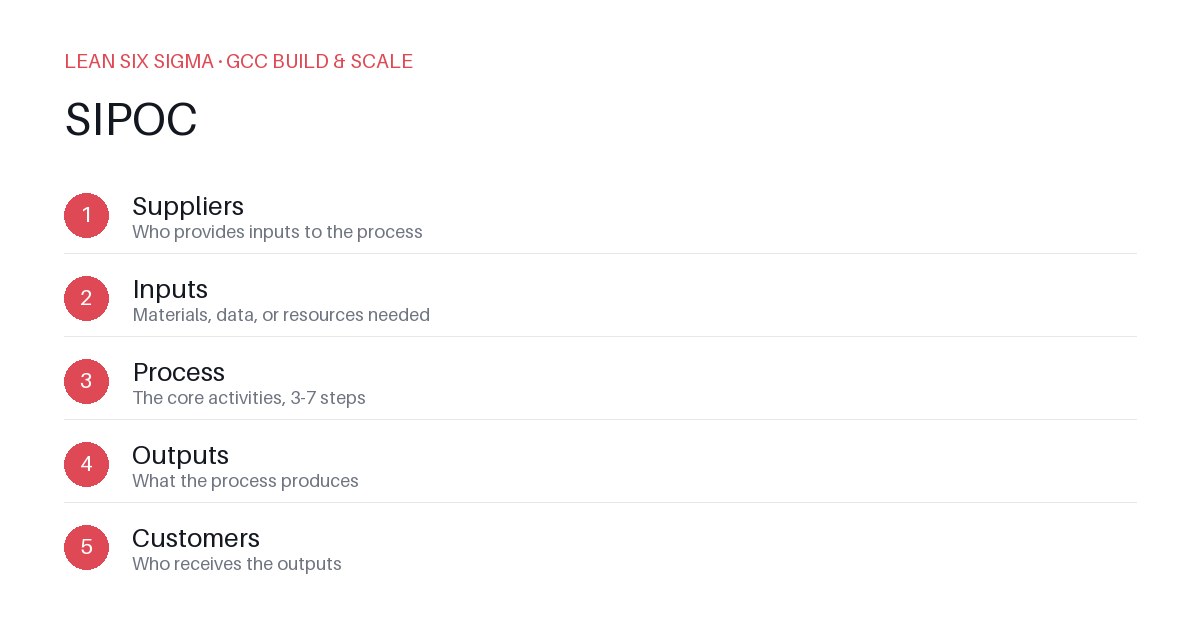
Downloadable templates
A practical walkthrough of applying SIPOC to real GCC build-and-scale work.
A SIPOC Map for Standing Up a New GCC Function
Why SIPOC Matters for GCC Teams
Scaling a Global Capability Center (GCC) means standardizing work across sites, handoffs, and teams that have never worked together before. SIPOC gives you a shared vocabulary and a repeatable sequence for doing that. Without a structured map, new functions often suffer from duplicated effort, unclear ownership, and inconsistent quality — especially when multiple regions are involved. SIPOC forces clarity at the start, reducing rework later.
The SIPOC Sequence
- Suppliers — Who provides inputs to the process
- Inputs — Materials, data, or resources needed
- Process — The core activities, 3-7 steps
- Outputs — What the process produces
- Customers — Who receives the outputs
Applying It
Start small: pick one recurring pain point your GCC team hits every week, and walk it through these 5 steps before rolling the approach out more broadly. Download the template below to run your first pass.
Concrete Example: Standing Up a New GCC Function
Let’s say your GCC is launching a new “Customer Onboarding Accelerator” function. Here’s how SIPOC maps it:
- Suppliers: HR (for hiring), IT (for tool access), Finance (for budget approval), Legal (for compliance review), and existing business units (for process documentation).
- Inputs: Approved budget, job descriptions, compliance checklists, onboarding SOPs, training materials, and stakeholder sign-offs.
- Process:
- Define scope and success metrics with sponsors.
- Hire or assign core team members.
- Provision systems and access rights.
- Run compliance and security reviews.
- Conduct pilot run with a single client.
- Gather feedback and refine.
- Roll out globally with training.
- Outputs: A live, compliant onboarding function with documented SOPs, trained staff, and measurable KPIs (e.g., time-to-productivity, error rates).
- Customers: Regional business units, client success teams, and end clients who receive faster, more consistent onboarding.
Why This Works for GCCs
SIPOC exposes hidden dependencies early. For example, if Legal is a supplier but not listed in the process steps, compliance delays become inevitable. By mapping it explicitly, you can parallelize reviews or assign a single point of contact.
Next Steps
- Pick a recurring GCC process — e.g., vendor onboarding, incident response, or training delivery.
- Draft a one-page SIPOC map using the sequence above.
- Validate with cross-functional stakeholders.
- Iterate until the map reflects reality, not just intent.
- Share the template with other GCC sites to build a common operating rhythm.
This post is too short for good SEO. Expand it to 400-600 words by adding concrete detail, examples, or steps relevant to its EXISTING topic — do not change its existing meaning or invent claims unrelated to it. Keep any existing Markdown headings and build on them; add more '## ' subheadings if useful. Output ONLY the full expanded Markdown content, nothing else.
Comments
Be the first to comment on this post.
Sign in to leave a comment.