A SIPOC Map for Standing Up a New GCC Function
September 13, 2026
Like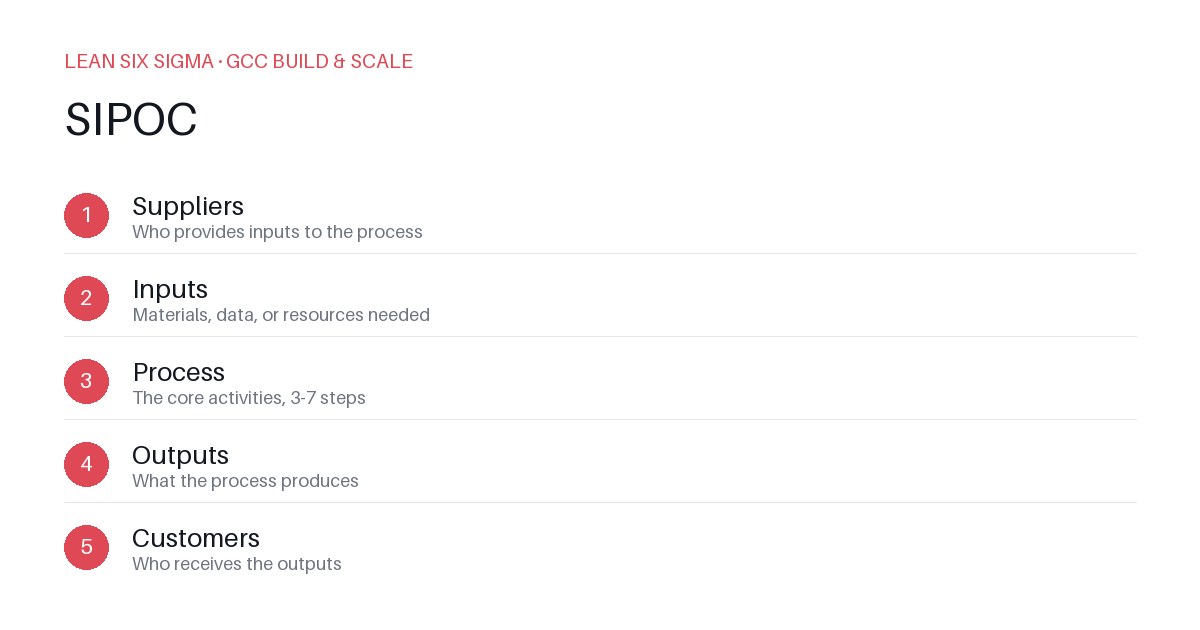
Downloadable templates
A practical walkthrough of applying SIPOC to real GCC build-and-scale work.
A SIPOC Map for Standing Up a New GCC Function
Why SIPOC Matters for GCC Teams
Scaling a Global Capability Center means standardizing work across sites, handoffs, and teams that have never worked together before. SIPOC gives you a shared vocabulary and a repeatable sequence for doing that. When you’re standing up a new GCC function—whether it’s a new testing center, a delivery hub, or a centralized engineering team—you’re not just hiring people or buying tools. You’re building a system. Without a clear map of who provides what, when, and why, even the best-intentioned launches fracture into chaos. SIPOC forces you to define the process before you execute it, reducing ambiguity, aligning stakeholders, and creating a single source of truth that can be audited, improved, and scaled.
The SIPOC Sequence
- Suppliers — Who provides inputs to the process
- Inputs — Materials, data, or resources needed
- Process — The core activities, 3-7 steps
- Outputs — What the process produces
- Customers — Who receives the outputs
This framework isn’t just a checklist—it’s a diagnostic tool. If your process stalls, SIPOC helps you trace whether the bottleneck is upstream (suppliers or inputs), midstream (process steps), or downstream (outputs or customers). It also reveals hidden dependencies. For example, you might assume your GCC function only needs engineers, but SIPOC might reveal that legal, procurement, or facility management are critical suppliers whose delays cascade into your timeline.
Applying It
Start small: pick one recurring pain point your GCC team hits every week, and walk it through these 5 steps before rolling the approach out more broadly. Download the template below to run your first pass.
Example: Standing Up a New GCC Testing Center
Suppliers:
- HR (recruiting, onboarding)
- Facilities (space, power, cooling)
- Procurement (test hardware, software licenses)
- Engineering (test cases, automation scripts)
- Security (access controls, compliance certifications)
Inputs:
- Test equipment inventory
- Employee credentials and training records
- Software build artifacts
- Facility lease agreement
- Compliance audit checklist
Process:
- Secure and configure physical space
- Procure and install test hardware
- Onboard and train engineers
- Integrate automation and CI/CD pipelines
- Run dry-run test cycles
- Obtain compliance sign-off
- Go-live with production test workloads
Outputs:
- Operational testing environment
- Trained GCC testing team
- Validated test automation suite
- Compliance documentation
- Performance baseline reports
Customers:
- Product development teams
- QA leadership
- DevOps/CI/CD pipeline owners
- Compliance and audit teams
- End users (indirectly, via improved product quality)
How to Use This Map
- Map it live: Don’t draft it in isolation. Run a 90-minute workshop with representatives from each supplier and customer role.
- Validate inputs: Confirm that every input is actually required and that suppliers can deliver on time.
- Timebox process steps: Assign realistic durations to each step to identify bottlenecks early.
- Define output quality: What does “done” look like? Use measurable criteria (e.g., “95% test pass rate,” “zero critical security findings”).
- Review with customers: Ensure the outputs meet their actual needs, not just your assumptions.
SIPOC isn’t a one-time exercise—it’s a living artifact. As your GCC function matures, revisit the map to capture new suppliers, refine process steps, and adapt to changing customer expectations. The goal isn’t perfection; it’s clarity. And in a global capability center, clarity is the fastest path to scale.
Comments
Be the first to comment on this post.
Sign in to leave a comment.