A SIPOC Map for Standing Up a New GCC Function
September 13, 2026
Like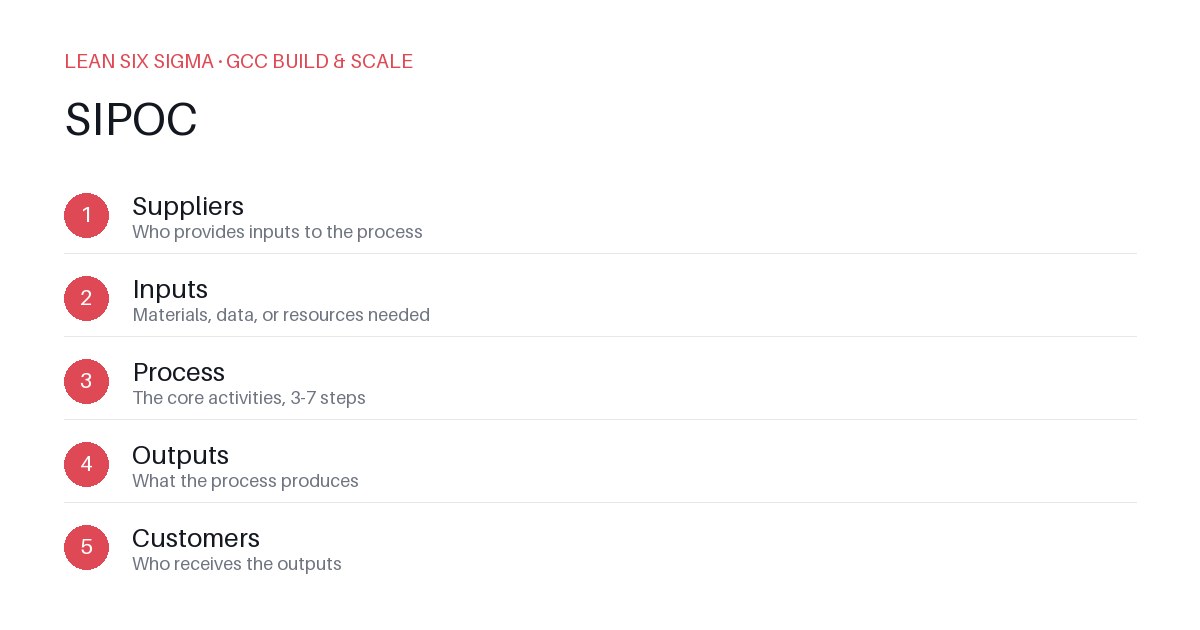
Downloadable templates
A practical walkthrough of applying SIPOC to real GCC build-and-scale work.
A SIPOC Map for Standing Up a New GCC Function
Why SIPOC Matters for GCC Teams
Scaling a Global Capability Center means standardizing work across sites, handoffs, and teams that have never worked together before. SIPOC gives you a shared vocabulary and a repeatable sequence for doing that. Without it, you risk building fragmented processes that duplicate effort, create bottlenecks, and confuse stakeholders who don’t understand who owns what. In the context of standing up a new GCC function—whether it’s a new center of excellence, a specialized service desk, or a regional delivery hub—the SIPOC framework forces clarity before execution. It turns abstract goals into concrete handoffs, making it easier to onboard new sites, audit compliance, and measure maturity over time.
The SIPOC Sequence
-
Suppliers — Who provides inputs to the process
These are the upstream entities or individuals whose contributions are required before the core process can begin. In a GCC context, suppliers might include HR for staffing, finance for budget approval, IT for infrastructure provisioning, or subject matter experts who define the function’s scope and KPIs. -
Inputs — Materials, data, or resources needed
These are the tangible or intangible prerequisites that enable the process. Examples include approved budgets, finalized org charts, access credentials, training materials, policy documents, and stakeholder sign-offs. Clear input definitions prevent delays caused by missing or incomplete dependencies. -
Process — The core activities, 3-7 steps
This is the heart of the SIPOC map: the standardized sequence of actions that transform inputs into outputs. For standing up a new GCC function, this might include: (1) Define function charter and success metrics, (2) Hire or assign core team members, (3) Provision tools and environments, (4) Conduct cross-site alignment workshops, (5) Run pilot deliverables, and (6) Formalize handoff protocols. Each step should be owned, timed, and measurable. -
Outputs — What the process produces
These are the deliverables or states that result from the process. Outputs might include an operational team, documented SOPs, active ticketing systems, trained personnel, and signed SLAs. Outputs must be verifiable and aligned with the original business need. -
Customers — Who receives the outputs
Customers are the downstream recipients who benefit from the process. In a GCC setting, these could be regional delivery teams, executive sponsors, compliance officers, or end-users who now receive standardized support or expertise. Identifying customers early ensures the process delivers real value, not just activity.
Applying It
Start small: pick one recurring pain point your GCC team hits every week, and walk it through these 5 steps before rolling the approach out more broadly. Download the template below to run your first pass.
Concrete Example: Standing Up a New Security Governance Function
To illustrate, consider launching a Security Governance GCC across three regions:
- Suppliers: Legal (policy alignment), IT Security (tooling), HR (recruiting), Regional Directors (stakeholder buy-in)
- Inputs: Approved budget ($500K), org chart draft, access to SIEM platform, security policy v2.1, KPI definitions
- Process:
- Finalize governance charter with legal
- Hire 2 lead analysts per region
- Configure SIEM dashboards and alert workflows
- Conduct regional readiness assessments
- Run mock incident response drills
- Publish SOPs and publish to knowledge base
- Outputs: Operational governance teams, documented SOPs, active monitoring dashboards, trained personnel, signed regional SLAs
- Customers: Regional delivery teams, compliance auditors, executive risk committee
By mapping this function using SIPOC, the GCC leadership can quickly identify gaps—like missing legal sign-off or unconfigured dashboards—before they cause delays. It also creates a repeatable template for future GCC launches, reducing ramp-up time and improving consistency.
Next Steps
Use this framework to audit your current GCC onboarding process. Identify where handoffs are unclear, where inputs are delayed, or where customers are underserved. Then, iterate. SIPOC isn’t a one-time exercise—it’s a living model that evolves as your GCC matures. Start with one function, refine the map, and scale the discipline.
Comments
Be the first to comment on this post.
Sign in to leave a comment.