A SIPOC Map for Standing Up a New GCC Function
September 16, 2026
Like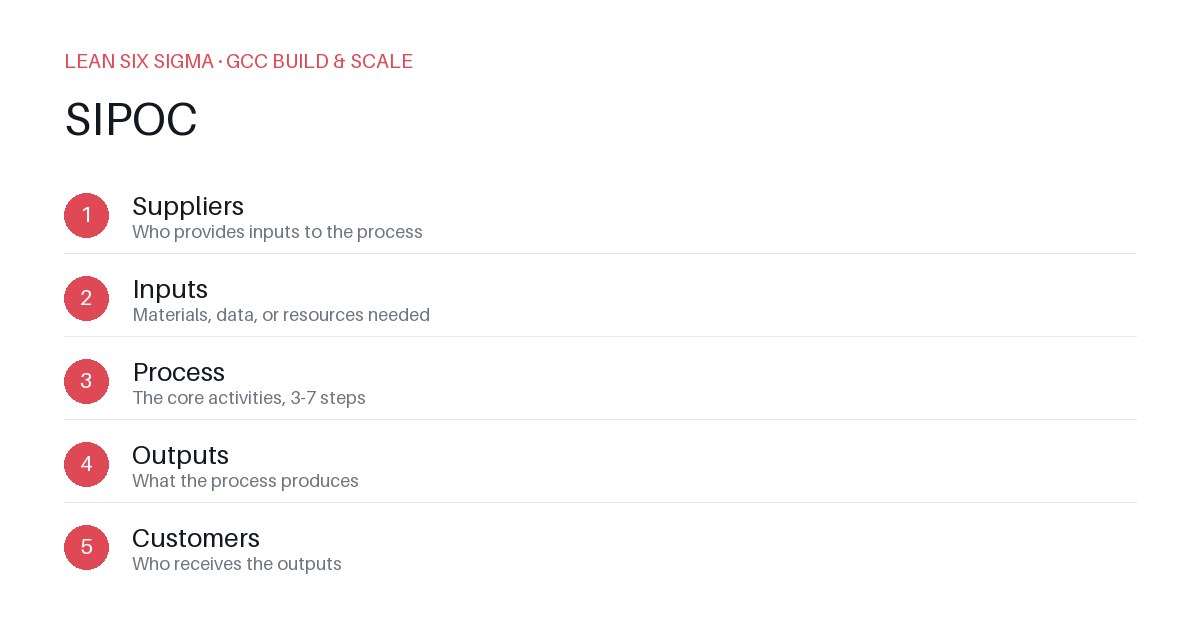
Downloadable templates
A practical walkthrough of applying SIPOC to real GCC build-and-scale work.
A SIPOC Map for Standing Up a New GCC Function
Why SIPOC Matters for GCC Teams
Scaling a Global Capability Center means standardizing work across sites, handoffs, and teams that have never worked together before. SIPOC gives you a shared vocabulary and a repeatable sequence for doing that. Without a structured framework, new functions often suffer from duplicated effort, unclear ownership, and inconsistent quality across regions. SIPOC forces teams to explicitly define who does what, with what inputs, and for which consumers — creating alignment before execution begins.
The SIPOC Sequence
- Suppliers — Who provides inputs to the process
- Inputs — Materials, data, or resources needed
- Process — The core activities, 3-7 steps
- Outputs — What the process produces
- Customers — Who receives the outputs
Applying It
Start small: pick one recurring pain point your GCC team hits every week, and walk it through these 5 steps before rolling the approach out more broadly. Download the template below to run your first pass.
Example: Standing Up a New GCC Function — “Cloud Cost Optimization”
To illustrate how SIPOC brings clarity to function launch, consider establishing a new Cloud Cost Optimization role within a GCC. Using SIPOC, the team can map the end-to-end workflow:
- Suppliers: Finance team (historical spend data), IT infrastructure owners (resource utilization metrics), HR (job descriptions and interview panels), Legal (contract compliance guidelines).
- Inputs: Monthly cloud invoices, architecture diagrams, cost allocation tags, organizational approval workflows, benchmarking reports from industry peers.
- Process:
- Gather and normalize cost data across all cloud providers.
- Identify underutilized or over-provisioned resources.
- Collaborate with engineering to right-size instances and implement auto-scaling policies.
- Validate changes in non-production environments.
- Roll out optimizations and monitor impact.
- Document savings and update governance guidelines.
- Outputs: Optimized cloud architecture, reduced monthly spend report, updated runbooks, compliance sign-offs from IT and finance.
- Customers: Engineering teams (for implementation), Finance (for budget reporting), Executive leadership (for ROI visibility), Compliance (for audit readiness).
Benefits of Using SIPOC in GCC Function Launches
- Clarity of Ownership: Every step is assigned to a specific team or individual, reducing ambiguity during handoffs.
- Risk Mitigation: Early identification of missing inputs or unclear customers prevents bottlenecks post-launch.
- Scalability: Once mapped, the SIPOC can be reused for similar functions (e.g., “Security Posture Assessment” or “Data Governance Implementation”), accelerating future launches.
- Cross-Functional Alignment: Forces collaboration between traditionally siloed teams like IT, Finance, and HR before work begins.
Next Steps for Your Team
- Select a high-impact, recurring process your GCC team struggles with.
- Gather representatives from all potential supplier and customer groups.
- Draft the SIPOC map collaboratively, focusing on clarity over perfection.
- Validate the map with stakeholders and refine based on feedback.
- Implement the process and measure outcomes against baseline metrics.
By embedding SIPOC into your function launch methodology, you transform ad-hoc efforts into repeatable, measurable capabilities — laying the foundation for sustainable GCC growth.
Comments
Be the first to comment on this post.
Sign in to leave a comment.