A SIPOC Map for Standing Up a New GCC Function
September 19, 2026
Like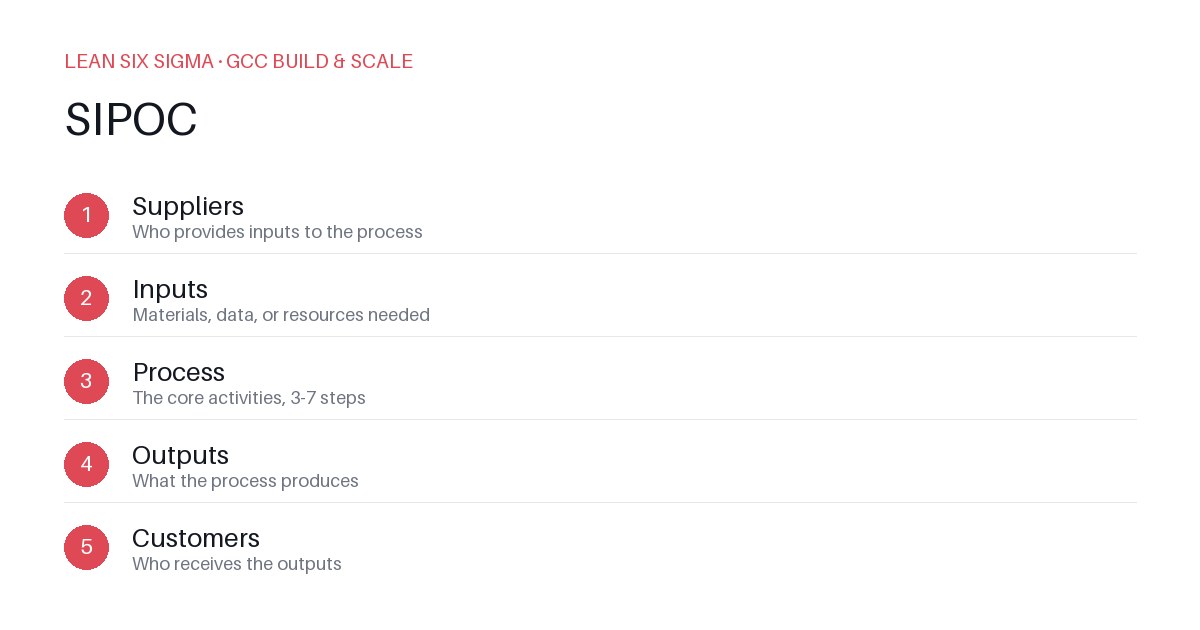
Downloadable templates
A practical walkthrough of applying SIPOC to real GCC build-and-scale work.
A SIPOC Map for Standing Up a New GCC Function
Why SIPOC Matters for GCC Teams
Scaling a Global Capability Center (GCC) means standardizing work across sites, handoffs, and teams that have never worked together before. In a GCC, you’re not just building software—you’re building a repeatable operating model. SIPOC gives you a shared vocabulary and a repeatable sequence for doing that. Without it, you end up with tribal knowledge, inconsistent handoffs, and friction between sites. With it, you create a blueprint that any site can follow to stand up a new function—whether it’s a QA automation hub, a DevOps enablement team, or a cloud migration squad—without reinventing the wheel.
The SIPOC Sequence
- Suppliers — Who provides inputs to the process
- Inputs — Materials, data, or resources needed
- Process — The core activities, 3-7 steps
- Outputs — What the process produces
- Customers — Who receives the outputs
This framework forces clarity. It turns vague intentions like “we need to stand up a new function” into a structured workflow with clear ownership, dependencies, and deliverables.
Applying It: A Concrete Example
Let’s walk through how a GCC team might use SIPOC to stand up a new Cloud Security Function at a new site.
Suppliers
- Enterprise Architecture Team (provides cloud security policies)
- Central Security Operations Center (SOC) (provides threat intelligence feeds)
- Local IT Infrastructure Team (provides access to cloud environments)
- Vendor Partners (e.g., cloud provider, security tooling vendors)
Inputs
- Cloud security policy documents
- Compliance requirements (e.g., ISO 27001, SOC 2)
- Access credentials and provisioning templates
- Security tooling licenses and access
- Local team members with cloud and security background
Process
- Align with Enterprise Standards: Review and internalize global cloud security policies.
- Provision Tooling & Access: Set up security scanning tools, SIEM integration, and role-based access.
- Hire & Train Local Talent: Recruit and upskill team members on cloud security practices.
- Run Pilot Assessments: Conduct initial security scans and vulnerability assessments on a subset of workloads.
- Document & Iterate: Create runbooks, playbooks, and feedback loops for continuous improvement.
Outputs
- Operational cloud security function with trained personnel
- Documented security runbooks and compliance checklists
- Initial vulnerability assessment reports
- Integrated security tooling dashboards
- Feedback report to enterprise security team
Customers
- Local application development teams (who need secure cloud environments)
- Enterprise compliance and audit teams
- Central GCC leadership (for scalability and standardization)
- Local IT operations teams (for secure infrastructure support)
Why This Works
By mapping the process this way, the GCC team avoids common pitfalls:
- No ambiguity: Everyone knows who does what and when.
- No silos: Suppliers and customers are explicitly identified, reducing handoff friction.
- No reinvention: The template can be reused for any new GCC function, just swap in different inputs, steps, and outputs.
Start Small, Scale Smart
Don’t try to map your entire GCC at once. Pick one recurring pain point—like “how do we onboard a new site into our security function?”—and run it through SIPOC. Use the template to document it, socialize it with stakeholders, and iterate. Once you’ve validated it, roll it out to other functions.
Download the SIPOC template below to run your first pass. Fill it out, share it with your team, and watch the clarity multiply.
Template link placeholder: [Download SIPOC Mapping Template]
This approach turns chaos into clarity, and chaos into repeatable excellence.
Comments
Be the first to comment on this post.
Sign in to leave a comment.