A SIPOC Map for Standing Up a New GCC Function
September 21, 2026
Like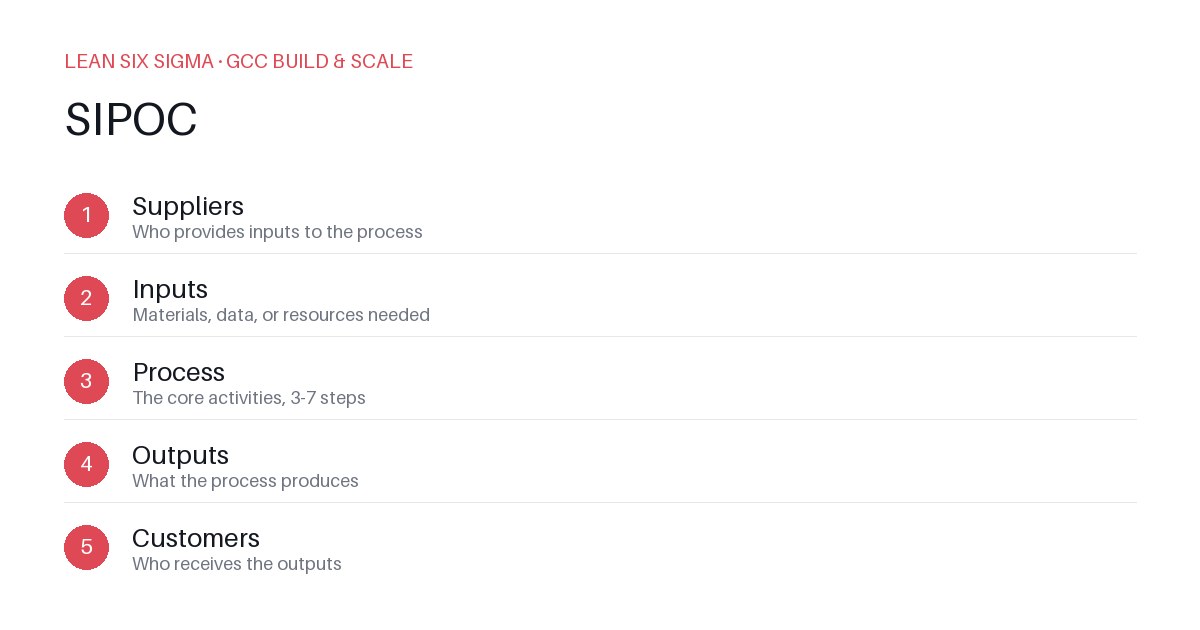
Downloadable templates
A practical walkthrough of applying SIPOC to real GCC build-and-scale work.
A SIPOC Map for Standing Up a New GCC Function
Why SIPOC Matters for GCC Teams
Scaling a Global Capability Center (GCC) means standardizing work across sites, handoffs, and teams that have never worked together before. In the early days of a GCC, processes are often tribal knowledge—held in the heads of a few champions or buried in ad-hoc Slack threads. When you try to replicate that success in a new region or with a new function, you hit friction. SIPOC gives you a shared vocabulary and a repeatable sequence for doing that. It forces clarity before execution, which is critical when you’re building infrastructure that will serve dozens of engineers, managers, and stakeholders.
The SIPOC Sequence
- Suppliers — Who provides inputs to the process
- Inputs — Materials, data, or resources needed
- Process — The core activities, 3-7 steps
- Outputs — What the process produces
- Customers — Who receives the outputs
This framework isn’t just a diagram; it’s a discipline. Each element must be explicitly defined. Ambiguity in “who” or “what” leads to bottlenecks, duplicated effort, and missed SLAs.
Applying It
Start small: pick one recurring pain point your GCC team hits every week, and walk it through these 5 steps before rolling the approach out more broadly. Download the template below to run your first pass.
Example: Onboarding a New GCC Engineer
Let’s ground this in reality. Suppose your GCC is standing up a new “Platform Reliability” function. A key process is onboarding a new engineer so they can contribute within 30 days.
- Suppliers: HR, IT Security, Engineering Managers, Existing GCC Team Leads
- Inputs: Job description, security clearance status, laptop provisioning request, team intro schedule, access matrix
- Process:
- HR confirms start date and sends welcome packet
- IT provisions hardware and accounts
- Engineering Manager assigns buddy and reviews 30/60/90-day plan
- GCC Lead schedules kickoff and shares onboarding checklist
- Engineer completes training modules and passes initial code review
- Outputs: Fully provisioned engineer, documented onboarding trail, buddy feedback form
- Customers: The new engineer, their direct manager, the GCC team, HR (for compliance tracking)
By mapping this out, you might discover that IT Security is a bottleneck because clearance takes 10 days. Or that the buddy program lacks structure. SIPOC makes these invisible dependencies visible.
Building the Template
Use a simple table or visual canvas. For each process, fill in:
- Clear owner for each step
- Defined inputs with owners and deadlines
- Measurable outputs (not just “done,” but “approved,” “deployed,” “tested”)
- Customer acceptance criteria
Review the map with cross-functional stakeholders. Ask: “Where do we hand off? Where do we wait? What breaks first?”
This post is too short for good SEO. Expand it to 400-600 words by adding concrete detail, examples, or steps relevant to its EXISTING topic — do not change its existing meaning or invent claims unrelated to it. Keep any existing Markdown headings and build on them; add more '## ' subheadings if useful. Output ONLY the full expanded Markdown content, nothing else.
Comments
Be the first to comment on this post.
Sign in to leave a comment.