A SIPOC Map for Standing Up a New GCC Function
September 27, 2026
Like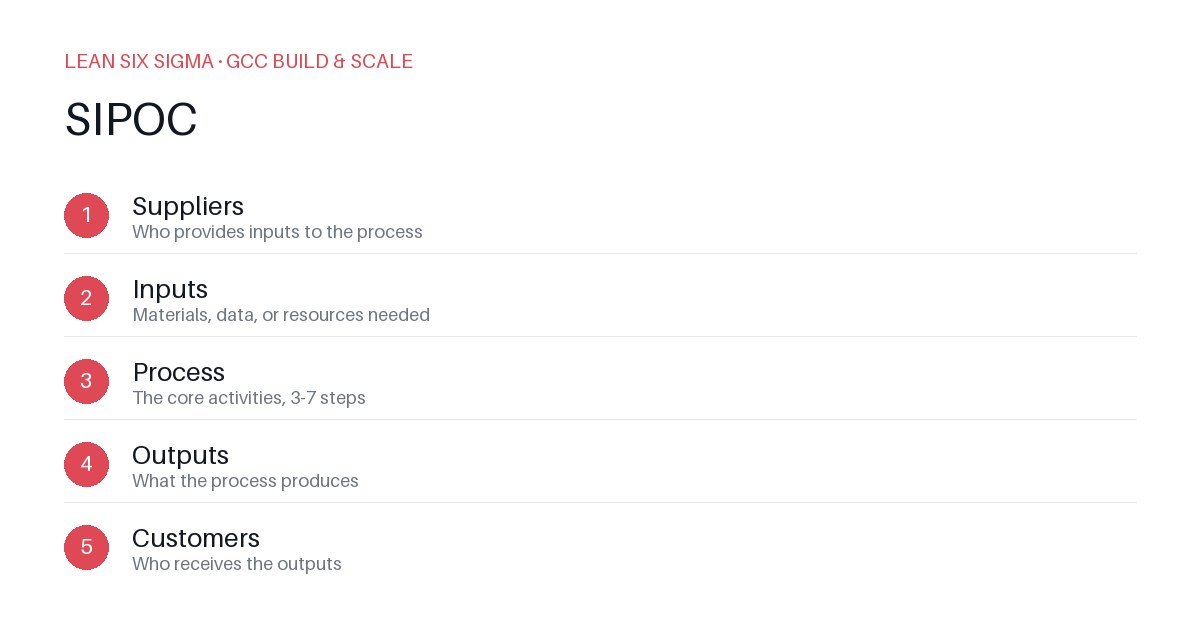
Downloadable templates
A practical walkthrough of applying SIPOC to real GCC build-and-scale work.
A SIPOC Map for Standing Up a New GCC Function
Why SIPOC Matters for GCC Teams
Scaling a Global Capability Center means standardizing work across sites, handoffs, and teams that have never worked together before. SIPOC gives you a shared vocabulary and a repeatable sequence for doing that. When you’re standing up a new GCC function—whether it’s a new center of excellence, a regional delivery team, or a specialized skill hub—the risk of misalignment is high. Without a clear process map, you’ll see duplicated efforts, unclear ownership, and delayed time-to-value. SIPOC forces you to document who does what, with what inputs, and for whom—creating a single source of truth that can be audited, improved, and scaled.
The SIPOC Sequence
- Suppliers — Who provides inputs to the process
- Inputs — Materials, data, or resources needed
- Process — The core activities, 3-7 steps
- Outputs — What the process produces
- Customers — Who receives the outputs
This framework isn’t just a diagram—it’s a diagnostic tool. If your process stalls, SIPOC helps you pinpoint whether the bottleneck is upstream (suppliers), internal (process), or downstream (customers).
Applying It: Standing Up a New GCC Function
Start small: pick one recurring pain point your GCC team hits every week, and walk it through these 5 steps before rolling the approach out more broadly. Download the template below to run your first pass.
Step 1: Identify Suppliers
Who feeds your new GCC function? For example, if you’re standing up a GCC for cloud migration, suppliers might include:
- IT infrastructure teams providing access to cloud platforms
- Security teams offering compliance guidelines
- Finance departments allocating budget
- Regional delivery managers nominating candidates
Document each supplier’s role, contact point, and SLA expectations. Ambiguity here causes delays later.
Step 2: Define Inputs
What must be ready before the process starts? Common inputs include:
- Approved budget and headcount plan
- Signed-off skill matrix or competency model
- Tooling licenses (e.g., collaboration platforms, training LMS)
- Legal/HR onboarding documents
- Stakeholder sign-off from business units
List inputs explicitly. Missing one can halt the entire rollout.
Step 3: Map the Process
Break the function setup into 3–7 discrete steps. Example:
- Secure leadership sponsorship and define scope
- Hire or assign core team members
- Procure and configure tools
- Develop operating model and governance
- Run pilot program with feedback loop
- Formalize handoff to business units
Keep steps action-oriented and time-boxed. Avoid vague language like “align stakeholders”—replace with “conduct alignment workshop with 3 key business leads.”
Step 4: Specify Outputs
What does the process deliver? Concrete outputs might include:
- Signed GCC charter with KPIs
- Onboarded team with training completion records
- Documented runbooks and escalation paths
- Pilot results report with lessons learned
- Transition plan to business unit ownership
Outputs should be verifiable. If it can’t be measured or shared, it’s not a real output.
Step 5: Identify Customers
Who benefits from the outputs? Customers could be:
- Regional delivery teams receiving standardized playbooks
- Business unit leaders accessing new capabilities
- HR and finance teams receiving updated resource models
- Compliance officers receiving audit-ready documentation
Clarify customer expectations early. Misaligned expectations cause rework.
Next Steps
SIPOC isn’t a one-time exercise—it’s a living artifact. Revisit it quarterly as your GCC evolves. Use it to onboard new team members, train cross-site partners, and justify resource requests. When your process is visible, scalable, and customer-focused, scaling a Global Capability Center stops being a guess and starts being a repeatable system.
Comments
Be the first to comment on this post.
Sign in to leave a comment.