A SIPOC Map for Standing Up a New GCC Function
August 18, 2026
Like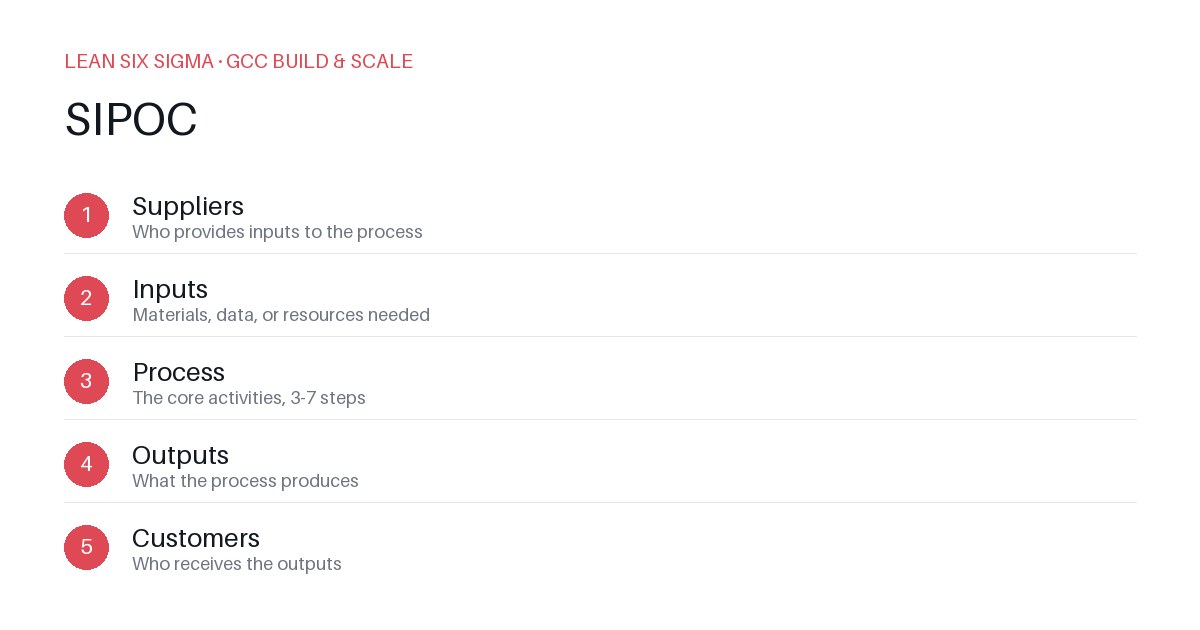
Downloadable templates
A practical walkthrough of applying SIPOC to real GCC build-and-scale work.
Why SIPOC Matters for GCC Teams
Scaling a Global Capability Center means standardizing work across sites, handoffs, and teams that have never worked together before. SIPOC gives you a shared vocabulary and a repeatable sequence for doing that. In the context of standing up a new GCC function — whether it’s a new capability, a new delivery stream, or a new operational model — ambiguity in roles, inputs, and handoffs is the fastest path to delays, rework, and stakeholder frustration. SIPOC forces clarity before execution begins.
The SIPOC Sequence
- Suppliers — Who provides inputs to the process
- Inputs — Materials, data, or resources needed
- Process — The core activities, 3-7 steps
- Outputs — What the process produces
- Customers — Who receives the outputs
This structure is not just a diagram; it’s a risk-mitigation tool. By mapping each element explicitly, you expose dependencies, single points of failure, and communication gaps before they become operational realities.
Applying It to Standing Up a New GCC Function
When launching a new GCC function — for example, a new customer support capability, a new engineering enablement stream, or a new compliance reporting process — the first step is to identify the recurring pain point that justifies the new function. Is it slow onboarding? Inconsistent quality? Poor handoff between regions? Pick one process that runs weekly or biweekly and run it through the SIPOC lens.
Step 1: Identify Suppliers and Inputs
Who feeds your new function? These are your suppliers. In a GCC context, suppliers might include:
- Regional delivery teams providing case data
- Product owners supplying release notes
- Finance teams providing budget approvals
- Security/compliance teams offering access grants
Inputs are what those suppliers provide: tickets, documentation, access tokens, SLA definitions, training materials, etc. Document these explicitly. If an input is “verbal approval,” that’s a red flag — make it written. If an input is “shared drive file,” specify the format, versioning, and update frequency.
Step 2: Define the Core Process
Break the function into 3–7 discrete steps. For example, if standing up a new GCC onboarding function:
- Receive onboarding request from regional lead
- Validate eligibility and assign GCC mentor
- Provision system access and tools
- Schedule 30-minute orientation call
- Confirm completion and log in tracker
Keep it lean. Each step should have an owner, a trigger, and a completion criterion. Avoid combining steps that require different skill sets or approvals.
Step 3: Clarify Outputs and Customers
What does your process produce? A completed training module? A signed SLA? A dashboard report? Who consumes it? Customers might be:
- Regional managers who need visibility
- New hires who need guidance
- Audit teams who require evidence
- Leadership who need metrics
Define the format, frequency, and quality bar for each output. If customers don’t know what to expect, they won’t use it — and the function fails.
Start Small, Iterate, Scale
Don’t boil the ocean. Pick one high-friction, high-frequency process. Run a 60-minute SIPOC workshop with cross-functional reps. Use the template below to document the first pass. Share it with stakeholders for validation. Then refine. Once you’ve proven the model on one function, replicate it across others.
This post is too short for good SEO. Expand it to 400-600 words by adding concrete detail, examples, or steps relevant to its EXISTING topic — do not change its existing meaning or invent claims unrelated to it. Keep any existing Markdown headings and build on them; add more '## ' subheadings if useful. Output ONLY the full expanded Markdown content, nothing else.
Comments
Be the first to comment on this post.
Sign in to leave a comment.