A SIPOC Map for Standing Up a New GCC Function
September 30, 2026
Like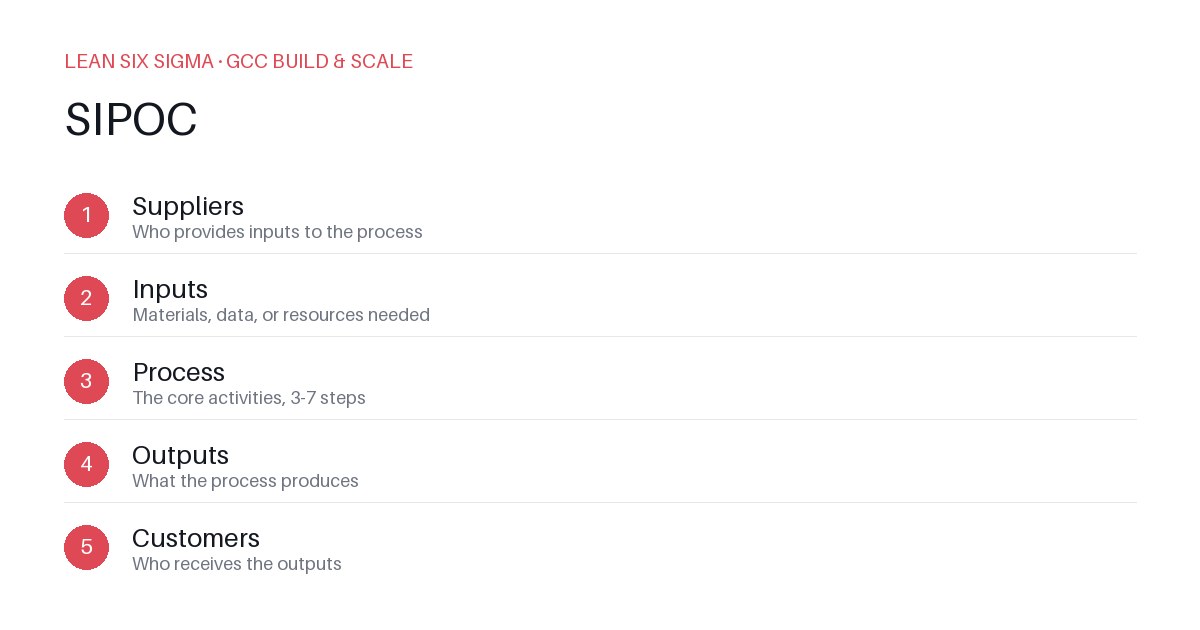
Downloadable templates
A practical walkthrough of applying SIPOC to real GCC build-and-scale work.
A SIPOC Map for Standing Up a New GCC Function
Why SIPOC Matters for GCC Teams
Scaling a Global Capability Center (GCC) means standardizing work across sites, handoffs, and teams that have never worked together before. In the early days of a GCC, every new function—whether it’s a new service, a new tool, or a new operational process—often emerges as a chaotic patchwork of tribal knowledge. Without a shared framework, teams reinvent the wheel, duplicate efforts, and create bottlenecks that slow down delivery. SIPOC gives you a shared vocabulary and a repeatable sequence for doing that. It transforms ambiguity into clarity, ensuring that everyone from leadership to frontline engineers understands not just what needs to happen, but who is responsible for each step, what they need, and who benefits from the outcome.
The SIPOC Sequence
A SIPOC map is a simple but powerful visual framework that breaks down any process into five essential components:
- Suppliers — Who provides inputs to the process. These can be internal teams, external vendors, or even automated systems.
- Inputs — Materials, data, or resources needed to execute the process. This includes documentation, tools, approvals, and technical specifications.
- Process — The core activities, ideally 3-7 steps. This is the heart of the map, where you define the actual work being done.
- Outputs — What the process produces. These are tangible deliverables, such as deployed code, approved budgets, or trained personnel.
- Customers — Who receives the outputs. These are the end-users, stakeholders, or downstream teams that depend on the process to succeed.
Applying It to a New GCC Function
Let’s say your GCC is standing up a new function: Automated Security Scanning for Microservices. Here’s how you’d map it using SIPOC:
- Suppliers: Security team, DevOps engineers, third-party scanning tools (e.g., SonarQube, Trivy), and infrastructure providers.
- Inputs: Application code repositories, CI/CD pipeline configurations, security policies, and vulnerability thresholds.
- Process:
- Integrate scanning tools into CI/CD pipelines.
- Configure scan triggers (e.g., on every commit or nightly).
- Aggregate and analyze scan results.
- Flag critical vulnerabilities and assign remediation tasks.
- Generate compliance reports for stakeholders.
- Outputs: Scan reports, remediation tickets, compliance dashboards, and updated security policies.
- Customers: Development teams, security compliance officers, product owners, and external auditors.
By mapping this out, you immediately see where handoffs occur, where bottlenecks might form, and who needs to be involved early. This prevents surprises and ensures accountability.
Start Small, Scale Smart
Don’t try to map every process in your GCC at once. Start small: pick one recurring pain point your GCC team hits every week—like onboarding a new engineer, deploying a staging environment, or managing vendor contracts—and walk it through these 5 steps. Document it, socialize it, and refine it. Once you’ve seen the value in one area, you’ll have a template and a team that understands the language of SIPOC. Then, roll out the approach more broadly, adapting it to each function’s unique context.
Download the template below to run your first pass. Consistency in how you define and document processes will save hours of rework, reduce miscommunication, and accelerate time-to-value across your GCC.
Comments
Be the first to comment on this post.
Sign in to leave a comment.