A SIPOC Map for Standing Up a New GCC Function
October 3, 2026
Like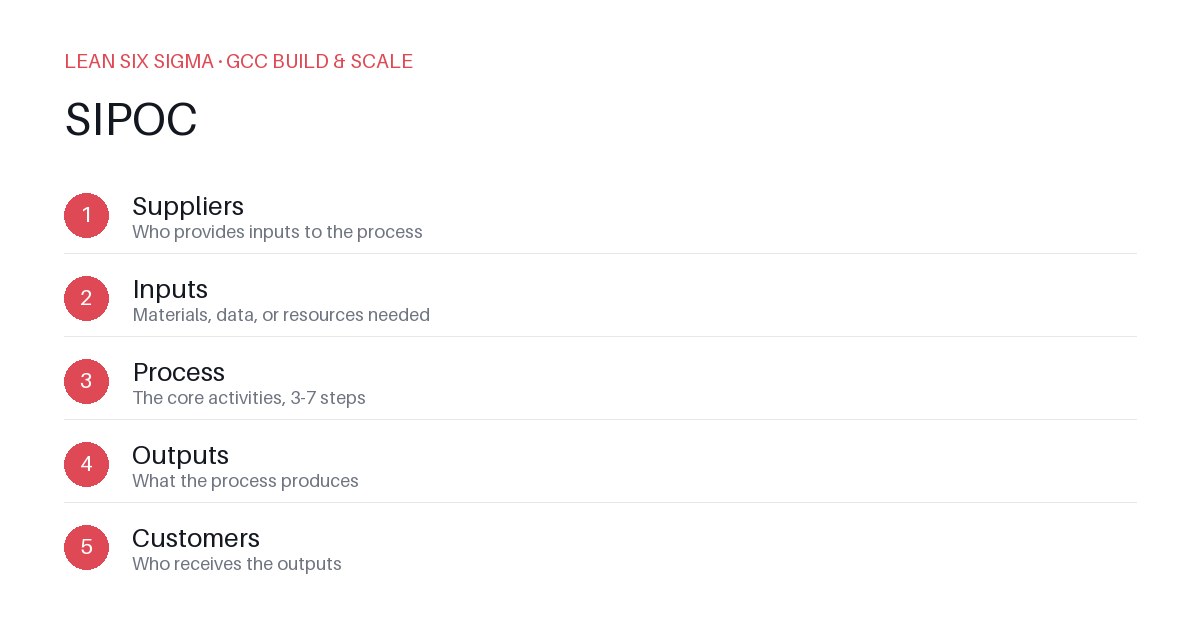
Downloadable templates
Map suppliers, inputs, processes, outputs, and customers to avoid scope creep when launching a new GCC capability.
Define the Function Boundary
Start by naming the capability in one line. Example: “Automated test case generation for regression suites.” Vague names like “test automation” lead to bloomed scope. Write the function name, the business problem it solves, and the target team it serves. This becomes the anchor for the rest of the map.
Identify Suppliers (S)
List every entity that feeds the function. Be specific. Instead of “IT,” write “Cloud infrastructure team,” “DevOps pipeline owners,” and “Legacy system integrators.” Include external sources if relevant, like third-party test data providers or licensing vendors. For each supplier, note the interface: API, ticketing system, shared drive, or handoff meeting. This clarifies dependencies early.
List Inputs (I)
Match each supplier to the materials they provide. Inputs can be data, tools, approvals, or personnel. Example inputs: existing test scripts, environment access credentials, SLA agreements, and a dedicated QA engineer. Specify format and frequency. If inputs arrive as unstructured spreadsheets, note that as a friction point to address later.
Map the Process (P)
Break the function into discrete steps. Use active verbs: “Ingest,” “Validate,” “Generate,” “Deploy,” “Report.” Avoid abstract phases like “collaborate” or “align.” For each step, define the owner, tool, and exit criterion. Example: “Generate test cases” → owned by automation lead → uses Python framework → exits when 90% coverage threshold is met. This structure exposes bottlenecks and handoff gaps.
Define Outputs (O)
Specify what the function delivers to customers. Outputs should be measurable: “Automated test suite with 500 cases,” “Weekly defect trend report,” or “Updated CI/CD pipeline config.” Avoid vague outputs like “improved quality.” If outputs feed other functions, note that linkage explicitly.
Identify Customers (C)
List who consumes the outputs. Internal customers: release managers, product owners, QA leads. External customers: clients if the GCC serves client-facing teams. For each, define their success metric: “Release on-time delivery,” “Defect escape rate,” or “Test execution time.” This aligns the function to business outcomes.
Validate and Iterate
Review the SIPOC with stakeholders. Ask: “Is anything missing?” “Are inputs realistic?” “Do outputs match customer needs?” Update the map after each sprint or milestone. A living SIPOC prevents scope creep and keeps the GCC function focused.
Next Steps
Use this SIPOC to draft a launch plan. Assign owners to each process step. Set up tracking for input availability and output quality. Revisit the map quarterly to refine scope as the GCC scales.
Comments
Be the first to comment on this post.
Sign in to leave a comment.