A SIPOC Map for Standing Up a New GCC Function
October 5, 2026
Like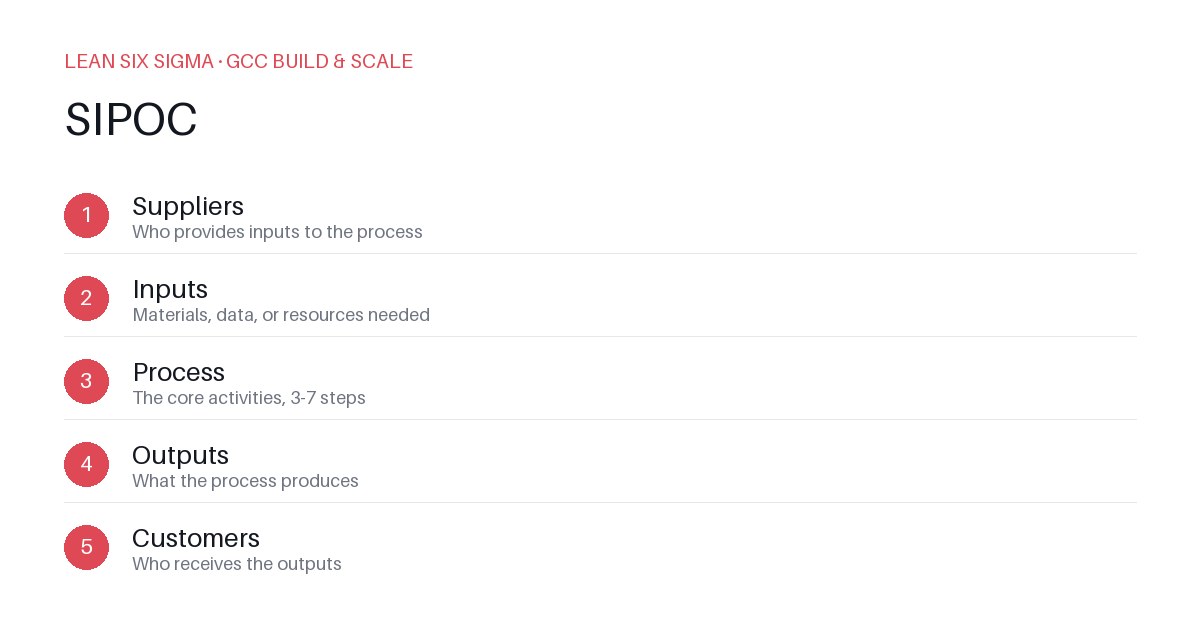
Downloadable templates
A practical walkthrough of applying SIPOC to real GCC build-and-scale work.
A SIPOC Map for Standing Up a New GCC Function
Why SIPOC Matters for GCC Teams
Scaling a Global Capability Center means standardizing work across sites, handoffs, and teams that have never worked together before. SIPOC gives you a shared vocabulary and a repeatable sequence for doing that. Without a structured framework, new functions often suffer from inconsistent onboarding, duplicated effort, and unclear ownership. By mapping out who supplies what, what gets done, what comes out, and who benefits, you create a single source of truth that can be audited, improved, and scaled. This is especially critical when launching a new GCC function—whether it’s quality assurance, compliance, or operations—where cross-functional alignment and process clarity are non-negotiable for long-term success.
The SIPOC Sequence
- Suppliers — Who provides inputs to the process
- Inputs — Materials, data, or resources needed
- Process — The core activities, 3-7 steps
- Outputs — What the process produces
- Customers — Who receives the outputs
Each element serves a specific purpose. Suppliers define your dependencies; inputs clarify what must be ready before work begins; the process outlines the actual work; outputs specify deliverables; and customers identify who will use or be impacted by those deliverables. This sequence forces teams to think holistically rather than in silos, reducing ambiguity and ensuring every stakeholder understands their role.
Applying It
Start small: pick one recurring pain point your GCC team hits every week, and walk it through these 5 steps before rolling the approach out more broadly. Download the template below to run your first pass.
To make this practical, consider standing up a new GCC function like “Cross-Regional Compliance Review.” In this scenario, Suppliers might include regional legal teams, local data privacy officers, and third-party audit firms. Inputs could consist of updated regulatory guidelines, raw transaction logs, and prior audit findings. The Process would involve initial data collection, gap analysis, stakeholder interviews, report drafting, and final review. Outputs would be a compliance assessment report, remediation action items, and an executive summary. Customers would be regional managers, internal audit, and external regulators. Mapping this out prevents miscommunication and ensures no critical step is overlooked during rollout.
Building Your First SIPOC Map
Begin by gathering your core team—ideally 3–5 people who understand the function end-to-end. Use a whiteboard or digital collaboration tool to sketch the five components. Ask targeted questions: Who truly feeds this process? What exactly is required before work starts? What are the non-negotiable steps? What tangible results are expected? Who will use or be affected by the results? Document answers clearly, avoiding jargon so that new hires or remote partners can easily follow along.
Iterating and Scaling
SIPOC is not a one-time exercise. After your initial map, run a quick validation session with actual users to check for gaps or redundancies. Update the map as the function evolves, and embed it into onboarding materials, SOPs, and training modules. Over time, this becomes a living document that supports continuous improvement and seamless scaling across your GCC network.
Comments
Be the first to comment on this post.
Sign in to leave a comment.