A SIPOC Map for Standing Up a New GCC Function
October 5, 2026
Like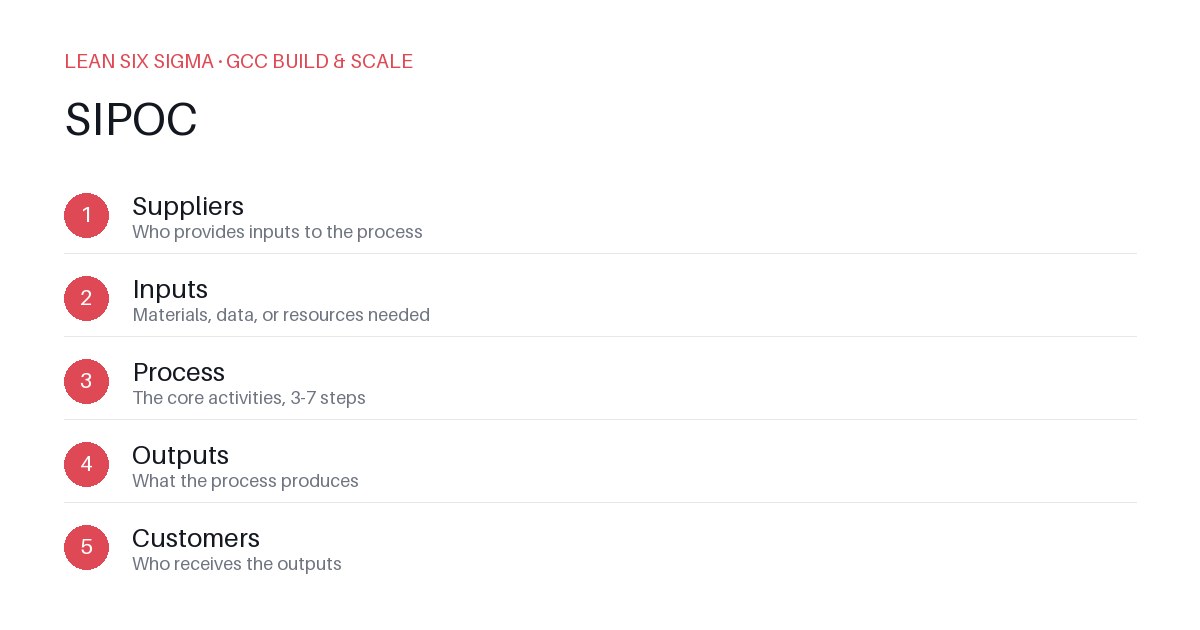
Downloadable templates
A practical walkthrough of applying SIPOC to real GCC build-and-scale work.
A SIPOC Map for Standing Up a New GCC Function
Why SIPOC Matters for GCC Teams
Scaling a Global Capability Center means standardizing work across sites, handoffs, and teams that have never worked together before. SIPOC gives you a shared vocabulary and a repeatable sequence for doing that. Without a structured framework, new functions often suffer from fragmented ownership, inconsistent quality, and delayed time-to-value. By mapping the end-to-end flow of a new GCC function using SIPOC, leadership can identify bottlenecks early, align cross-functional stakeholders, and create a blueprint that scales consistently across regions. This approach transforms ad-hoc efforts into repeatable, auditable processes that drive operational excellence.
The SIPOC Sequence
- Suppliers — Who provides inputs to the process
- Inputs — Materials, data, or resources needed
- Process — The core activities, 3-7 steps
- Outputs — What the process produces
- Customers — Who receives the outputs
Applying It
Start small: pick one recurring pain point your GCC team hits every week, and walk it through these 5 steps before rolling the approach out more broadly. Download the template below to run your first pass.
Concrete Example: Standing Up a New GCC Function
Let’s apply SIPOC to a realistic scenario: launching a new GCC function for Cross-Regional Compliance Reporting.
Suppliers: Legal teams, regional compliance officers, IT infrastructure teams, and data governance partners provide regulatory requirements, historical audit data, system access credentials, and reporting templates.
Inputs: Updated regulatory guidelines, anonymized dataset exports, approved reporting formats, access to centralized data warehouses, and a designated project lead.
Process:
- Gather and validate regulatory inputs from all regions.
- Map data sources to reporting requirements.
- Configure automated reporting workflows in the central dashboard.
- Conduct UAT with regional stakeholders.
- Train end-users on dashboard navigation and exception handling.
- Go-live with monitoring protocols and feedback loops.
Outputs: A live compliance reporting dashboard, user training documentation, a runbook for routine maintenance, and a post-launch review report.
Customers: Regional compliance managers, external auditors, and the GCC leadership team who rely on accurate, timely reports for decision-making and risk mitigation.
Benefits of Using SIPOC in GCC Operations
- Clarity: Every stakeholder understands their role and dependencies.
- Consistency: Standardized steps reduce variation across sites.
- Scalability: Once mapped, the process can be replicated for new functions with minimal rework.
- Accountability: Clear inputs and outputs make it easier to measure performance and assign ownership.
Next Steps for Your Team
- Identify a high-impact, recurring process in your GCC.
- Assemble a cross-functional team to populate the SIPOC template.
- Validate each step with real-world examples and historical data.
- Refine the map based on feedback and pilot results.
- Institutionalize the process by embedding it into onboarding and SOP documentation.
By treating SIPOC as a living framework rather than a one-time exercise, GCC teams can continuously improve operational resilience and deliver measurable value to the broader organization.
Comments
Be the first to comment on this post.
Sign in to leave a comment.