A SIPOC Map for Standing Up a New GCC Function
October 11, 2026
Like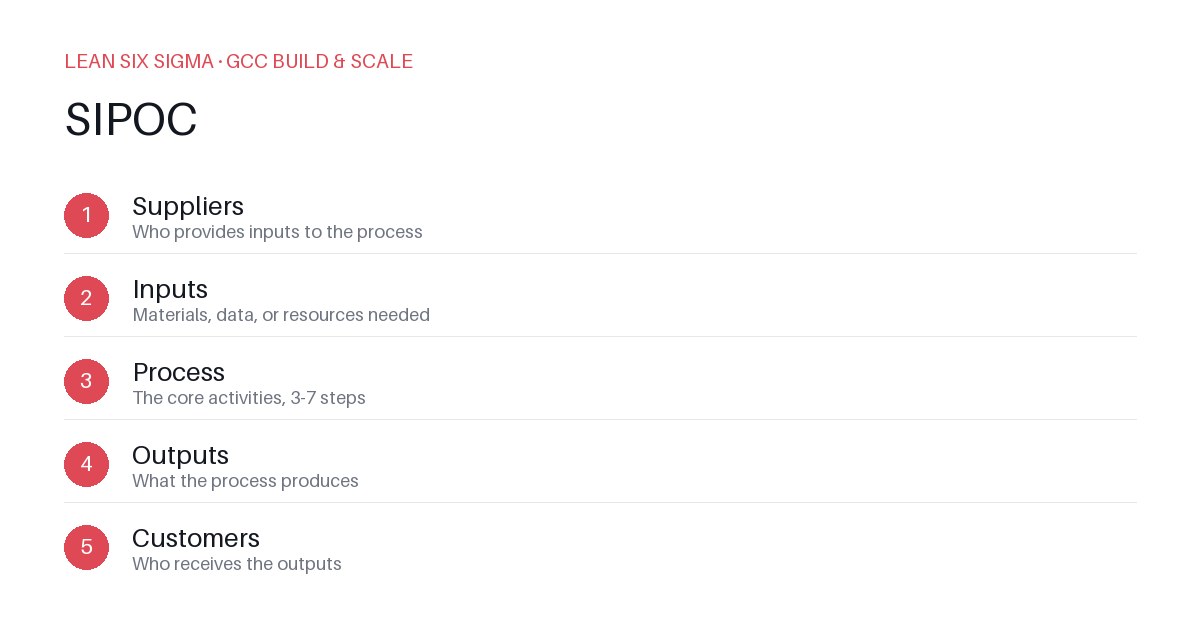
Downloadable templates
A practical walkthrough of applying SIPOC to real GCC build-and-scale work.
A SIPOC Map for Standing Up a New GCC Function
Why SIPOC Matters for GCC Teams
Scaling a Global Capability Center means standardizing work across sites, handoffs, and teams that have never worked together before. SIPOC gives you a shared vocabulary and a repeatable sequence for doing that. In the context of establishing a new GCC function—such as a new center of excellence, a regional delivery pod, or a specialized service line—SIPOC becomes an essential diagnostic and alignment tool. It helps you map who depends on whom, where bottlenecks form, and how information flows before you invest in processes, tools, or headcount. Without this clarity, GCC initiatives often suffer from duplicated effort, unclear ownership, and inconsistent quality across geographies.
The SIPOC Sequence
- Suppliers — Who provides inputs to the process
- Inputs — Materials, data, or resources needed
- Process — The core activities, 3-7 steps
- Outputs — What the process produces
- Customers — Who receives the outputs
Each element serves a specific purpose in building a resilient, scalable function. Suppliers define your upstream dependencies; inputs clarify what must be available before work begins; the process captures the actual execution logic; outputs specify deliverables; and customers anchor the value proposition.
Applying It to a New GCC Function
When standing up a new GCC function, start by identifying the primary process you want to standardize. For example, if you’re launching a new “Cloud Migration Support” function, the process might be “Assess and Approve Cloud Migration Requests.”
Suppliers might include:
- Local IT infrastructure teams
- Business unit project managers
- Security and compliance officers
- Third-party cloud service providers
Inputs could be:
- Current on-prem architecture diagrams
- Data volume and latency requirements
- Compliance checklists
- Budget approvals
- Vendor SLAs
Process steps might include:
- Intake and triage of migration request
- Technical feasibility assessment
- Security and compliance review
- Cost modeling and business case validation
- Approval routing and documentation
- Handoff to execution team
Outputs would be:
- Approved migration plan
- Risk register
- Resource allocation document
- Signed-off requirements spec
Customers might be:
- Regional delivery teams
- Finance and procurement
- End business units
- Executive sponsors
Concrete Benefits for GCC Teams
Using SIPOC early prevents common pitfalls:
- Unclear ownership: By explicitly listing suppliers and customers, you eliminate ambiguity about who is accountable for each stage.
- Missing dependencies: Inputs reveal what must be available before the process can start, helping you build pre-requisite checklists.
- Inconsistent execution: Documenting the process in 3-7 steps ensures every GCC site follows the same sequence, reducing variation and rework.
- Poor handoffs: Defining outputs clearly sets expectations for what downstream teams receive, improving transition quality.
Getting Started
Start small: pick one recurring pain point your GCC team hits every week, and walk it through these 5 steps before rolling the approach out more broadly. Download the template below to run your first pass. Once you’ve mapped one process, replicate the exercise for adjacent workflows. Over time, you’ll build a library of SIPOC maps that serve as living documentation, onboarding aids, and continuous improvement baselines.
This method doesn’t just standardize—it scales. By anchoring every new GCC function to a clear SIPOC structure, you create a foundation that can grow with complexity, geography, and team size without losing clarity or control.
Comments
Be the first to comment on this post.
Sign in to leave a comment.