A SIPOC Map for Standing Up a New GCC Function
October 11, 2026
Like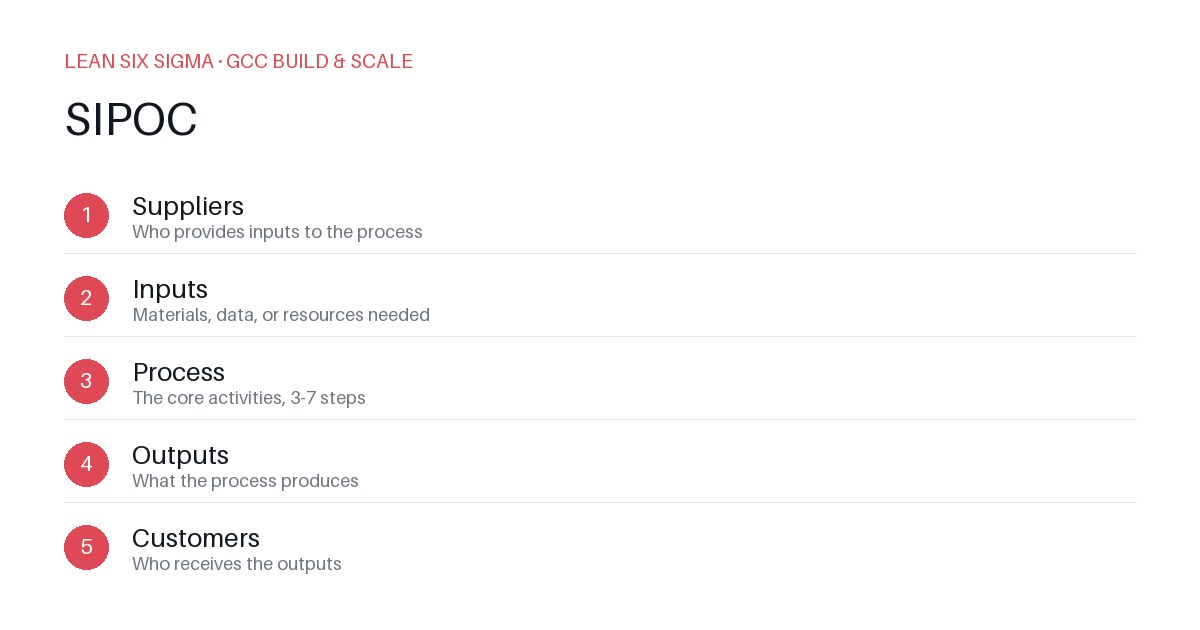
Downloadable templates
Map the SIPOC for your new GCC function to spot gaps before hiring or building tools.
Why SIPOC Before You Hire or Build
A new GCC function—say, AI-driven test automation—looks clean in a PowerPoint. In practice, it stalls because nobody owns the training, the toolchain isn approved, or the SLA with the product team is vague. SIPOC (Suppliers, Inputs, Process, Outputs, Customers) forces you to name every handoff, tool, and decision point before you spend budget. It’s a living diagram, not a decoration.
Draw the SIPOC in One Afternoon
Grab a whiteboard or a Miro board. Use five columns:
- Suppliers: Who or what provides what your function needs?
- Inputs: The specific artifacts, approvals, or data your function consumes.
- Process: The steps your function executes, from intake to delivery.
- Outputs: What you produce—reports, code, dashboards, trained staff.
- Customers: Who uses your outputs and what they need from you.
Fill each cell with concrete items. No “stakeholders” or “leadership.” Write “Product Owner for Feature X,” “Security team for approval,” “Jira for backlog,” “Python 3.11 runtime.”
Example: AI Test Automation Function
Here’s a tight SIPOC for a GCC function that builds and runs AI-based test scripts:
Suppliers:
- Product team (feature specs)
- QA team (existing test coverage)
- DevOps (CI/CD pipeline access)
- Security (model approval)
Inputs:
- Jira tickets with acceptance criteria
- Repository links for target services
- Existing test results (pass/fail rates)
- Approved ML model versions
Process:
- Intake tickets and map to services.
- Pull existing tests and coverage gaps.
- Train and validate AI models on historical data.
- Generate test scripts and integrate into CI.
- Run tests and report results.
Outputs:
- Updated test suites in Git
- Coverage dashboards
- Model performance reports
- Trained QA engineers
Customers:
- Product managers (release readiness)
- QA leads (test quality)
- DevOps (pipeline stability)
- Engineering managers (ROI on automation)
Spot the Leaks
Once the map is filled, ask three questions:
- Are any inputs undocumented? If a QA engineer must “guess” which model version to use, you’ve got a process gap.
- Are any outputs misaligned with customer needs? If the dashboard shows model accuracy but product managers need release risk scores, redesign the output.
- Are any suppliers single points of failure? If one DevOps engineer controls all CI access, you’ve created a bottleneck.
Fix these before you hire or buy. A SIPOC that’s two pages long and wrong is worse than no map at all.
Keep It Alive
Review the SIPOC every quarter. Add new inputs when tools change. Remove outputs that no one uses. Share it with your GCC leadership and product partners. When a new GCC function is proposed, start with the map. The rest of the build will follow.
Comments
Be the first to comment on this post.
Sign in to leave a comment.