A SIPOC Map for Standing Up a New GCC Function
October 16, 2026
Like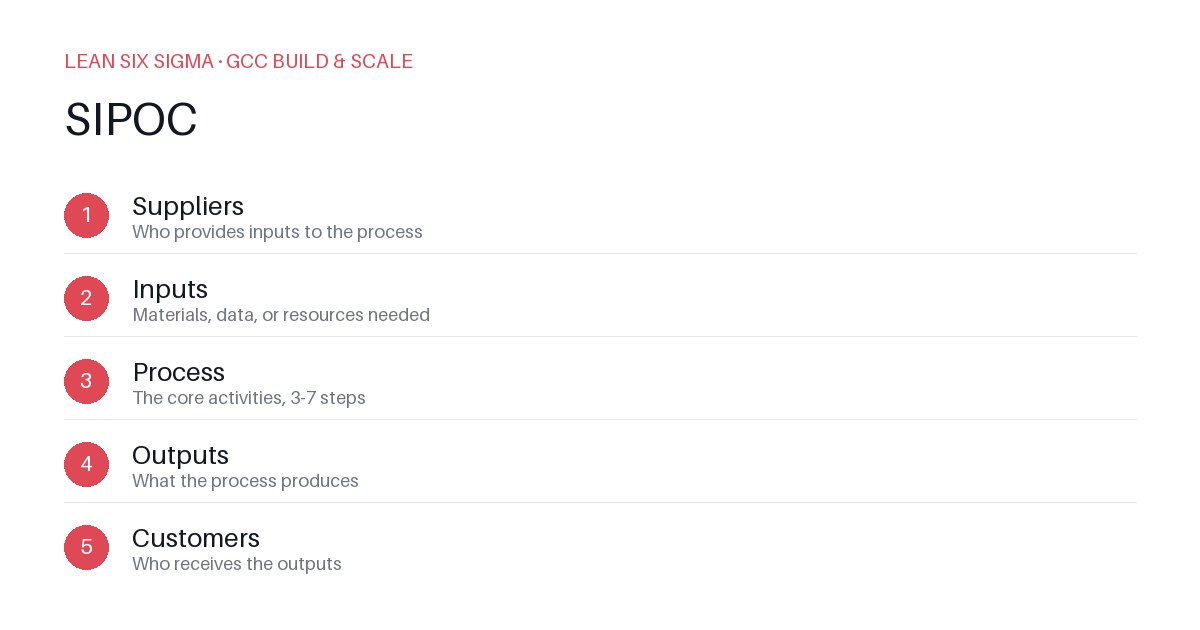
Downloadable templates
Map inputs, processes, outputs, and customers to avoid scope creep and gaps when launching a new GCC capability.
Why SIPOC Before You Hire
Launching a new GCC function—say, AI model monitoring or supply chain analytics—without a clear SIPOC map leads to duplicated work and missed dependencies. SIPOC gives you a single source of truth for what the function does and who it serves.
Define the Process Boundaries
Start by naming the function in one line. Example: "AI Model Monitoring for Retail Analytics."
Ask:
- What problem does this function solve?
- What is the first activity it performs?
- What is the last activity before handoff?
Keep it tight. If the process includes training, that’s a separate function.
List Suppliers (Inputs)
Suppliers provide data, tools, or decisions. Be specific:
- Data Science Team: Model artifacts and drift metrics.
- IT Infrastructure: Cloud compute and storage access.
- Product Owners: Use case requirements and success criteria.
- Compliance: Data governance rules.
If you skip a supplier, you’ll hit roadblocks later. Document who owns each input.
Map the Processes
Break the function into core activities. Example:
- Ingest model performance data.
- Run drift detection algorithms.
- Generate alert reports.
- Trigger remediation workflows.
Use verbs. Avoid nouns. Each step should be actionable and measurable.
Identify Outputs
Outputs are deliverables or decisions:
- Weekly drift reports.
- Automated alerts for threshold breaches.
- Remediation tickets.
Specify format and frequency. Ambiguity here causes friction with customers.
Name the Customers
Customers receive outputs. Internal or external.
- Product Teams: Use reports to adjust campaigns.
- Data Engineering: Fix data pipelines flagged by alerts.
- Executive Leadership: Review weekly summaries.
Assign a primary customer per output. Multiple stakeholders dilute accountability.
Validate with Real Scenarios
Test your SIPOC against a recent project.
- Did all suppliers deliver on time?
- Were outputs useful to customers?
- Were processes clear or ambiguous?
Adjust based on feedback. SIPOC is a living document.
Next Steps
- Draft your SIPOC in a shared doc.
- Review with suppliers and customers.
- Update after the first 90 days.
A solid SIPOC prevents scope creep and aligns teams before you scale.
Comments
Be the first to comment on this post.
Sign in to leave a comment.