A SIPOC Map for Standing Up a New GCC Function
October 20, 2026
Like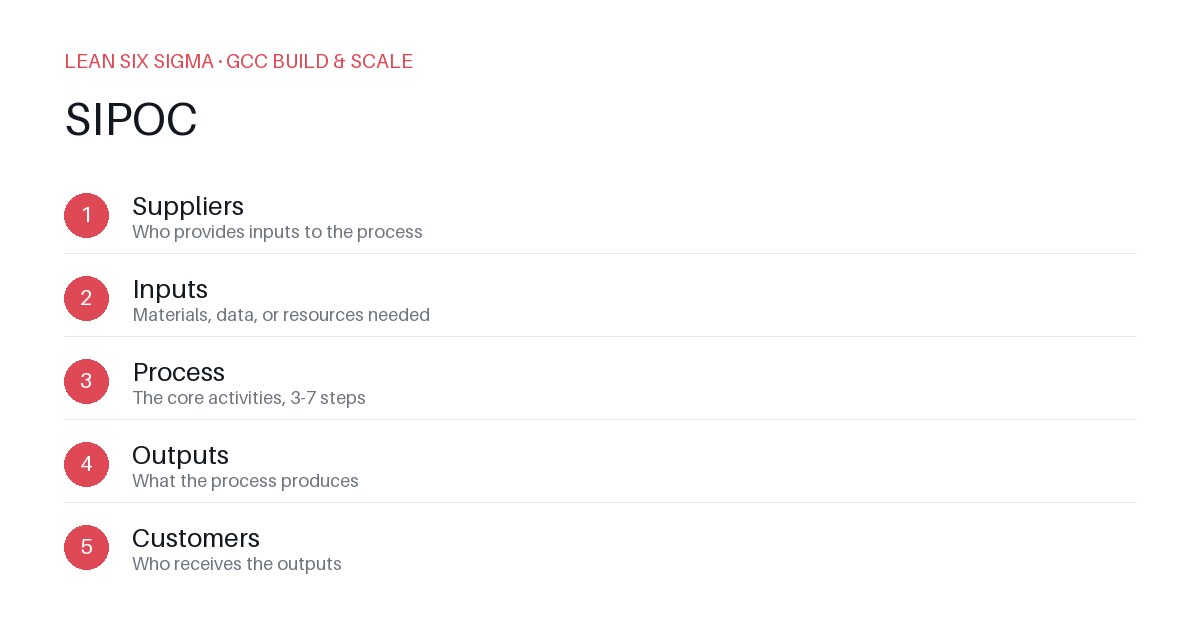
Downloadable templates
A practical walkthrough of applying SIPOC to real GCC build-and-scale work.
A SIPOC Map for Standing Up a New GCC Function
Why SIPOC Matters for GCC Teams
Scaling a Global Capability Center means standardizing work across sites, handoffs, and teams that have never worked together before. SIPOC gives you a shared vocabulary and a repeatable sequence for doing that. In the context of launching a new GCC function—whether it’s a new service line, a regional expansion, or a specialized team—you need clarity on who owns what, where bottlenecks hide, and how to measure success from day one. Without this structure, you risk duplicating efforts, misaligning incentives, and creating handoff friction that slows delivery. SIPOC isn’t just a diagram; it’s a governance and operational blueprint that aligns stakeholders before you spend a dollar.
The SIPOC Sequence
- Suppliers — Who provides inputs to the process
- Inputs — Materials, data, or resources needed
- Process — The core activities, 3-7 steps
- Outputs — What the process produces
- Customers — Who receives the outputs
When you map a new GCC function using this sequence, you force explicit ownership. For example, if your function is “Customer Onboarding for Enterprise Clients,” Suppliers might include Legal, IT Security, and the Sales Enablement team. Inputs could be signed contracts, access provisioning requests, and training materials. The Process might involve account setup, security clearance, and kickoff scheduling. Outputs would be a live client portal, a completed onboarding checklist, and a handoff to customer success. Customers are the Enterprise Sales team and the newly onboarded clients. This level of detail prevents ambiguity and creates accountability.
Applying It
Start small: pick one recurring pain point your GCC team hits every week, and walk it through these 5 steps before rolling the approach out more broadly. Download the template below to run your first pass.
Step 1: Define the Scope and Trigger
Before mapping, clarify what you’re standardizing. Is this a new GCC function for “Regulatory Compliance Reporting” or “Multi-Region Talent Onboarding”? Define the trigger event that starts the process. For instance, the trigger might be “New hire approved by regional HR” or “Quarterly audit request received.” A well-defined trigger ensures consistency and prevents ad-hoc variations.
Step 2: Identify Suppliers and Inputs
List every entity or system that feeds into your process. Don’t skip internal stakeholders—often, the biggest delays come from unacknowledged dependencies. For a new GCC function, Suppliers might include Finance (budget approvals), IT (tool access), Legal (policy sign-offs), and regional leads (localization input). Inputs should be specific: e.g., “Signed vendor contract,” “Access credentials,” “Localized training deck,” or “Compliance checklist v2.1.”
Step 3: Map the Core Process
Break the process into 3–7 discrete, sequential steps. Avoid vague language like “coordinate with teams.” Instead, use action-oriented phrases: “Submit compliance form,” “Provision system access,” “Conduct kickoff call,” “Archive documentation.” Each step should have a clear owner, a timeline, and a success criterion. This step is where you expose bottlenecks—like manual approvals or redundant reviews.
Step 4: Specify Outputs and Quality Standards
Define what the process must deliver to be considered complete. Outputs should be tangible: a report, a certified system, a signed agreement, or a trained team. Include quality metrics: e.g., “All inputs reviewed within 48 hours,” “Zero compliance gaps,” or “Customer satisfaction score ≥ 4.5/5.” This ensures your GCC function isn’t just moving tasks but delivering value.
Step 5: Identify Customers and Feedback Loops
Who consumes the outputs? Customers might be internal (e.g., Finance, Legal) or external (e.g., clients, regulators). Map how they receive the output and how they provide feedback. A strong SIPOC includes a feedback mechanism—like a monthly review or a digital survey—that feeds back into the Suppliers or Process steps for continuous improvement.
Building the Map
Use a simple table or visual diagram. For each step, note:
- Owner
- Input source
- Action
- Output
- Success metric
- Customer feedback channel
Review the map with cross-functional stakeholders. Challenge assumptions: Are there hidden dependencies? Is a step redundant? Does the output match customer needs? Refine until it’s lean and actionable.
Scaling the Approach
Once you’ve mapped one function, template the SIPOC structure for others. Create a library of standardized SIPOCs for common GCC functions. Train new team members using these maps. Track KPIs tied to each step. Over time, SIPOC becomes your operating system for scaling GCC capabilities with precision, speed, and accountability.
Comments
Be the first to comment on this post.
Sign in to leave a comment.