A SIPOC Map for Standing Up a New GCC Function
October 23, 2026
Like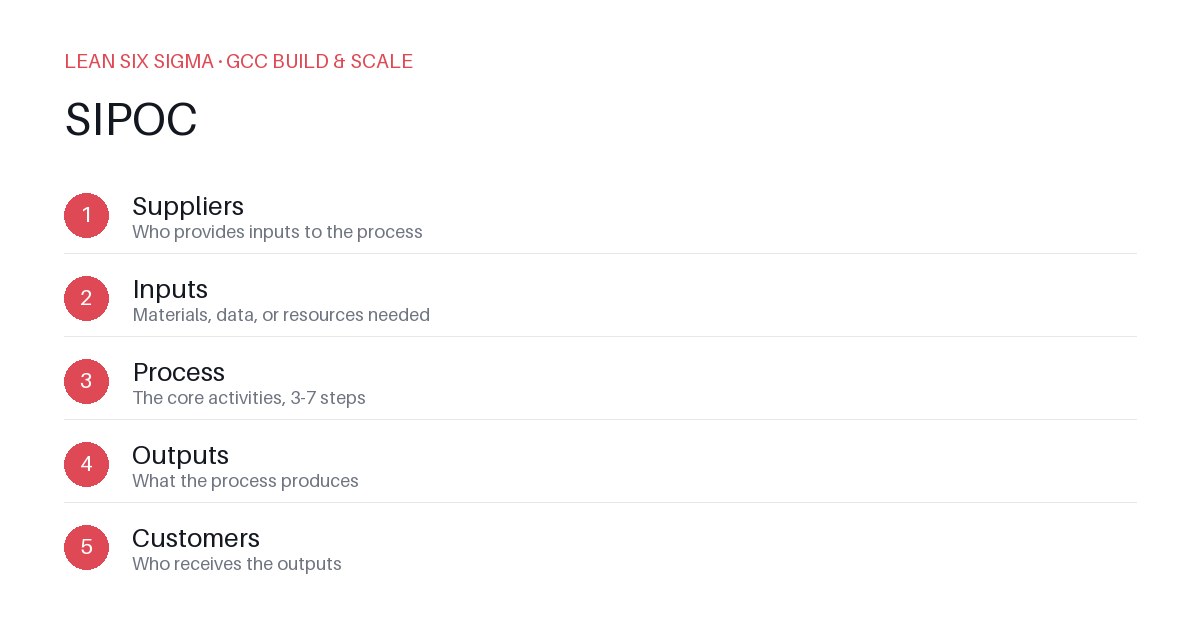
Downloadable templates
A practical walkthrough of applying SIPOC to real GCC build-and-scale work.
A SIPOC Map for Standing Up a New GCC Function
Why SIPOC Matters for GCC Teams
Scaling a Global Capability Center means standardizing work across sites, handoffs, and teams that have never worked together before. SIPOC gives you a shared vocabulary and a repeatable sequence for doing that. When you’re spinning up a new GCC function—whether it’s DevOps, Data Engineering, or Security—you’re not just hiring people; you’re designing a process that will run reliably across time zones, cultures, and organizational silos. Without a clear map of who provides what, when, and how, you’ll end up with duplicated efforts, delayed onboarding, and inconsistent quality. SIPOC forces you to surface those hidden dependencies early, turning ambiguity into a documented, executable workflow.
The SIPOC Sequence
- Suppliers — Who provides inputs to the process
- Inputs — Materials, data, or resources needed
- Process — The core activities, 3-7 steps
- Outputs — What the process produces
- Customers — Who receives the outputs
This framework isn’t just theoretical. In practice, it becomes the backbone of your GCC launch playbook. Every step should be traceable, owned, and measurable.
Applying It to a New GCC Function
Start small: pick one recurring pain point your GCC team hits every week, and walk it through these 5 steps before rolling the approach out more broadly. Download the template below to run your first pass.
Step 1: Identify Suppliers with Precision
Don’t just list “HR” or “IT.” Specify: Which HR business partner? Which IT service desk? For example, if you’re standing up a new GCC Data Engineering function, your suppliers might include:
- HR Talent Acquisition for role postings and interview scheduling
- Finance for budget approval and cost center allocation
- IT Security for access provisioning and compliance sign-off
- Product Owners for requirement clarification
Document each supplier’s expected response time and escalation path. Ambiguity here causes bottlenecks later.
Step 2: Define Inputs That Are Actionable
Inputs shouldn’t be vague. Instead of “requirements,” specify:
- Signed-off job descriptions
- Approved budget codes
- Approved infrastructure templates
- Compliance checklists
- Onboarding playbooks
If an input isn’t standardized, your process will break. Create templates or checklists for each input to ensure consistency across GCC sites.
Step 3: Map the Core Process Steps
Break the launch into 3–7 discrete, repeatable steps. For a new GCC function, this might look like:
- Secure budget and headcount approval
- Finalize role definitions and competency models
- Provision tools, access, and environments
- Conduct targeted recruitment and interviews
- Onboard hires with standardized training
- Assign initial projects and KPIs
- Conduct 30/60/90-day check-ins
Each step should have a clear owner, a success criterion, and a timebox. Avoid combining steps that require different approvals or skill sets.
Step 4: Specify Outputs That Are Measurable
Outputs aren’t just “a new team.” They’re:
- A live, documented SOP for onboarding
- A list of hired and trained engineers
- A set of deployed environments with access logs
- A KPI dashboard tracking time-to-productivity
- A post-launch retrospective report
If you can’t measure it, you can’t improve it. Define what “done” looks like for each output.
Step 5: Name Your Customers Clearly
Customers aren’t just “management.” They’re:
- Site leads who depend on GCC talent
- Product teams needing engineering support
- Compliance officers requiring audit trails
- Finance teams tracking ROI
Understanding who benefits helps you prioritize which outputs matter most and how to communicate success.
Building Your SIPOC Template
Use this structure to document your first GCC function launch:
| Element | Details |
|---|---|
| Suppliers | [List specific roles/departments] |
| Inputs | [List required documents, approvals, tools] |
| Process | [Numbered steps with owners and timeboxes] |
| Outputs | [Measurable deliverables] |
| Customers | [Stakeholders who consume outputs] |
Iterate this map after your first launch. Where did delays occur? Which inputs were missing? Which customers weren’t satisfied? Refine accordingly.
Why This Works for GCC Scaling
SIPOC turns chaos into clarity. It’s not about bureaucracy—it’s about predictability. When every GCC site follows the same SIPOC map for standing up a new function, you reduce ramp-up time, improve quality, and create a repeatable model that can be audited, improved, and scaled. Start with one function. Master the map. Then expand.
Comments
Be the first to comment on this post.
Sign in to leave a comment.