A SIPOC Map for Standing Up a New GCC Function
August 18, 2026
Like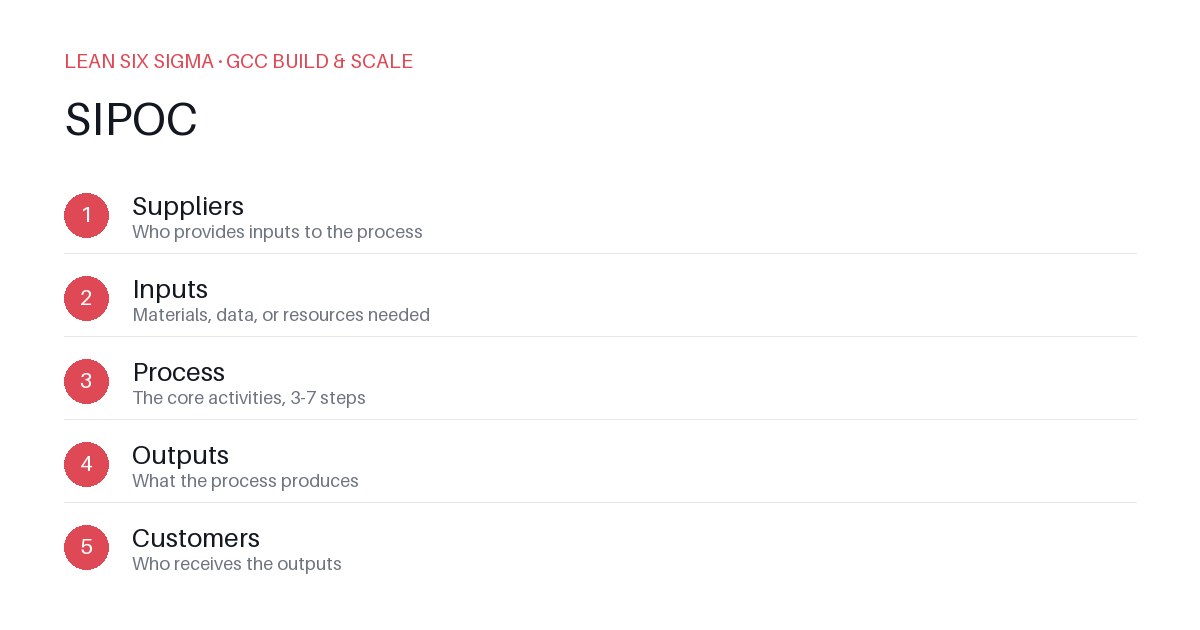
Downloadable templates
A practical walkthrough of applying SIPOC to real GCC build-and-scale work.
A SIPOC Map for Standing Up a New GCC Function
Why SIPOC Matters for GCC Teams
Scaling a Global Capability Center means standardizing work across sites, handoffs, and teams that have never worked together before. SIPOC gives you a shared vocabulary and a repeatable sequence for doing that. Without it, you risk duplicated effort, inconsistent quality, and bottlenecks that slow delivery. When teams speak the same process language, onboarding accelerates, handoffs become predictable, and leadership can measure performance against a known baseline.
The SIPOC Sequence
- Suppliers — Who provides inputs to the process
- Inputs — Materials, data, or resources needed
- Process — The core activities, 3-7 steps
- Outputs — What the process produces
- Customers — Who receives the outputs
This five-part framework forces clarity at every stage. It prevents assumptions, surfaces dependencies early, and creates a single source of truth that can be audited, improved, and scaled.
Applying It: A Concrete Example
Start small: pick one recurring pain point your GCC team hits every week, and walk it through these 5 steps before rolling the approach out more broadly. For instance, consider the process of standing up a new GCC function for a new product line.
Suppliers might include the product owner, the regional delivery manager, the IT infrastructure team, and the training coordinator. Each brings something essential to the table.
Inputs could be the approved business case, the assigned budget, the technical requirements document, the list of required tools and licenses, and the confirmed start date.
Process steps might be:
- Validate requirements and secure stakeholder alignment.
- Provision infrastructure and access controls.
- Onboard and train the new team members.
- Conduct a dry-run with a pilot project.
- Review performance metrics and adjust as needed.
Outputs would be a fully operational GCC function with documented SOPs, trained personnel, active systems, and a baseline performance report.
Customers are the regional business units that depend on the function for timely delivery, plus the central GCC leadership that monitors capability health.
Building Your First SIPOC Map
Download the template below to run your first pass. Fill in each section with specifics from your chosen process. Keep descriptions concise and action-oriented. Use verbs for the process steps. Avoid jargon that only one team understands.
Review and Refine
Once your map is complete, share it with a cross-functional group. Ask: “Does this reflect reality?” “What’s missing?” “Where do delays happen?” Iterate until the map matches actual workflow. Then publish it as the official standard.
Scaling the Approach
After validating one process, apply SIPOC to additional recurring workflows. Over time, you’ll build a library of standardized maps that drive consistency, reduce onboarding time, and improve handoff quality across your GCC.
Comments
Be the first to comment on this post.
Sign in to leave a comment.