A SIPOC Map for Standing Up a New GCC Function
October 30, 2026
Like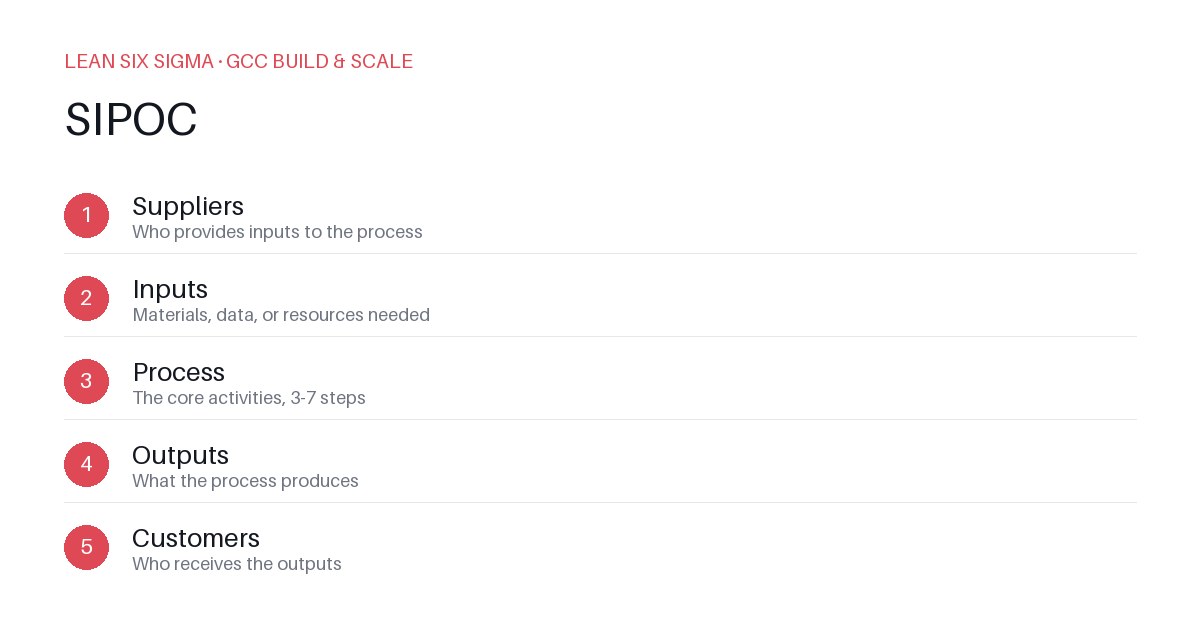
Downloadable templates
A practical walkthrough of applying SIPOC to real GCC build-and-scale work.
A SIPOC Map for Standing Up a New GCC Function
Why SIPOC Matters for GCC Teams
Scaling a Global Capability Center means standardizing work across sites, handoffs, and teams that have never worked together before. SIPOC gives you a shared vocabulary and a repeatable sequence for doing that. When you’re spinning up a new function—whether it’s a center of excellence, a delivery pod, or a specialized engineering team—the risk of misalignment is high. Without a clear map of who provides what, when, and how, you’ll end up with duplicated effort, delayed onboarding, and inconsistent quality. SIPOC cuts through that noise by forcing you to articulate the process before you execute it. It’s not just a diagram; it’s a communication tool that aligns stakeholders, surfaces hidden dependencies, and creates a baseline for continuous improvement.
The SIPOC Sequence
- Suppliers — Who provides inputs to the process
- Inputs — Materials, data, or resources needed
- Process — The core activities, 3-7 steps
- Outputs — What the process produces
- Customers — Who receives the outputs
This five-step framework forces clarity at every stage. Suppliers aren’t just “HR” or “IT”—they’re specific roles or systems. Inputs aren’t vague “resources”—they’re documented templates, approved codebases, or trained personnel. The process must be actionable and sequential. Outputs must be measurable and verifiable. Customers must be explicitly named so accountability doesn’t dissipate into “everyone.”
Applying It: A Concrete Example
Start small: pick one recurring pain point your GCC team hits every week, and walk it through these 5 steps before rolling the approach out more broadly. Consider the common scenario of standing up a new GCC function—say, a Cloud Security Center of Excellence.
- Suppliers: Talent Acquisition (for hiring), IT Security (for access provisioning), Legal (for compliance sign-off), Finance (for budget approval), and existing engineering leads (for domain knowledge transfer).
- Inputs: Approved hiring plan, security clearance templates, budget allocation, onboarding checklist, and a list of initial projects.
- Process:
- Finalize team structure and roles
- Secure budget and legal approvals
- Recruit and onboard core members
- Provision tools and environments
- Define first 90-day deliverables
- Outputs: Fully staffed team, active tooling, documented SOPs, and a signed project charter.
- Customers: Regional delivery teams, compliance officers, and executive sponsors who expect measurable security posture improvements.
By mapping this out, you immediately see where delays occur (e.g., legal sign-off taking 3 weeks) and where handoffs are fragile (e.g., IT security not aligned on access timelines). You also clarify who owns each output, reducing blame games later.
Building the Habit
Download the template below to run your first pass. Use it in your next team sync. Assign one person to draft, another to challenge assumptions, and a third to validate with actual stakeholders. Review it weekly for the first month, then monthly thereafter. Over time, your SIPOC maps will evolve into living documents that reflect real workflows—not idealized versions. That’s how you turn chaos into capability.
Comments
Be the first to comment on this post.
Sign in to leave a comment.