A SIPOC Map for Standing Up a New GCC Function
November 2, 2026
Like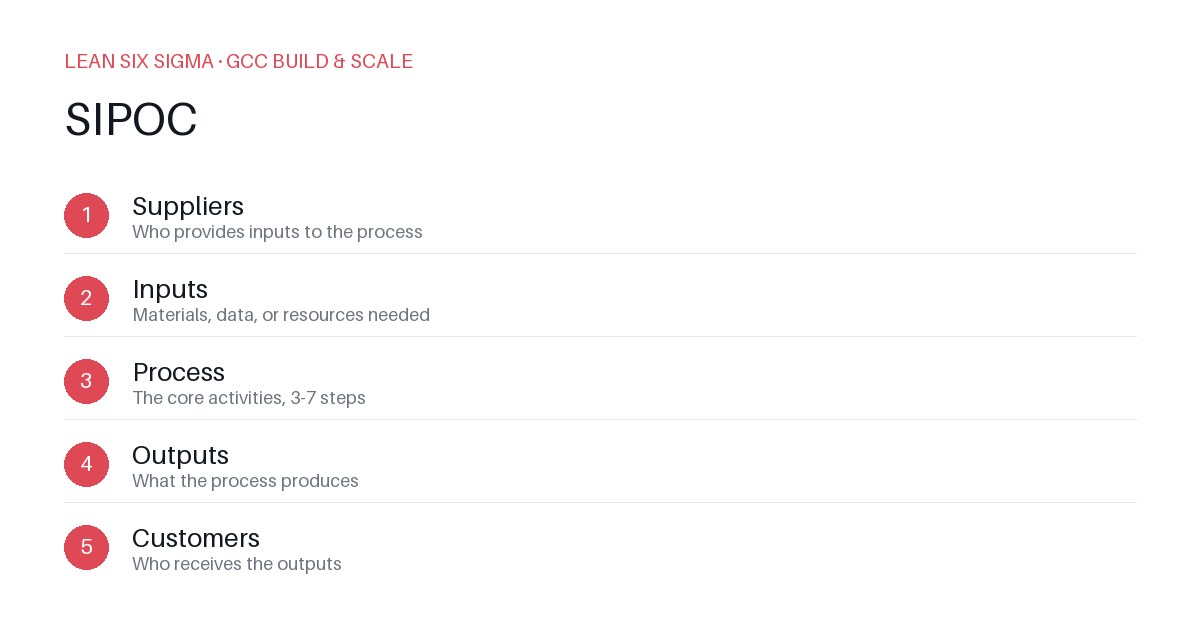
Downloadable templates
A practical walkthrough of applying SIPOC to real GCC build-and-scale work.
Why SIPOC Matters for GCC Teams
Scaling a Global Capability Center means standardizing work across sites, handoffs, and teams that have never worked together before. SIPOC gives you a shared vocabulary and a repeatable sequence for doing that. In the context of standing up a new GCC function — whether it’s QA automation, DevOps, or application modernization — ambiguity around who owns what, what data is required, and what “done” looks like can stall progress for weeks. A SIPOC map forces clarity at the start, reducing rework, miscommunication, and dependency bottlenecks. It turns an ad-hoc launch into a repeatable playbook that any site can follow, ensuring consistency in onboarding, tooling, and process adoption.
The SIPOC Sequence
- Suppliers — Who provides inputs to the process
- Inputs — Materials, data, or resources needed
- Process — The core activities, 3-7 steps
- Outputs — What the process produces
- Customers — Who receives the outputs
Applying It
Start small: pick one recurring pain point your GCC team hits every week, and walk it through these 5 steps before rolling the approach out more broadly. Download the template below to run your first pass.
Example: Standing Up a New GCC Function — “Automated Release Validation”
To illustrate how SIPOC brings structure to a real GCC initiative, consider launching a new automated release validation function. This process ensures that every release passing through the pipeline meets quality, security, and performance thresholds before going live.
Suppliers
- Application Development Teams (provide build artifacts and test cases)
- Infrastructure & Platform Engineering (provide CI/CD pipeline access and staging environments)
- Security & Compliance Teams (provide vulnerability scan thresholds and policy rules)
- QA Center of Excellence (provide test automation frameworks and validation criteria)
Inputs
- Source code repository URLs and branch names
- CI/CD pipeline configuration files (e.g., Jenkins, GitLab, Azure DevOps)
- Pre-approved test automation scripts and data sets
- Security scan configurations and compliance policy documents
- Environment credentials and access tokens (managed via secret vaults)
Process
- Trigger Validation: CI/CD pipeline detects a new build and initiates the validation workflow.
- Environment Provisioning: Automated scripts spin up an isolated staging environment matching production specs.
- Test Execution: Automated test suites run against the build, including unit, integration, performance, and security scans.
- Result Aggregation: Pipeline collects logs, metrics, and compliance reports into a centralized dashboard.
- Gate Decision: If all thresholds are met, the build is approved for promotion; otherwise, it fails with actionable feedback.
- Notification & Handoff: Results are communicated to the development team and, if approved, passed to the release management team.
Outputs
- Pass/fail validation report with detailed metrics
- Updated release artifact tagged as “validated”
- Compliance and security scan certificates
- Automated rollback triggers (if validation fails)
- Audit trail for governance and post-mortem analysis
Customers
- Release Management Teams (use outputs to schedule and execute deployments)
- Development Teams (receive feedback to fix defects before next build)
- Compliance & Audit Teams (review validation logs for regulatory evidence)
- Operations & SRE Teams (use performance data to tune production environments)
Building Your First SIPOC Map
- Select a Process: Choose a single, recurring workflow your GCC team executes — e.g., “New Developer Onboarding,” “Security Patch Deployment,” or “Feature Flag Rollout.”
- Identify Suppliers: List every team or system that feeds data, access, or decisions into the process.
- Define Inputs: Specify exact artifacts, credentials, configurations, or approvals required.
- Map the Process: Break the workflow into 3–7 discrete, sequential steps. Use action verbs and avoid ambiguity.
- Clarify Outputs: Document what tangible or measurable results emerge from each step.
- Name Customers: Identify who consumes those outputs and why it matters to them.
- Validate & Iterate: Walk the map with stakeholders from each supplier and customer group. Refine until everyone agrees on ownership and expectations.
Why This Works for GCC Scaling
SIPOC transforms implicit knowledge into explicit documentation. When a new GCC site needs to stand up the same function, they don’t reinvent the process — they adapt a proven map. This reduces ramp-up time, ensures compliance with global standards, and creates a feedback loop for continuous improvement. Over time, SIPOC maps become the backbone of your GCC’s operating model, enabling consistent execution, measurable outcomes, and scalable capability delivery.
Comments
Be the first to comment on this post.
Sign in to leave a comment.