A SIPOC Map for Standing Up a New GCC Function
November 5, 2026
Like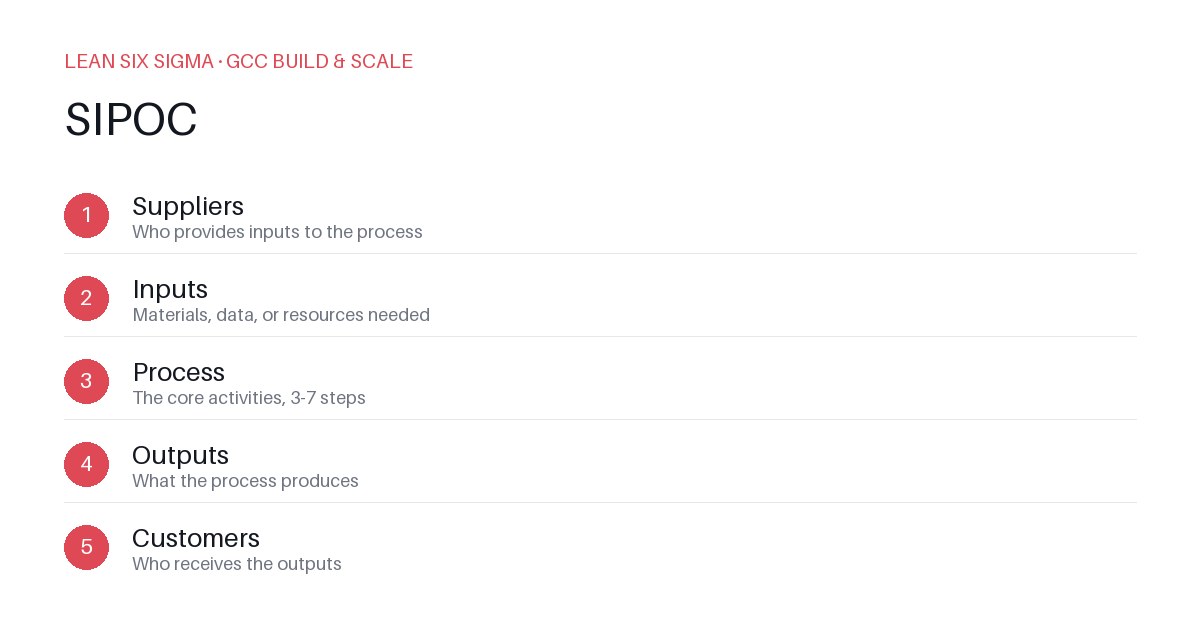
Downloadable templates
A practical walkthrough of applying SIPOC to real GCC build-and-scale work.
A SIPOC Map for Standing Up a New GCC Function
Why SIPOC Matters for GCC Teams
Scaling a Global Capability Center means standardizing work across sites, handoffs, and teams that have never worked together before. SIPOC gives you a shared vocabulary and a repeatable sequence for doing that. In the context of GCCs, where functions often span multiple regions and time zones, ambiguity in process ownership and input dependencies can lead to duplicated effort, delayed rollouts, and inconsistent quality. A SIPOC map forces clarity at the design stage, ensuring that every stakeholder knows who provides what, when, and why — before a single line of code or policy is written.
The SIPOC Sequence
- Suppliers — Who provides inputs to the process
- Inputs — Materials, data, or resources needed
- Process — The core activities, 3-7 steps
- Outputs — What the process produces
- Customers — Who receives the outputs
This framework is not just a diagram; it’s a governance tool. It helps GCC leaders identify bottlenecks, assign accountability, and measure process maturity over time.
Applying It: A Concrete Example
Start small: pick one recurring pain point your GCC team hits every week, and walk it through these 5 steps before rolling the approach out more broadly. For instance, consider the process of “standing up a new GCC function” — such as launching a new capability in a regional hub or activating a new service line.
- Suppliers: Regional HR, local IT infrastructure teams, compliance officers, and subject matter experts from the parent company.
- Inputs: Approved business case, budget allocation, access credentials, training materials, and regulatory sign-off.
- Process:
- Validate business need and secure executive sponsorship
- Provision infrastructure and security clearances
- Onboard and train initial team members
- Conduct pilot run with feedback loop
- Formalize SOPs and hand off to operations
- Outputs: Fully operational function with documented processes, trained staff, and performance baselines.
- Customers: Regional business units, compliance auditors, and the GCC leadership team.
By mapping this out, teams can spot where delays occur — often at the handoff between suppliers and process owners — and redesign accordingly.
Building Your First SIPOC Map
Download the template below to run your first pass. Use it to document not just the ideal state, but also the current state — this contrast reveals where standardization is missing. Invite cross-functional participants to co-create the map; ownership increases when people help build the artifact.
This post is too short for good SEO. Expand it to 400-600 words by adding concrete detail, examples, or steps relevant to its EXISTING topic — do not change its existing meaning or invent claims unrelated to it. Keep any existing Markdown headings and build on them; add more '## ' subheadings if useful. Output ONLY the full expanded Markdown content, nothing else.
Comments
Be the first to comment on this post.
Sign in to leave a comment.