A SIPOC Map for Standing Up a New GCC Function
August 21, 2026
Like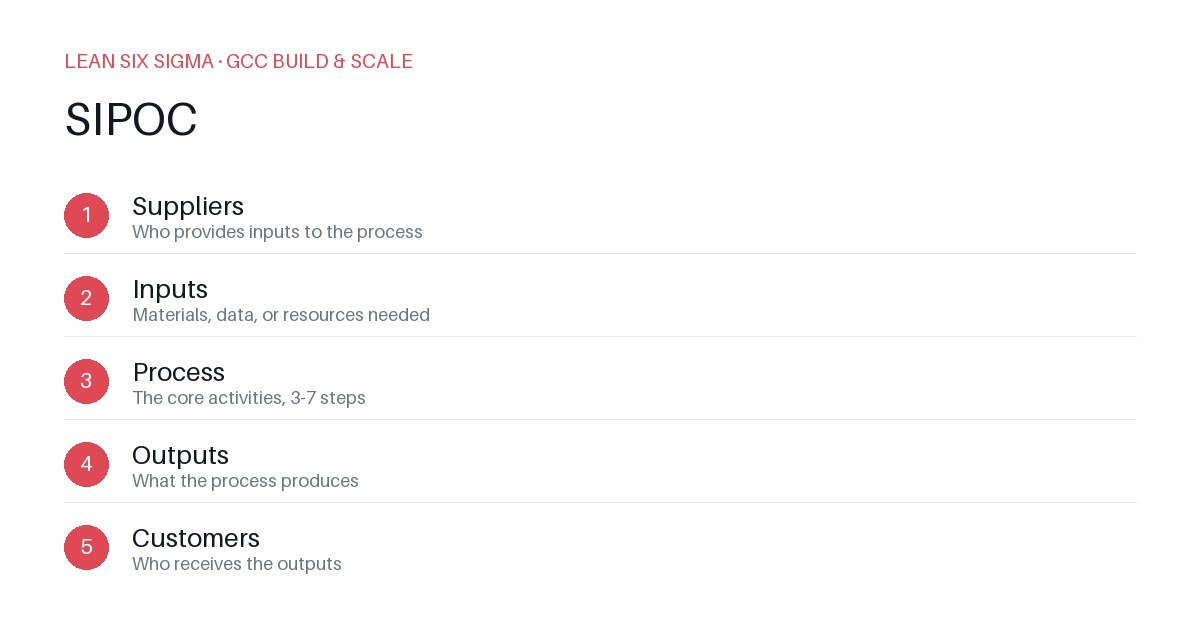
Downloadable templates
A practical walkthrough of applying SIPOC to real GCC build-and-scale work.
A SIPOC Map for Standing Up a New GCC Function
Why SIPOC Matters for GCC Teams
Scaling a Global Capability Center (GCC) means standardizing work across sites, handoffs, and teams that have never worked together before. In the GCC ecosystem, where efficiency, governance, and cross-functional alignment are paramount, ad-hoc processes quickly become bottlenecks. SIPOC gives you a shared vocabulary and a repeatable sequence for doing that. It transforms ambiguous responsibilities into documented workflows, ensuring that whether you’re in London, Bangalore, or New York, the process for standing up a new function remains consistent, auditable, and scalable.
The SIPOC Sequence
-
Suppliers — Who provides inputs to the process
These are the individuals, teams, or systems that feed necessary resources into your workflow. In a GCC context, suppliers might include HR for onboarding, IT for infrastructure provisioning, or finance for budget approvals. -
Inputs — Materials, data, or resources needed
These are the tangible or intangible requirements that must be gathered before the process can begin. Examples include approved budgets, job descriptions, compliance checklists, and stakeholder sign-offs. -
Process — The core activities, 3-7 steps
This is the heart of your workflow. Each step should be clearly defined, actionable, and time-bound. For instance, when standing up a new GCC function, the process might include: (1) Define scope and objectives, (2) Secure leadership approval, (3) Allocate resources, (4) Onboard team members, and (5) Launch and monitor. -
Outputs — What the process produces
These are the deliverables or results that emerge from the process. Outputs could be a fully operational team, a documented SOP, a live system, or a performance dashboard. -
Customers — Who receives the outputs
These are the internal or external stakeholders who benefit from the process. In GCC operations, customers might be business unit leaders, compliance officers, or downstream process owners who rely on the new function’s output.
Applying It
Start small: pick one recurring pain point your GCC team hits every week, and walk it through these 5 steps before rolling the approach out more broadly. For example, if your team struggles with delayed onboarding for new analysts, map out the SIPOC for that specific workflow. Identify who delays the process (e.g., IT provisioning), what’s missing (e.g., pre-approved access templates), and how to streamline the steps. This targeted approach builds momentum and demonstrates quick wins.
Building Your First SIPOC Map
Download the template below to run your first pass. Use it to document the current state of your chosen process, then compare it against the ideal state. Highlight gaps in supplier reliability, input completeness, or process clarity. Assign owners to each step and set SLAs for handoffs. Over time, refine the map as you gather feedback and iterate.
SIPOC isn’t just a diagram—it’s a governance tool. It aligns expectations, reduces friction, and creates a foundation for continuous improvement. By standardizing how you stand up new GCC functions, you empower your teams to operate with confidence, consistency, and clarity.
Next Steps
Once you’ve completed your first SIPOC, share it with stakeholders for validation. Use it as a living document—update it as processes evolve. Over time, you’ll build a library of standardized workflows that can be replicated across your GCC network. This is how you turn operational chaos into scalable excellence.
Comments
Be the first to comment on this post.
Sign in to leave a comment.