A SIPOC Map for Standing Up a New GCC Function
August 25, 2026
Like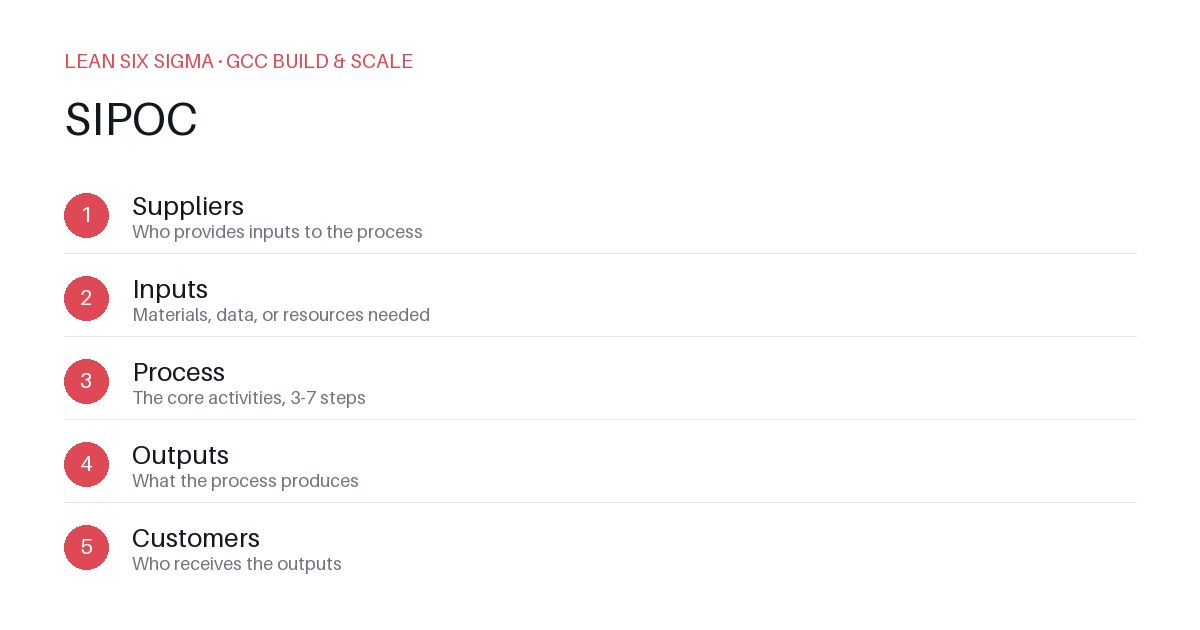
Downloadable templates
A practical walkthrough of applying SIPOC to real GCC build-and-scale work.
A SIPOC Map for Standing Up a New GCC Function
Why SIPOC Matters for GCC Teams
Scaling a Global Capability Center (GCC) means standardizing work across sites, handoffs, and teams that have never worked together before. In complex IT service management or enterprise architecture initiatives, ambiguity in roles and deliverables often leads to duplicated effort, delayed time-to-value, and misaligned expectations between regional offices and central governance. SIPOC gives you a shared vocabulary and a repeatable sequence for doing that. It forces clarity on who owns what, what is consumed, what is produced, and who benefits — all before a single ticket is opened or a sprint is scoped.
The SIPOC Sequence
- Suppliers — Who provides inputs to the process. These are not just vendors; they can be internal stakeholders, legacy systems, or upstream functions that feed data, approvals, or resources into your workflow.
- Inputs — Materials, data, or resources needed. This includes documented requirements, access credentials, budget allocations, technical specifications, and compliance checklists.
- Process — The core activities, ideally 3-7 steps. Each step should be actionable, owned by a specific role, and measurable. Avoid vague terms like “collaborate” or “align” — instead, specify “validate,” “configure,” “test,” or “deploy.”
- Outputs — What the process produces. These are tangible deliverables: approved configurations, trained users, documented runbooks, or deployed services.
- Customers — Who receives the outputs. In a GCC context, customers are often other business units, regional IT teams, or end-users who depend on the capability to operate effectively.
Applying It: A Concrete Example
Start small: pick one recurring pain point your GCC team hits every week, and walk it through these 5 steps before rolling the approach out more broadly. Consider the scenario of “standing up a new GCC function” — for example, deploying a centralized logging and monitoring service across multiple regions.
- Suppliers: Regional infrastructure teams, security compliance officers, and the vendor providing the monitoring platform.
- Inputs: Architecture diagrams, network topology maps, security clearance forms, vendor licensing agreements, and baseline performance metrics.
- Process:
- Validate regional network compatibility with vendor specs.
- Provision infrastructure in each target region.
- Configure data collection agents and alerting rules.
- Conduct integration testing with regional support teams.
- Document runbooks and hand off to operations.
- Outputs: Deployed monitoring infrastructure, validated alerting workflows, approved documentation, and trained regional support staff.
- Customers: Regional IT operations teams, application development groups, and executive leadership tracking system health.
Building Your First SIPOC Map
Download the template below to run your first pass. Use it to map the process in detail, identify bottlenecks, and clarify ownership. Once completed, socialize the map with all stakeholders to ensure alignment. Iterate based on feedback, then apply the same framework to other critical processes within your GCC.
This post is too short for good SEO. Expand it to 400-600 words by adding concrete detail, examples, or steps relevant to its EXISTING topic — do not change its existing meaning or invent claims unrelated to it. Keep any existing Markdown headings and build on them; add more '## ' subheadings if useful. Output ONLY the full expanded Markdown content, nothing else.
Comments
Be the first to comment on this post.
Sign in to leave a comment.