A SIPOC Map for Standing Up a New GCC Function
August 30, 2026
Like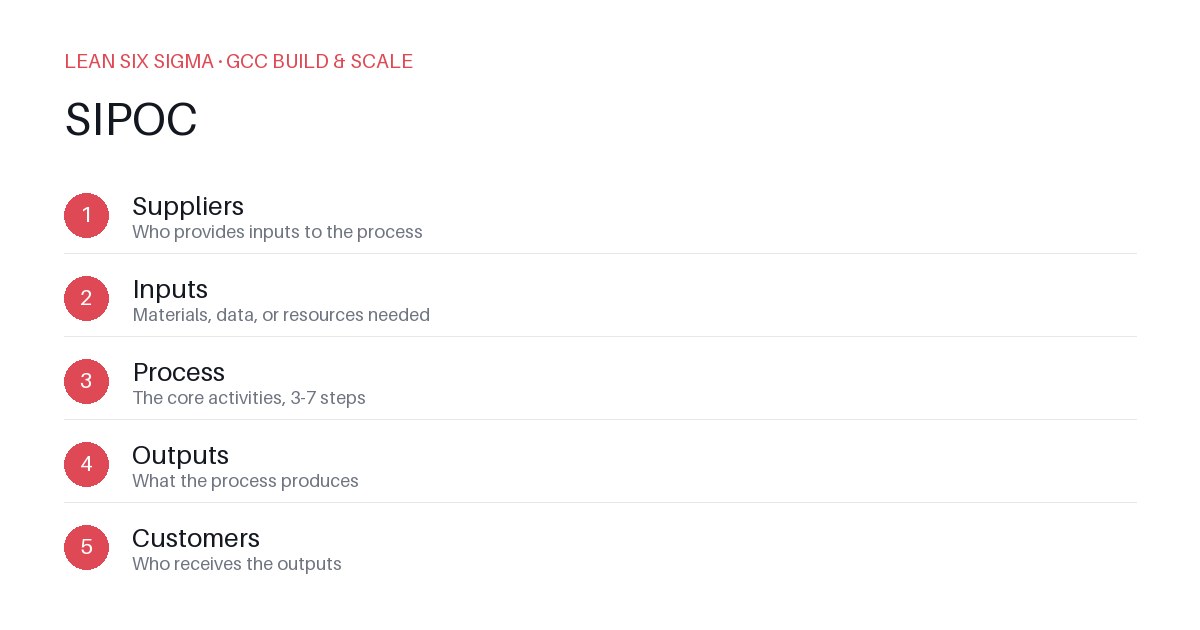
Downloadable templates
A practical walkthrough of applying SIPOC to real GCC build-and-scale work.
A SIPOC Map for Standing Up a New GCC Function
Why SIPOC Matters for GCC Teams
Scaling a Global Capability Center (GCC) means standardizing work across sites, handoffs, and teams that have never worked together before. In complex, distributed environments, ambiguity in handoffs and unclear ownership are the primary drivers of delays and rework. SIPOC gives you a shared vocabulary and a repeatable sequence for mapping out how work actually flows. It turns abstract responsibilities into visible dependencies, making it easier to identify bottlenecks, assign clear ownership, and establish measurable service-level expectations between teams.
The SIPOC Sequence
- Suppliers — Who provides inputs to the process. These are external or internal teams that must deliver resources, data, or approvals before your process can begin.
- Inputs — Materials, data, or resources needed. These are the tangible or intangible requirements that enable the process to run.
- Process — The core activities, 3-7 steps. This is where the actual work happens. Each step should be clearly defined, owned, and timed.
- Outputs — What the process produces. These are the deliverables, artifacts, or completed tasks that move the work forward.
- Customers — Who receives the outputs. These are the teams or stakeholders who depend on your process to complete their own work.
Applying It
Start small: pick one recurring pain point your GCC team hits every week, and walk it through these 5 steps before rolling the approach out more broadly. Download the template below to run your first pass.
Concrete Example: Standing Up a New GCC Function
Let’s say your GCC is standing up a new “Code Review & Quality Gate” function to ensure all pull requests meet security and performance standards. Here’s how you might map it using SIPOC:
Suppliers
- Development Teams: Provide code changes and pull requests.
- Security Team: Provide policy guidelines and vulnerability scanning tools.
- Platform Team: Provide CI/CD pipeline access and logging infrastructure.
Inputs
- Pull request metadata (branch, author, change summary)
- Security policy version and rule set
- CI/CD pipeline configuration
- Access credentials for scanning tools
Process
- Pull Request Ingestion: The system automatically detects new PRs and triggers the quality gate.
- Static Analysis: Automated tools scan code for vulnerabilities and style violations.
- Performance Benchmarking: Code is tested against baseline performance metrics.
- Policy Compliance Check: Results are compared against current security and compliance rules.
- Approval or Rejection: If all checks pass, the PR is approved; otherwise, it’s rejected with actionable feedback.
Outputs
- Approved or rejected pull requests
- Detailed scan reports and compliance scores
- Escalation tickets for critical failures
Customers
- Development Teams: Receive feedback and need to fix issues or proceed with deployment.
- Release Managers: Depend on clean, compliant code for production releases.
- Security Compliance Team: Audits the quality gate outputs for regulatory adherence.
Why This Works
By mapping the “Code Review & Quality Gate” function this way, your GCC can quickly see:
- Where delays occur (e.g., if security tooling is slow or policies are unclear)
- Who owns each step (e.g., Platform Team vs. Security Team)
- What happens when something breaks (e.g., missing inputs cause pipeline stalls)
This clarity reduces handoff friction, sets realistic SLAs, and makes it easier to onboard new team members or expand the GCC to new regions.
Next Steps
- Pick a Process: Choose a high-impact, recurring workflow in your GCC.
- Gather Stakeholders: Include representatives from suppliers, process owners, and customers.
- Map It Out: Use the SIPOC template to document each step clearly.
- Identify Gaps: Look for missing inputs, unclear ownership, or slow handoffs.
- Iterate: Refine the map based on feedback and real-world execution.
SIPOC isn’t just a diagram—it’s a communication tool that aligns teams around how work should flow. Use it to build transparency, reduce waste, and scale your GCC with confidence.
Comments
Be the first to comment on this post.
Sign in to leave a comment.