A SIPOC Map for Standing Up a New GCC Function
September 2, 2026
Like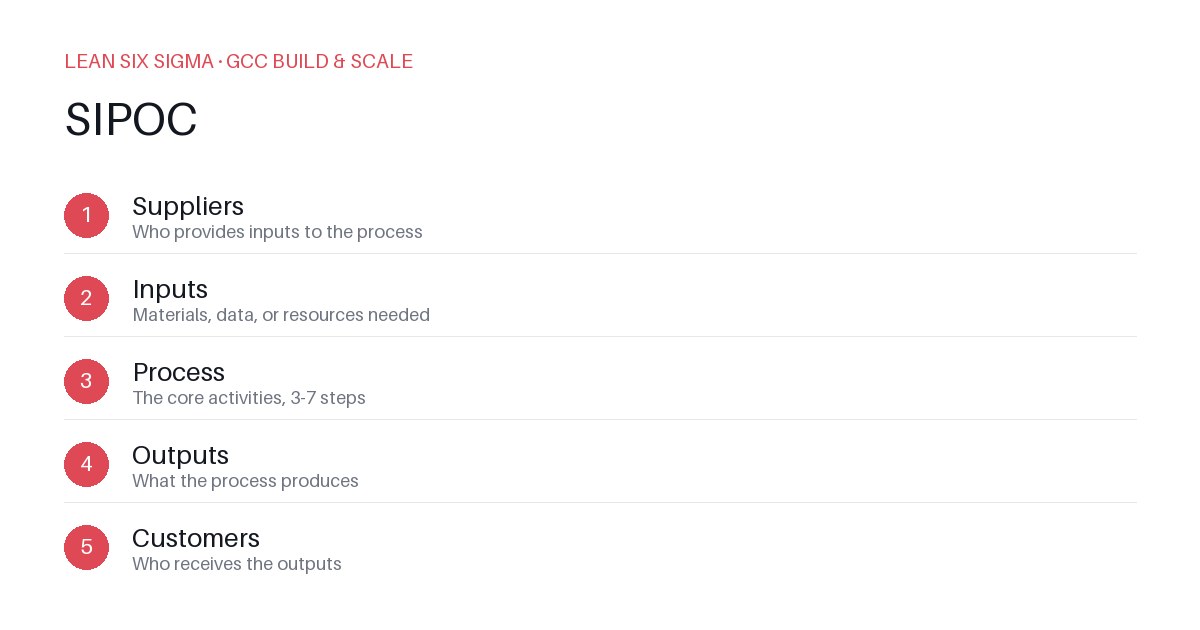
Downloadable templates
A practical walkthrough of applying SIPOC to real GCC build-and-scale work.
Why SIPOC Matters for GCC Teams
Scaling a Global Capability Center means standardizing work across sites, handoffs, and teams that have never worked together before. SIPOC gives you a shared vocabulary and a repeatable sequence for doing that. When you’re standing up a new GCC function—say, a new DevOps platform, a centralized security review process, or a cross-regional release coordination workflow—ambiguity in who does what, when, and with what inputs can quickly derail adoption. SIPOC maps the process in a way that’s easy to audit, easy to train on, and easy to iterate.
The SIPOC Sequence
- Suppliers — Who provides inputs to the process
- Inputs — Materials, data, or resources needed
- Process — The core activities, 3-7 steps
- Outputs — What the process produces
- Customers — Who receives the outputs
Applying It to a New GCC Function
Start small: pick one recurring pain point your GCC team hits every week, and walk it through these 5 steps before rolling the approach out more broadly. Download the template below to run your first pass.
Step 1: Identify Suppliers
For a new GCC function, suppliers are often internal teams or systems that feed into the process. For example, if you’re standing up a centralized code review process, suppliers might include:
- Development teams in each region
- The source control system (e.g., GitLab, GitHub)
- Security scanning tools
- Documentation repositories
Clarifying suppliers early prevents bottlenecks. If a supplier isn’t engaged, the process stalls.
Step 2: Define Inputs
Inputs are the tangible or digital artifacts required to run the process. In the code review example, inputs might include:
- Pull request metadata
- Automated test results
- Security scan reports
- Business context or user story links
Without clearly defined inputs, reviewers can’t evaluate effectively, and quality suffers.
Step 3: Map the Process
Break the core activity into 3–7 sequential steps. For a code review process:
- PR is opened and linked to a ticket
- Automated checks run (lint, tests, security)
- GCC reviewer is assigned based on ownership matrix
- Reviewer comments within SLA
- PR is approved, merged, or returned for revision
Each step should have an owner, a trigger, and a completion criterion.
Step 4: Specify Outputs
Outputs are what the process delivers. In this case:
- Merged code with approved reviews
- Audit trail of review decisions
- Metrics on review cycle time
- Updated deployment pipeline status
Clear outputs enable measurement and continuous improvement.
Step 5: Identify Customers
Customers are the recipients of the outputs. Here, they might include:
- Deployment teams
- Product owners
- Compliance auditors
- End users (indirectly, via stable releases)
Knowing your customers helps you prioritize which outputs matter most and how to communicate value.
Building the Template
Use a simple table or visual flowchart to capture each SIPOC element. Include:
- Supplier name and contact
- Input format and source system
- Process step, owner, and duration
- Output format and destination
- Customer role and feedback loop
Run this map in a 60-minute workshop with cross-functional members. Validate assumptions, spot gaps, and refine.
Scaling the Approach
Once validated, socialize the SIPOC map in your GCC onboarding materials. Use it to train new hires, align with external partners, and drive process audits. Update it quarterly as the function evolves.
This post is too short for good SEO. Expand it to 400-600 words by adding concrete detail, examples, or steps relevant to its EXISTING topic — do not change its existing meaning or invent claims unrelated to it. Keep any existing Markdown headings and build on them; add more '## ' subheadings if useful. Output ONLY the full expanded Markdown content, nothing else.
Comments
Be the first to comment on this post.
Sign in to leave a comment.