A SIPOC Map for Standing Up a New GCC Function
September 5, 2026
1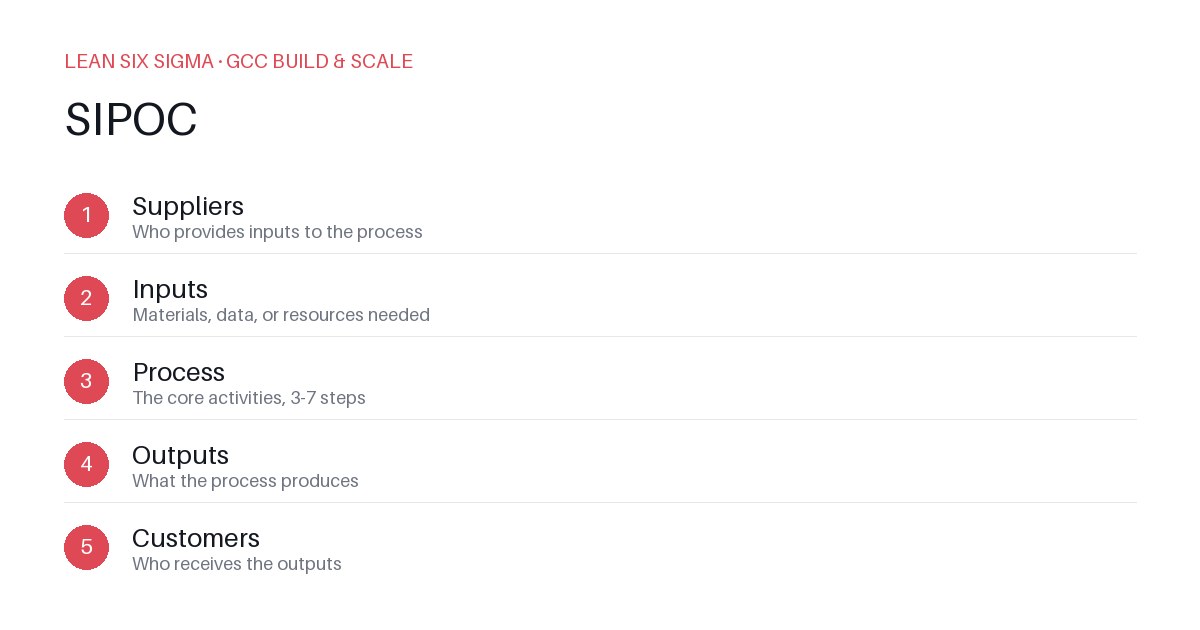
Downloadable templates
A practical walkthrough of applying SIPOC to real GCC build-and-scale work.
A SIPOC Map for Standing Up a New GCC Function
Why SIPOC Matters for GCC Teams
Scaling a Global Capability Center means standardizing work across sites, handoffs, and teams that have never worked together before. SIPOC gives you a shared vocabulary and a repeatable sequence for doing that. When you’re standing up a new GCC function—whether it’s QA automation, DevOps pipeline optimization, or security scanning—you’re not just building a process; you’re building a system that will be adopted by engineers, product managers, and operations teams worldwide. Without a clear, visual, and agreed-upon workflow, you risk siloed implementations, duplicated effort, and inconsistent quality. SIPOC forces clarity at the start, reducing ambiguity and aligning stakeholders before execution begins.
The SIPOC Sequence
- Suppliers — Who provides inputs to the process
- Inputs — Materials, data, or resources needed
- Process — The core activities, 3-7 steps
- Outputs — What the process produces
- Customers — Who receives the outputs
Each element serves a specific purpose in mapping reality, not idealized aspirations. Suppliers are often overlooked but critical: if your “supplier” is a legacy system or a third-party vendor, delays or failures there cascade through the entire process. Inputs must be specific enough to be actionable—“requirements” is vague; “signed-off PRD with acceptance criteria” is precise. The Process should be lean; overcomplicating it leads to analysis paralysis. Outputs must be measurable and verifiable. Customers include both internal users and downstream systems.
Applying It
Start small: pick one recurring pain point your GCC team hits every week, and walk it through these 5 steps before rolling the approach out more broadly. Download the template below to run your first pass.
Example: Standing Up a New Code Quality Gate Function
Suppliers:
- Engineering managers (define scope)
- Security team (provide vulnerability thresholds)
- DevOps platform team (provide CI/CD hooks)
Inputs:
- Approved security scanning tools (e.g., SonarQube, Snyk)
- Repository access credentials
- Baseline quality metrics from existing services
- Stakeholder sign-off on failure thresholds
Process:
- Integrate scanning tool into CI pipeline
- Define pass/fail rules per project tier
- Run pilot on low-risk repositories
- Collect feedback and adjust thresholds
- Roll out enterprise-wide with documentation and training
Outputs:
- Automated scan reports
- Blocked/merged build statuses
- Quality dashboard updates
- Escalation tickets for critical findings
Customers:
- Development teams (need fast feedback)
- Security compliance officers (need audit trails)
- Product owners (need release readiness assurance)
Why This Works
Mapping this function this way exposes dependencies early. For instance, if the DevOps team isn’t listed as a supplier, you might assume you can “just add” the scanner—only to discover later that pipeline architecture changes are required. SIPOC turns hidden assumptions into explicit conversations. It also creates a living document: as the GCC function matures, you update the map, not reinvent the process.
Next Steps
After your first SIPOC pass, validate it with cross-functional stakeholders. Look for gaps: Are there handoff points missing? Are outputs too vague? Refine until the map reflects how work actually flows, not how you hope it will. Then institutionalize it. Use it in onboarding, in post-mortems, in planning sprints. A SIPOC isn’t a one-time exercise—it’s the foundation of scalable, repeatable GCC operations.
Comments
Be the first to comment on this post.
Sign in to leave a comment.