Control Plans for GCC Process Stability
September 4, 2026
Like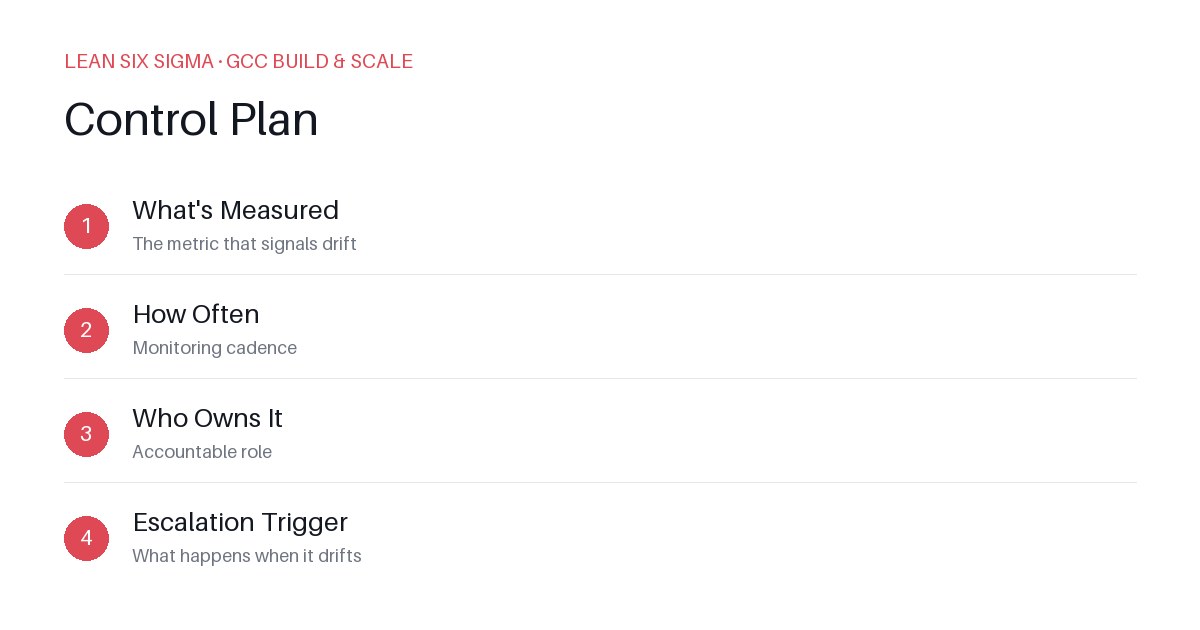
Downloadable templates
A practical walkthrough of applying Control Plan to real GCC build-and-scale work.
Control Plans for GCC Process Stability
Why Control Plan Matters for GCC Teams
Scaling a Global Capability Center (GCC) means standardizing work across sites, handoffs, and teams that have never worked together before. Without a shared operating rhythm, you’ll see inconsistent quality, delayed issue resolution, and duplicated effort. Control Plan gives you a shared vocabulary and a repeatable sequence for doing that. It transforms ad-hoc troubleshooting into disciplined process management, ensuring that when things go off-track, everyone knows what to measure, who to ask, and how to escalate.
The Control Plan Sequence
-
What's Measured — The metric that signals drift
This isn’t just a KPI; it’s an early-warning indicator. For example, in a GCC handling incident response, “mean time to acknowledge (MTTA)” might be the metric. If MTTA exceeds 15 minutes during peak hours, you know something is off before customers complain. -
How Often — Monitoring cadence
Frequency depends on risk and volatility. High-stakes processes may need real-time dashboards, while routine operations might only require daily or weekly reviews. The key is consistency: if you check metrics sporadically, drift goes unnoticed until it becomes a crisis. -
Who Owns It — Accountable role
Ownership prevents the “everyone’s responsible, so no one’s responsible” trap. Assign a named role—like a Process Lead or Site Coordinator—who is empowered to act when thresholds are breached. This person doesn’t need to fix everything but must trigger the next step. -
Escalation Trigger — What happens when it drifts
Define clear, objective conditions for escalation. For instance, if “ticket resolution time” exceeds 48 hours for three consecutive days, escalate to the GCC Operations Manager. Escalation paths should be documented, time-bound, and include communication templates to avoid ambiguity.
Applying It
Start small: pick one recurring pain point your GCC team hits every week, and walk it through these 4 steps before rolling the approach out more broadly. For example, if your GCC manages vendor onboarding, map out how long each step takes, who approves each stage, and what happens if a vendor delays documentation. Run this as a pilot for two weeks, collect feedback, then refine.
Download the template below to run your first pass. Use it to document your chosen metric, set realistic thresholds, assign clear owners, and define escalation paths. Revisit the plan monthly to adjust for changing workload or new risks.
Building Sustainability
A Control Plan isn’t a one-time exercise—it’s a living artifact. Integrate it into your GCC’s regular cadences: include metric reviews in weekly syncs, celebrate when teams hit targets, and conduct post-mortems when escalations occur. Over time, this builds a culture of proactive stability rather than reactive firefighting.
Next Steps
- Identify one high-impact, low-complexity process in your GCC.
- Draft a Control Plan using the four-step framework.
- Socialize it with stakeholders and assign ownership.
- Implement monitoring and test the escalation path.
- Review results after 30 days and iterate.
Stability isn’t about eliminating variability—it’s about managing it predictably. With Control Plans, your GCC can scale without sacrificing quality or speed.
Comments
Be the first to comment on this post.
Sign in to leave a comment.