Control Plans for GCC Process Stability
September 6, 2026
Like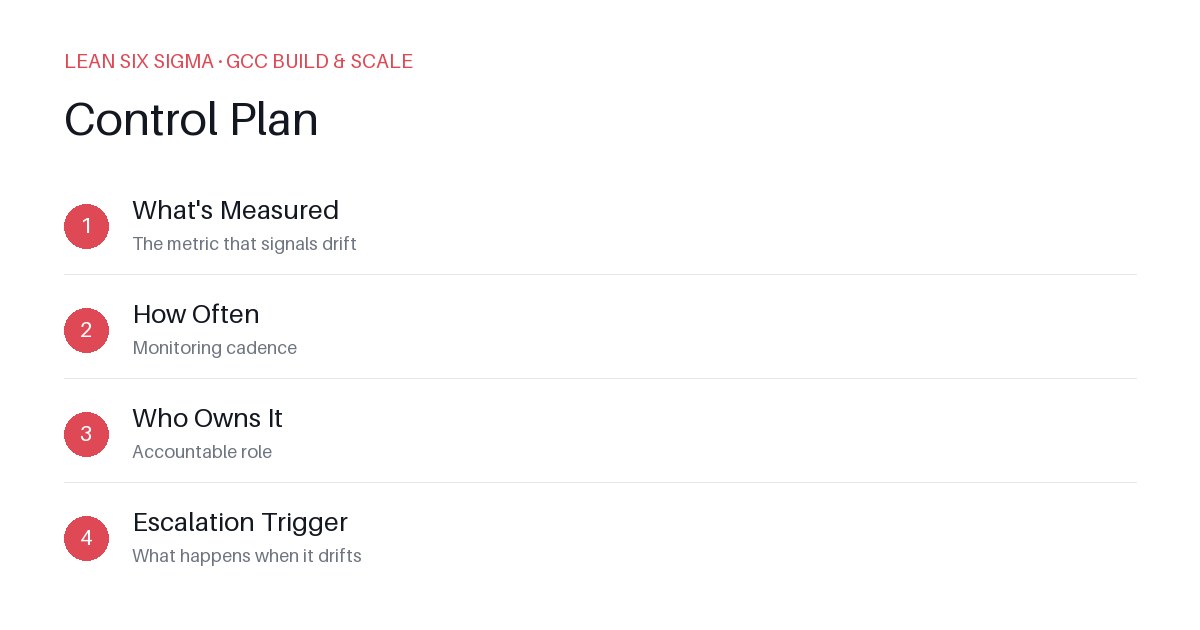
Downloadable templates
A practical guide to building and maintaining control plans that stabilize GCC processes using Lean Six Sigma methods.
Why Control Plans Matter in GCCs
A Global Capability Center (GCC) thrives on consistency. Without control plans, processes drift, errors accumulate, and scaling becomes chaotic. Control plans are the blueprint that locks in stable processes. They define how work is done, what to measure, and how to respond when things go off track.
Building Your Control Plan
Start with a clear process map. Identify each step, the owner, and the expected output. Then, define measurable criteria for each step. For example, in a software testing process, the control plan might specify that 95% of test cases must pass before moving to the next phase.
Next, establish monitoring methods. Use dashboards or automated tools to track key metrics. This real-time visibility helps teams catch issues before they escalate.
Implementing Control Measures
Assign accountability. Each team member should know their role in maintaining the process. Regular training ensures everyone follows the control plan consistently.
Set up feedback loops. When a metric falls outside acceptable limits, trigger a corrective action. For instance, if defect rates rise, pause the process, investigate, and adjust before resuming.
Sustaining Stability
Review and refine. Control plans aren’t static. Conduct periodic reviews to assess effectiveness. Update metrics or steps as the GCC evolves or new challenges emerge.
Celebrate wins. Recognize teams that maintain stability. Positive reinforcement encourages adherence to the control plan.
Common Pitfalls to Avoid
- Overcomplication: Keep control plans simple. Too many steps or metrics can overwhelm teams.
- Lack of Ownership: Without clear accountability, control plans become suggestions rather than standards.
- Ignoring Feedback: Dismissing corrective actions leads to recurring issues. Actively address deviations.
Real-World Example
A GCC managing customer support operations implemented a control plan with a target resolution time of 24 hours. By monitoring daily and training agents on prioritization techniques, they reduced average resolution time to 18 hours within three months. This stability improved customer satisfaction and allowed the team to scale efficiently.
Control plans are your GCC’s anchor. They turn good processes into great, scalable operations. Start small, stay disciplined, and watch your GCC thrive.
Comments
Be the first to comment on this post.
Sign in to leave a comment.