Control Plans for GCC Process Stability
September 6, 2026
Like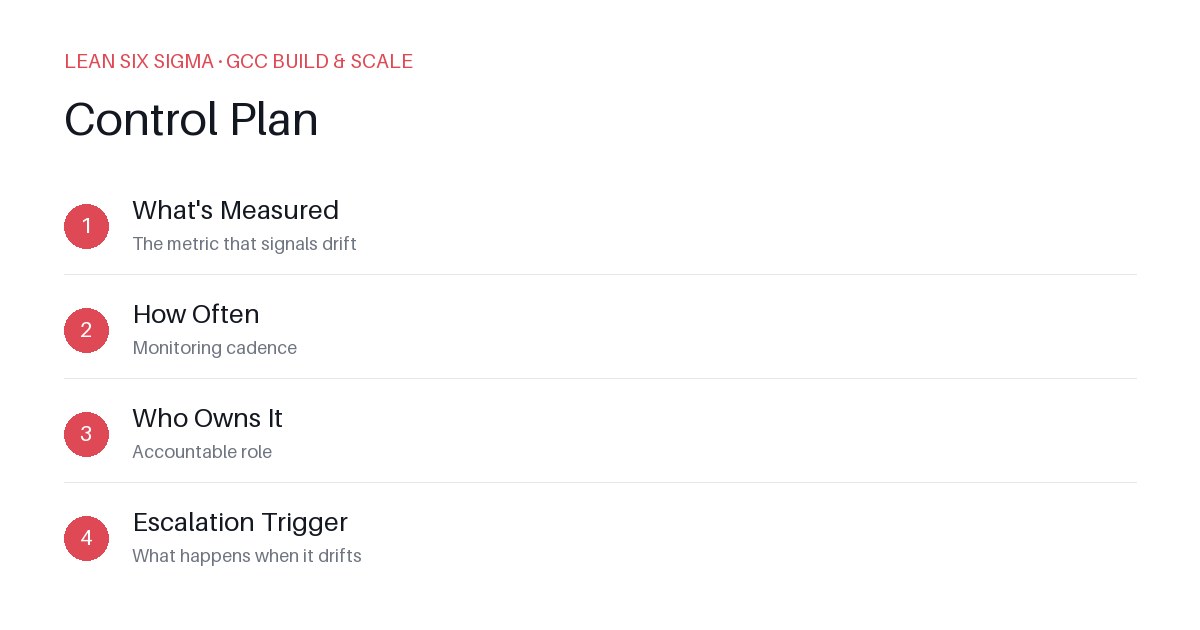
Downloadable templates
A practical walkthrough of applying Control Plan to real GCC build-and-scale work.
Control Plans for GCC Process Stability
Why Control Plan Matters for GCC Teams
Scaling a Global Capability Center means standardizing work across sites, handoffs, and teams that have never worked together before. Control Plan gives you a shared vocabulary and a repeatable sequence for doing that. Without it, you’ll end up with tribal knowledge, inconsistent monitoring, and reactive firefighting instead of proactive stability. A Control Plan turns abstract goals into observable, accountable, and actionable routines — the backbone of any mature GCC operating model.
The Control Plan Sequence
-
What's Measured — The metric that signals drift
Choose a leading or lagging indicator that directly reflects process health, quality, or throughput. Examples include cycle time variance, defect escape rate, SLA breach frequency, or approval turnaround time. The metric must be unambiguous, consistently collected, and tied to business outcomes. -
How Often — Monitoring cadence
Define the frequency at which the metric is reviewed: daily, weekly, monthly, or per sprint. The cadence should match the velocity of your work and the impact of potential drift. High-velocity processes may require daily checks, while strategic initiatives might only need monthly reviews. -
Who Owns It — Accountable role
Assign a single point of accountability — not a committee. This person is responsible for tracking the metric, interpreting deviations, and initiating corrective actions. Ownership should align with the team that directly influences the process, not just the team that reports on it. -
Escalation Trigger — What happens when it drifts
Establish clear thresholds that define when a metric has moved outside acceptable bounds. For example, if approval turnaround exceeds 48 hours for three consecutive days, escalate to the process owner or cross-functional lead. Define the exact next step: a root cause analysis, a process tweak, or a resource reallocation.
Applying It
Start small: pick one recurring pain point your GCC team hits every week, and walk it through these 4 steps before rolling the approach out more broadly. Download the template below to run your first pass.
Building a Control Plan: Step-by-Step
-
Identify the Process
Map the end-to-end workflow. Highlight handoffs, approval gates, and dependency points. These are where drift typically occurs. -
Select the Right Metric
Avoid vanity metrics. Choose something that, if it changes, will meaningfully impact delivery quality or speed. Validate with stakeholders that the metric is actionable. -
Define Baselines and Thresholds
Use historical data to establish what “normal” looks like. Set upper and lower bounds for acceptable performance. Document these clearly so there’s no ambiguity when evaluating drift. -
Assign Ownership and Cadence
Match the monitoring frequency to the process velocity. Ensure the owner has the data access, time allocation, and authority to act when triggers are hit. -
Document Escalation Paths
Create a simple decision tree: if metric X exceeds threshold Y for Z days, then action A is taken by role B. Share this with all involved parties so expectations are aligned. -
Review and Refine
Control Plans aren’t set-and-forget. Revisit them quarterly. Update thresholds as processes mature, adjust ownership if roles change, and retire metrics that no longer drive value.
Common Pitfalls to Avoid
- Too Many Metrics: Focus on 3–5 critical indicators per process. Dilution leads to paralysis.
- Vague Ownership: “The team” is not a role. Name a person.
- No Action on Triggers: If escalation doesn’t lead to a defined response, the plan becomes theater.
- Ignoring Human Factors: Involve frontline contributors in metric selection. They’ll spot blind spots leadership misses.
Next Steps
Run a pilot on one high-impact process. Measure the reduction in rework, faster resolution of bottlenecks, and improved cross-team alignment. Then scale the framework. Stability isn’t achieved through complexity — it’s built through clarity, consistency, and accountability. Start with the Control Plan, and let it guide your GCC toward predictable, high-quality delivery.
Comments
Be the first to comment on this post.
Sign in to leave a comment.