Control Plans for GCC Process Stability
September 9, 2026
Like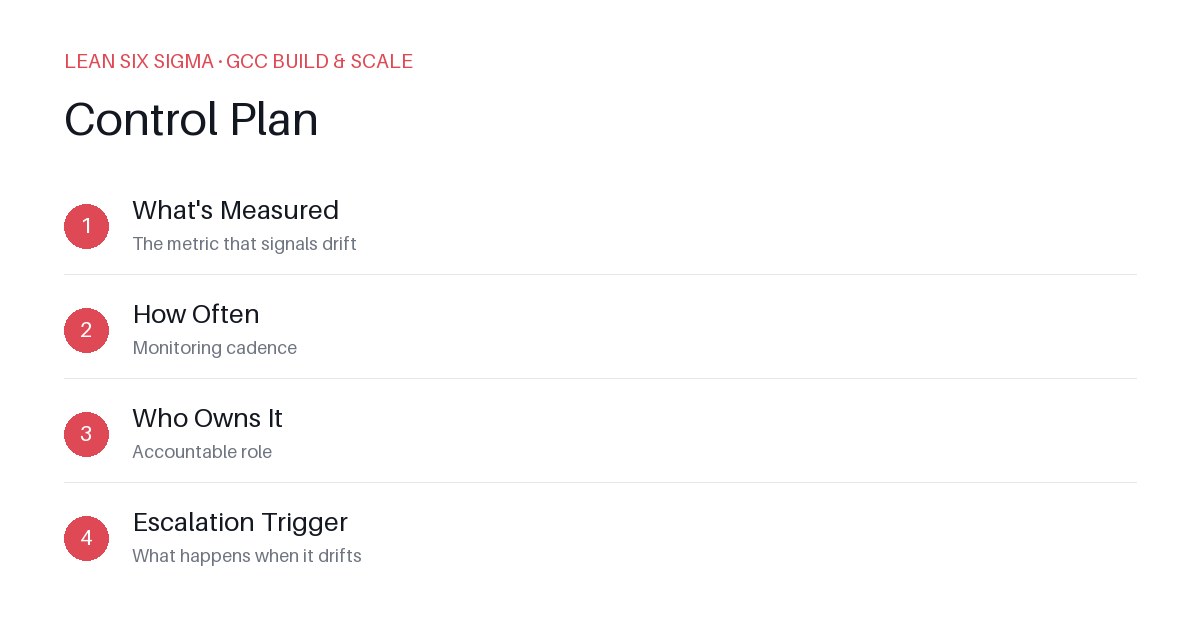
Downloadable templates
A practical walkthrough of applying Control Plan to real GCC build-and-scale work.
Why Control Plan Matters for GCC Teams
Scaling a Global Capability Center means standardizing work across sites, handoffs, and teams that have never worked together before. Control Plan gives you a shared vocabulary and a repeatable sequence for doing that. Without it, you risk inconsistent execution, duplicated effort, and silent failures that compound over time. A Control Plan isn’t just a document — it’s a living operating rhythm that aligns behavior, clarifies accountability, and turns reactive firefighting into proactive stability.
The Control Plan Sequence
-
What's Measured — The metric that signals drift
Choose a leading indicator, not just a lagging one. For example, instead of tracking “number of tickets resolved,” track “time from assignment to first response” or “% of deliverables meeting quality threshold on first pass.” The metric must be objective, observable, and directly tied to process health. -
How Often — Monitoring cadence
Define the frequency of review based on risk and velocity. High-impact processes may require daily or weekly check-ins, while mature, stable workflows can be reviewed biweekly or monthly. The cadence should balance visibility with operational efficiency — too frequent and you create noise; too infrequent and you miss drift until it becomes a crisis. -
Who Owns It — Accountable role
Assign a single point of accountability, not a committee. This person is responsible for reviewing the metric, initiating corrective actions, and reporting status. In GCC contexts, this often means a Process Owner or Quality Lead who has cross-functional authority. Clear ownership prevents the “everyone is responsible, so no one is” problem. -
Escalation Trigger — What happens when it drifts
Define explicit thresholds that trigger action. For instance, if “first-pass quality” drops below 85% for two consecutive weeks, escalate to the GCC leadership team with a root-cause analysis and remediation plan. Escalation paths must be pre-defined, time-bound, and include clear next steps to avoid paralysis.
Applying It
Start small: pick one recurring pain point your GCC team hits every week, and walk it through these 4 steps before rolling the approach out more broadly. Download the template below to run your first pass.
Building a Sustainable Control Plan
To make your Control Plan stick, embed it into existing workflows rather than treating it as an add-on. For example, if your team already holds weekly syncs, dedicate the first five minutes to reviewing Control Plan metrics. Use visual dashboards that update automatically — manual tracking leads to decay. Train new team members on the Control Plan during onboarding so it becomes part of the cultural DNA, not an optional guideline.
Measuring Control Plan Effectiveness
A Control Plan is only as good as its impact on process stability. Track leading indicators of success: reduction in rework, faster resolution times, fewer escalations, and improved cross-site consistency. After 60–90 days, review whether your Control Plan is driving behavior change or just documenting it. Iterate based on feedback — the goal is continuous improvement, not perfection.
Next Steps
Ready to stabilize your GCC operations? Identify one critical process, define its Control Plan using the four-step framework, and pilot it for one month. Measure the impact, refine the approach, and scale. Stability isn’t accidental — it’s designed, measured, and owned.
Comments
Be the first to comment on this post.
Sign in to leave a comment.