Control Plans for GCC Process Stability
September 11, 2026
Like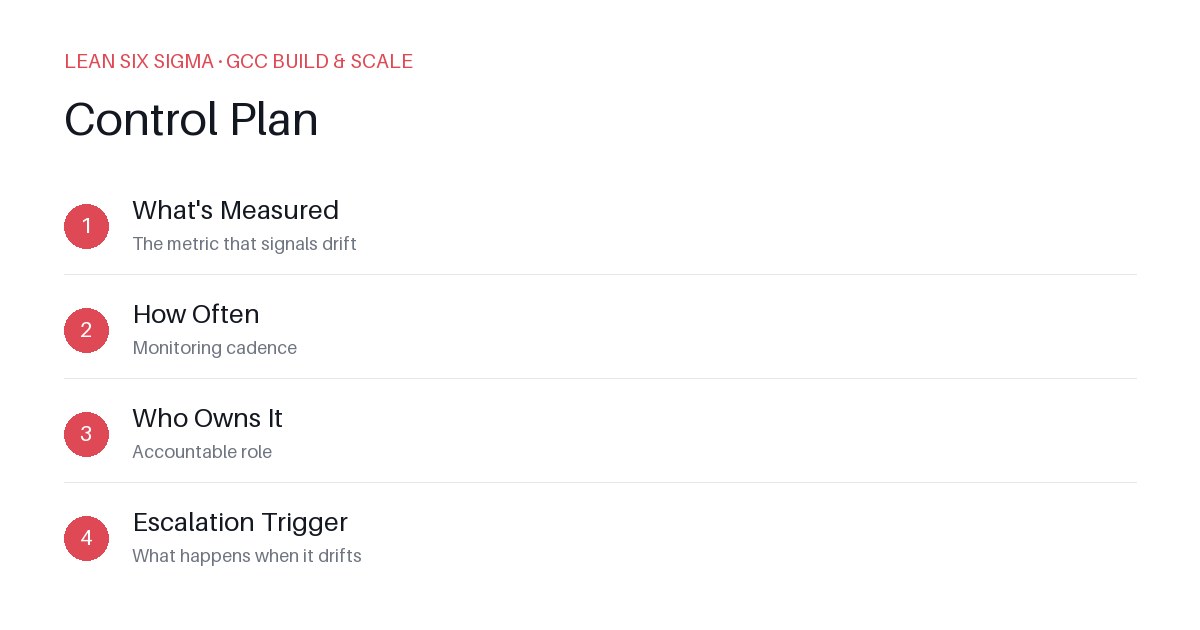
Downloadable templates
A practical walkthrough of applying Control Plan to real GCC build-and-scale work.
Why Control Plan Matters for GCC Teams
Scaling a Global Capability Center means standardizing work across sites, handoffs, and teams that have never worked together before. In such distributed environments, ambiguity is the enemy of velocity. When teams operate in silos with different definitions of “done,” inconsistent monitoring rhythms, or unclear ownership of quality metrics, performance degrades silently until a crisis forces intervention. Control Plan gives you a shared vocabulary and a repeatable sequence for doing that. It transforms ad-hoc troubleshooting into proactive governance, ensuring that every team—regardless of location or tenure—follows the same logic when something goes off track.
The Control Plan Sequence
A Control Plan is not a static document; it is an operational rhythm embedded into daily workflows. It consists of four interdependent components that must be defined together and reviewed regularly:
- What's Measured — The metric that signals drift. This should be a leading or lagging indicator that directly correlates with process health or output quality. Examples include cycle time variance, defect escape rate, SLA breach frequency, or stakeholder satisfaction score. The key is selectivity: measure only what matters to business outcomes, not vanity metrics.
- How Often — Monitoring cadence. This defines the frequency at which the metric is evaluated. Daily for real-time delivery pipelines, weekly for sprint reviews, monthly for capacity planning. The cadence must align with the metric’s volatility and the team’s decision-making cycle.
- Who Owns It — Accountable role. Ownership is not delegation; it is accountability. This person or role has the authority and responsibility to act when thresholds are breached. It should be a single point of contact, not a committee, to avoid diffusion of responsibility.
- Escalation Trigger — What happens when it drifts. This is the most critical yet often overlooked element. It must specify the exact condition (e.g., “metric exceeds target for three consecutive weeks”) and the predefined action (e.g., “trigger root-cause analysis workshop,” “notify program sponsor,” “pause new work until resolved”). Without a clear trigger, drift becomes normalized.
Applying It
Start small: pick one recurring pain point your GCC team hits every week, and walk it through these 4 steps before rolling the approach out more broadly. For instance, if your team consistently misses sprint deadlines due to unclear requirement handoffs, define:
- What's Measured: % of user stories with ambiguous acceptance criteria
- How Often: Reviewed at start of each sprint
- Who Owns It: Product Owner
- Escalation Trigger: If >15% of stories are flagged, pause new intake for 48 hours and schedule a refinement session with engineering leads
Document this in a lightweight template—no heavy governance required. The goal is consistency, not bureaucracy.
Building a Control Plan Culture
Control Plans gain power when they are treated as living artifacts, not compliance checkboxes. Review them in team retrospectives. Update them as processes evolve. Celebrate teams that catch drift early and act decisively. Over time, this creates a self-correcting system where stability is engineered into the workflow, not bolted on after failure.
Download the template below to run your first pass.
Comments
Be the first to comment on this post.
Sign in to leave a comment.