Control Plans for GCC Process Stability
September 14, 2026
Like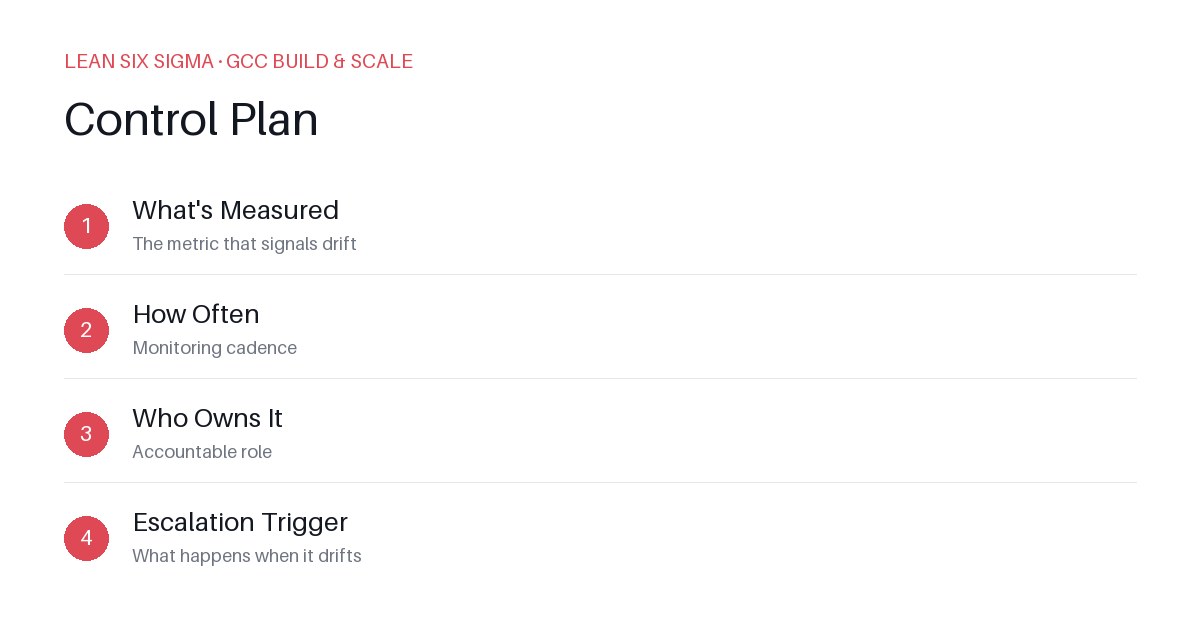
Downloadable templates
A practical guide to building control plans that keep your GCC processes stable and predictable.
Why Your GCC Needs a Control Plan
Many Global Capability Centers (GCCs) start with strong processes but lose momentum as teams scale. Without a control plan, small variations compound into delays, rework, and missed SLAs. A control plan isn't a document—it's an operational discipline that keeps your GCC running within defined parameters.
Define Critical Process Elements
Start by identifying the processes that directly impact your GCC's output. These are your Critical Process Elements (CPEs). Examples include:
- Time-to-deploy for new services
- Defect rate in QA testing
- Customer response time for tier-1 support
- Code review turnaround time
Map each CPE to a measurable metric. Vague goals like "improve quality" don't work. Use numbers: "reduce defect escape rate to <2%".
Set Control Limits
For each metric, establish upper and lower control limits. These are not arbitrary—they come from historical data and customer requirements.
- Upper Control Limit (UCL): The maximum acceptable value. Exceeding it triggers investigation.
- Lower Control Limit (LCL): The minimum acceptable value. Dropping below it also requires action.
Example: If your target is 95% first-contact resolution, set UCL at 98% and LCL at 90%. Anything outside this range needs a root cause analysis.
Monitor with SPC Charts
Statistical Process Control (SPC) charts are your early warning system. Use control charts to track metrics in real time.
- X-bar/R charts: Monitor average defect rates over time.
- Individual charts: Track single-unit metrics like response time.
Review charts daily. Look for trends, shifts, or points outside control limits. Don't wait for monthly reports—act when the chart shows a problem.
Assign Ownership and Response Protocols
Every CPE needs an owner. This person is responsible for:
- Reviewing SPC charts
- Investigating out-of-control signals
- Implementing corrective actions
- Updating the control plan if needed
Define clear response protocols. For example:
- Level 1: Minor deviation → Owner investigates and logs findings
- Level 2: Sustained deviation → Escalate to GCC lead and cross-functional team
- Level 3: Critical breach → Executive review and immediate corrective action
Review and Refine Quarterly
Control plans aren't set and forgotten. Review them quarterly to:
- Validate control limits against current performance
- Update metrics as the GCC evolves
- Incorporate lessons learned from incidents
Treat your control plan as a living document. It should evolve with your GCC, not stand still.
Common Pitfalls to Avoid
- Too many CPEs: Focus on 5-7 critical metrics, not 20. Dilution kills focus.
- Static limits: If your GCC improves, your limits should tighten. Otherwise, you'll miss improvements.
- No accountability: Without clear ownership, control plans become decorative.
Next Steps
- Identify your top 5 CPEs.
- Set data-driven control limits for each.
- Implement SPC charts and daily reviews.
- Assign owners and response protocols.
- Schedule quarterly reviews.
Stability isn't the absence of change—it's the ability to manage change predictably. Your control plan is the foundation of that predictability.
Comments
Be the first to comment on this post.
Sign in to leave a comment.