Control Plans for GCC Process Stability
September 20, 2026
Like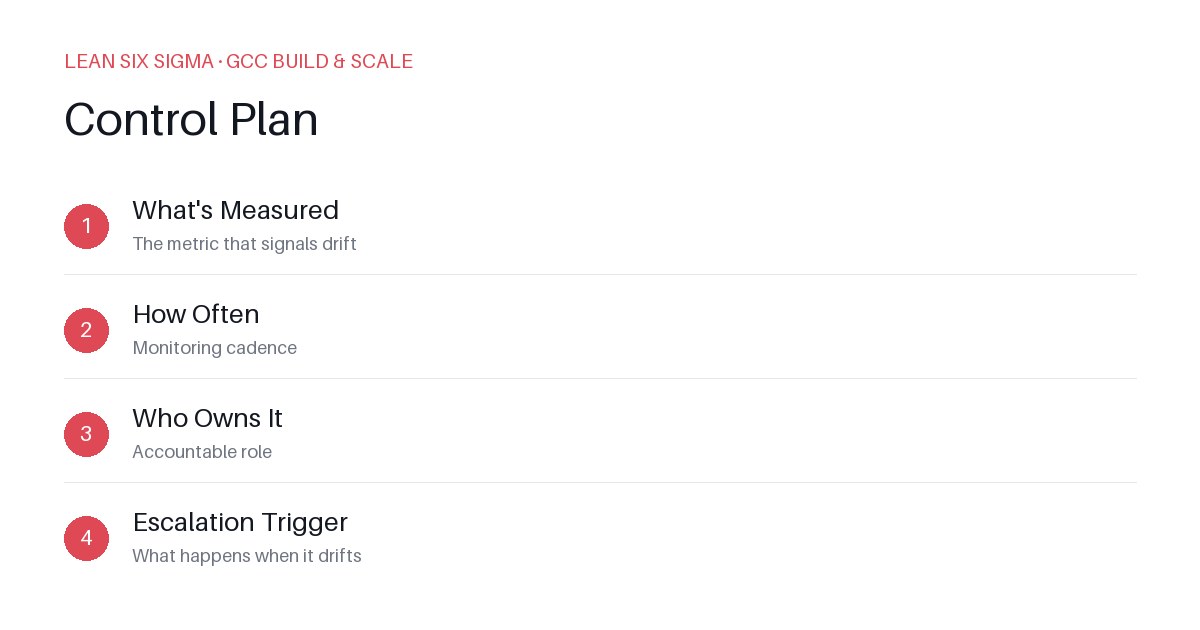
Downloadable templates
A practical walkthrough of applying Control Plan to real GCC build-and-scale work.
Why Control Plan Matters for GCC Teams
Scaling a Global Capability Center (GCC) means standardizing work across sites, handoffs, and teams that have never worked together before. Without a shared framework, teams default to tribal knowledge — leading to inconsistent execution, delayed responses, and repeated firefighting. Control Plan gives you a shared vocabulary and a repeatable sequence for doing that. It transforms ad-hoc monitoring into disciplined governance, ensuring that when a metric slips, the right person acts within the right timeframe.
The Control Plan Sequence
A Control Plan is not a static document; it’s an operational rhythm. It aligns measurement, cadence, ownership, and response into a single, executable flow.
-
What's Measured — The metric that signals drift
This must be specific, observable, and tied to business impact. Examples include: “Time to resolve critical defects,” “Percentage of sprint goals met,” or “Customer satisfaction score (CSAT) for tier-2 support.” Vague metrics like “improve quality” create ambiguity; precise metrics create accountability. -
How Often — Monitoring cadence
Frequency should match the speed of change and risk level. Daily metrics for active releases, weekly for stable processes, monthly for strategic KPIs. The cadence must be sustainable — over-monitoring breeds alert fatigue; under-monitoring hides problems until they escalate. -
Who Owns It — Accountable role
Ownership is not delegation; it’s accountability. Assign a named role (e.g., “GCC Process Lead,” “Site Operations Manager”) who has both the authority and the resources to act. Avoid “shared ownership” without a single point of responsibility — it dilutes action. -
Escalation Trigger — What happens when it drifts
Define thresholds clearly: “If CSAT drops below 4.2 for two consecutive weeks, escalate to GCC Director and initiate root-cause workshop.” Escalation paths must be pre-agreed, documented, and rehearsed. Ambiguity in escalation is the fastest route to operational paralysis.
Applying It
Start small: pick one recurring pain point your GCC team hits every week, and walk it through these 4 steps before rolling the approach out more broadly. For example, if “delayed knowledge base updates” consistently delay onboarding, define:
- Metric: % of KB articles updated within 48 hours of release
- Cadence: Daily check by Content Ops lead
- Owner: Content Operations Manager
- Trigger: If <90% updated for 3 days, escalate to Program Manager and pause new KB requests until backlog clears
Download the template below to run your first pass.
Building Control Plans That Stick
Control Plans fail when treated as compliance exercises. To embed them into GCC culture:
- Co-create with frontline teams — those who execute the work should help define the metrics and triggers.
- Review in regular forums — discuss drifts, not just successes, in GCC syncs or retrospectives.
- Tie to recognition — celebrate teams that catch drift early and resolve it without escalation.
- Iterate quarterly — as processes mature, adjust cadence, thresholds, and owners accordingly.
When Control Plans are lived, not just documented, GCC teams shift from reactive firefighting to proactive stability. That’s the foundation of scalable, resilient global operations.
Comments
Be the first to comment on this post.
Sign in to leave a comment.