Control Plans for GCC Process Stability
September 20, 2026
Like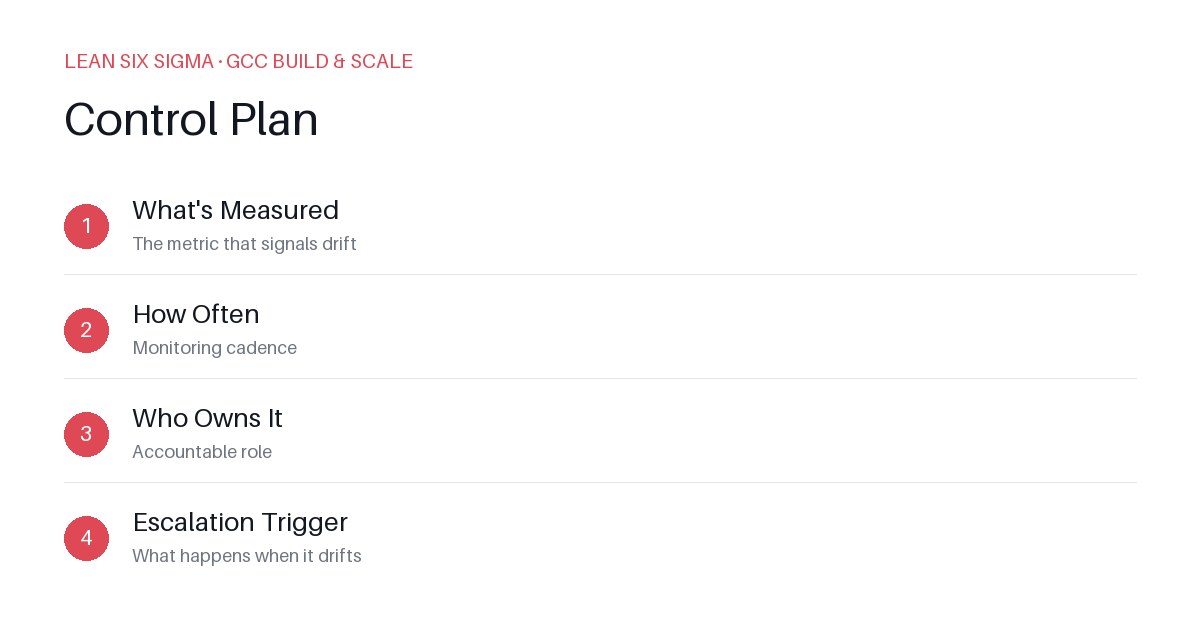
Downloadable templates
A practical walkthrough of applying Control Plan to real GCC build-and-scale work.
Why Control Plan Matters for GCC Teams
Scaling a Global Capability Center means standardizing work across sites, handoffs, and teams that have never worked together before. Control Plan gives you a shared vocabulary and a repeatable sequence for doing that. Without it, you risk inconsistent monitoring, unclear ownership, and reactive firefighting instead of proactive stability management. A well-structured Control Plan transforms ad-hoc troubleshooting into a disciplined operating rhythm.
The Control Plan Sequence
-
What's Measured — The metric that signals drift
This isn’t just any KPI. It’s a leading or lagging indicator that directly reflects process health. For example, in a GCC handling software delivery, “% of builds failing CI” or “average time to resolve P1 incidents” could serve as drift signals. The key is choosing metrics that are observable, actionable, and tied to business outcomes. -
How Often — Monitoring cadence
Frequency must match the criticality of the metric. High-impact, fast-moving processes (like deployment success rates) may require daily or even real-time checks. Slower-moving processes (like training completion rates) can be reviewed weekly. The cadence should be sustainable for the team and aligned with decision-making cycles. -
Who Owns It — Accountable role
Ownership is non-negotiable. Each metric must have a single named owner — not a committee. This person is responsible for reviewing the metric, interpreting anomalies, and initiating corrective actions. Clear ownership prevents the “everyone’s responsible, so no one’s responsible” trap. -
Escalation Trigger — What happens when it drifts
Define explicit thresholds and response protocols. For instance, if “% of builds failing CI” exceeds 15% for two consecutive days, the trigger might be: notify the engineering lead, pause non-critical deployments, and schedule a root-cause review within 24 hours. Escalation paths should be documented, automated where possible, and reviewed regularly.
Applying It
Start small: pick one recurring pain point your GCC team hits every week, and walk it through these 4 steps before rolling the approach out more broadly. Download the template below to run your first pass.
Example: Applying Control Plan to Release Quality
Consider a GCC managing software releases across three regions. A common pain point is inconsistent post-release defect rates. Here’s how Control Plan brings clarity:
- What’s Measured: Defect density per release (bugs per 1K lines of code)
- How Often: Reviewed weekly after each release window
- Who Owns It: Release Quality Lead (named role, not team)
- Escalation Trigger: If defect density exceeds baseline by >20% for two consecutive releases, trigger a mandatory retrospective and pause non-urgent feature rollouts until a mitigation plan is approved.
This simple structure turns chaos into a predictable loop: measure, monitor, own, respond.
Why This Works for GCCs
Global Capability Centers thrive on consistency, not heroics. Control Plans embed stability into daily operations, reduce cross-site variability, and create accountability without adding bureaucracy. When every team speaks the same language about what matters, how often, who’s responsible, and what happens when things go off track, you build resilience — not just processes.
This post is too short for good SEO. Expand it to 400-600 words by adding concrete detail, examples, or steps relevant to its EXISTING topic — do not change its existing meaning or invent claims unrelated to it. Keep any existing Markdown headings and build on them; add more '## ' subheadings if useful. Output ONLY the full expanded Markdown content, nothing else.
Comments
Be the first to comment on this post.
Sign in to leave a comment.