Control Plans for GCC Process Stability
August 18, 2026
Like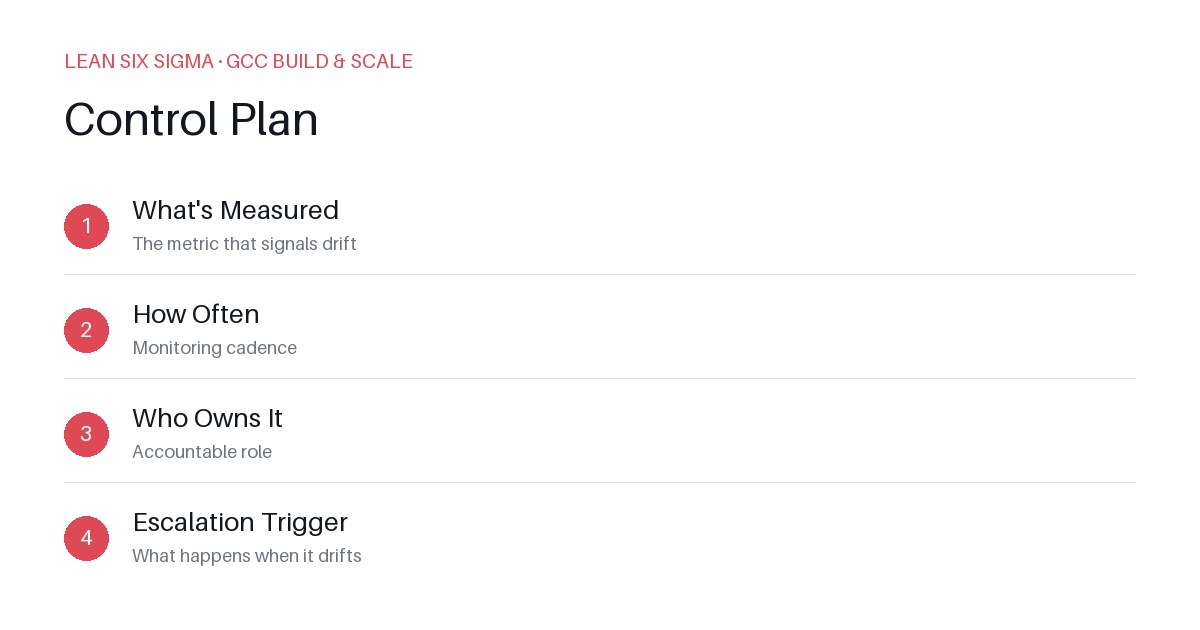
Downloadable templates
A practical guide to building control plans that keep your GCC processes stable and prevent variation from derailing your operations.
Why Control Plans Matter in GCCs
A Global Capability Center (GCC) thrives on consistency. When you standardize processes across regions, you’re not just cutting costs — you’re reducing risk. But standardization fails if you don’t monitor it. Control plans are your early warning system. They tell you when a process drifts, so you can fix it before it becomes a crisis.

Think of a control plan like a dashboard for your processes. Without it, you’re flying blind. With it, you can see what’s working, what’s slipping, and what needs immediate attention.

## What Is a Control Plan?

A control plan is a living document that defines how a process should run and how you’ll monitor it. It includes:

- Process steps and responsibilities
- Key performance indicators (KPIs)
- Control limits (what’s normal vs. abnormal)
- Actions to take when things go off track

It’s not a one-time exercise. It evolves as your GCC matures and new challenges emerge.

## How to Build a Control Plan

Start by mapping your core processes. Identify the steps, the people involved, and the tools used. Then, for each step, ask:

- What could go wrong?
- How will we know?
- What’s our response?

Document these answers. Use simple language. Avoid jargon. Your control plan should be easy to follow, even for someone new to the GCC.

## Example: Order Processing Control Plan

Let’s say your GCC handles order processing. Here’s how a control plan might look:

- **Step**: Receive order
- **KPI**: 95% of orders received within 24 hours
- **Control Limit**: If <90% for two consecutive days, investigate
- **Action**: Review intake process, check for system issues, escalate if needed

This is straightforward. It’s actionable. It tells you exactly what to do when things go wrong.

## Monitoring and Updating

A control plan is useless if you don’t use it. Set up regular reviews — weekly at first, then monthly as things stabilize. Track your KPIs. Compare them to your control limits. If you’re consistently hitting your targets, great. If not, dig into why.

Update your control plan as needed. New processes? New risks? New tools? Add them. Your control plan should reflect the current state of your GCC, not the state you had six months ago.

## Common Pitfalls

- **Too complex**: If your control plan is a 50-page document, no one will read it. Keep it concise.
- **No accountability**: Every action needs an owner. Assign names, not titles.
- **Ignoring exceptions**: Don’t just track the happy path. Plan for the messy stuff — it’s where you’ll learn the most.

## Next Steps

Start with one process. Build a simple control plan. Test it. Refine it. Then scale it out. Stability isn’t about perfection. It’s about knowing when things are off and fixing them fast. Your control plan is your best tool for that. Use it.
Comments
Be the first to comment on this post.
Sign in to leave a comment.