Control Plans for GCC Process Stability
September 22, 2026
Like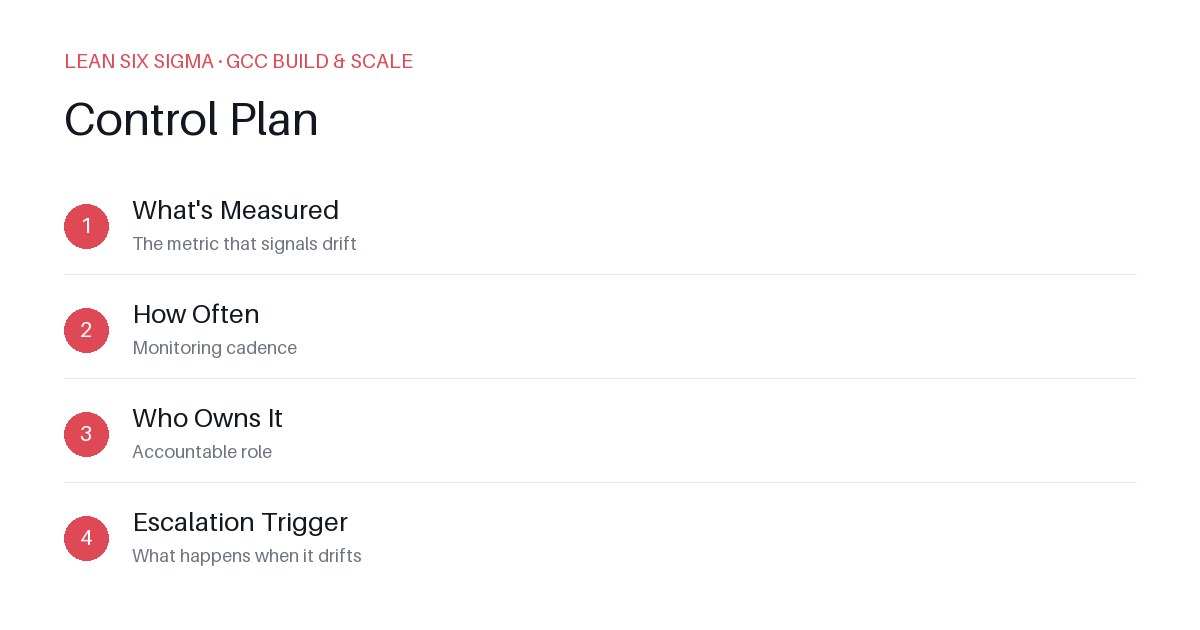
Downloadable templates
A practical walkthrough of applying Control Plan to real GCC build-and-scale work.
Control Plans for GCC Process Stability
Why Control Plan Matters for GCC Teams
Scaling a Global Capability Center means standardizing work across sites, handoffs, and teams that have never worked together before. Control Plan gives you a shared vocabulary and a repeatable sequence for doing that. Without it, you’re left with tribal knowledge, inconsistent monitoring, and reactive firefighting instead of proactive stability.
The Control Plan Sequence
- What's Measured — The metric that signals drift
- How Often — Monitoring cadence
- Who Owns It — Accountable role
- Escalation Trigger — What happens when it drifts
This four-part structure isn’t just a checklist — it’s a feedback loop designed to catch degradation before it becomes a crisis. Each component serves a specific operational purpose, and together they create transparency, accountability, and speed in response.
Applying It
Start small: pick one recurring pain point your GCC team hits every week, and walk it through these 4 steps before rolling the approach out more broadly. Download the template below to run your first pass.
Concrete Example: Code Review Turnaround Time
Let’s say your GCC team notices that critical path code reviews are taking too long, causing deployment delays and team friction. Here’s how you’d apply the Control Plan:
- What’s Measured: Average time from PR submission to first reviewer comment (in hours)
- How Often: Daily tracking, reviewed weekly in team sync
- Who Owns It: Engineering Lead of the service team
- Escalation Trigger: If average time exceeds 24 hours for two consecutive days, notify the GCC Process Owner and schedule a root-cause review
This turns a vague complaint (“reviews are slow”) into an actionable, monitored process with clear ownership and next steps.
Scaling the Approach
Once you’ve stabilized one metric, replicate the pattern across other high-impact areas:
- Deployment Failure Rate: Track daily, owned by DevOps lead, escalate if >5% over 3 days
- Incident Resolution Time: Monitor weekly, owned by SRE manager, trigger war room if >4 hours
- Customer Support SLA Breach Rate: Daily check, owned by Support Lead, escalate to VP if >10%
The key is consistency. Use the same template, the same cadence, and the same escalation language across all metrics. This creates a culture where stability is measured, not assumed.
Common Pitfalls to Avoid
- Vague metrics: “Good performance” isn’t measurable. Use numbers, thresholds, and timeframes.
- No clear owner: “Everyone” means no one. Assign a single accountable role.
- Static triggers: Escalation thresholds must be reviewed quarterly as processes evolve.
- Silent monitoring: Data without action is noise. Tie every metric to a response protocol.
Next Steps
- Identify your top 3 recurring GCC pain points
- Draft a Control Plan for each using the 4-step framework
- Socialize with cross-functional stakeholders
- Implement monitoring and track outcomes for 30 days
- Refine based on real-world drift and team feedback
Stability isn’t an accident — it’s engineered through disciplined measurement, clear ownership, and rapid response. Start with one metric, prove the model works, then scale.
Comments
Be the first to comment on this post.
Sign in to leave a comment.