Control Plans for GCC Process Stability
September 25, 2026
Like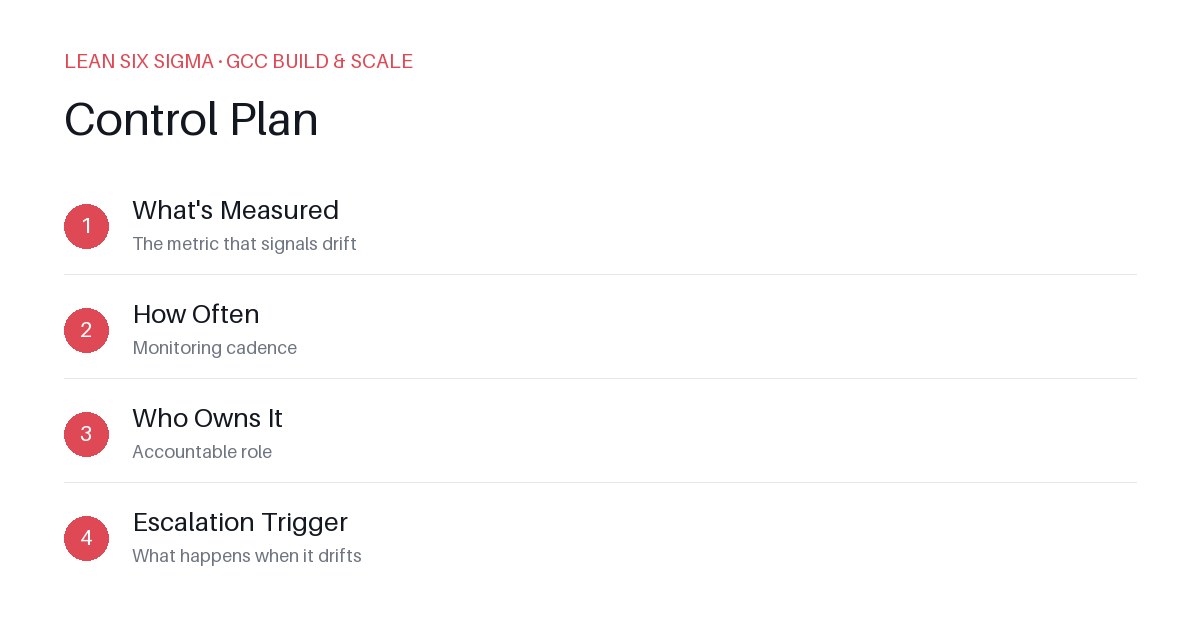
Downloadable templates
A practical walkthrough of applying Control Plan to real GCC build-and-scale work.
Control Plans for GCC Process Stability
Why Control Plan Matters for GCC Teams
Scaling a Global Capability Center (GCC) means standardizing work across sites, handoffs, and teams that have never worked together before. In such distributed environments, ad-hoc processes quickly become bottlenecks, leading to inconsistent quality, delayed delivery, and eroded trust between regions. A Control Plan gives you a shared vocabulary and a repeatable sequence for managing those handoffs and ensuring that critical processes remain stable over time. Without a structured approach to monitoring and responding to process drift, GCC teams risk reverting to local workarounds that undermine the very standardization the center was built to enforce.
The Control Plan Sequence
A Control Plan is not a static document; it is an operational rhythm. It transforms abstract process goals into observable, actionable behaviors. The sequence below ensures that every critical process has clear visibility into its health and a predefined response when that health degrades.
-
What's Measured — The metric that signals drift. This should be a leading or lagging indicator tied directly to process quality or efficiency. For example, in a GCC software delivery pipeline, you might measure “average cycle time from code commit to production deployment” or “percentage of builds failing due to flaky tests.” The metric must be unambiguous, easily quantifiable, and meaningful to the team responsible for it.
-
How Often — Monitoring cadence. Frequency depends on the criticality and volatility of the process. High-impact, fast-moving processes may require daily or real-time monitoring, while more stable processes can be reviewed weekly or monthly. The cadence should be sustainable for the owning team and aligned with their natural workflow rhythms.
-
Who Owns It — Accountable role. Ownership is not about who performs the work, but who is responsible for ensuring the metric stays within bounds. This role must have the authority to initiate corrective actions and the visibility to see the metric in action. In GCC contexts, this often means a process owner, team lead, or center-of-excellence liaison.
-
Escalation Trigger — What happens when it drifts. This is the most critical element. A trigger defines the threshold at which the metric is considered out of control and specifies the immediate next step. For instance, “If deployment failure rate exceeds 5% for two consecutive days, the process owner must convene a root-cause analysis session with the engineering lead and update the runbook within 48 hours.” Escalation paths should be documented, automated where possible, and reviewed regularly to ensure they remain effective.
Applying It
Start small: pick one recurring pain point your GCC team hits every week, and walk it through these 4 steps before rolling the approach out more broadly. For example, if your GCC team struggles with inconsistent handoff documentation between regional support teams, you could define a metric like “percentage of handoffs with complete documentation,” set a daily monitoring cadence via a shared dashboard, assign ownership to the regional process coordinator, and establish an escalation trigger that requires a 15-minute sync if documentation completeness drops below 90% for three days.
Download the template below to run your first pass. Use it to document your initial Control Plan, share it with stakeholders, and iterate based on real-world feedback. Over time, these plans become the backbone of process maturity in your GCC, enabling predictable performance, faster onboarding, and greater alignment across global teams.
Comments
Be the first to comment on this post.
Sign in to leave a comment.