Control Plans for GCC Process Stability
September 28, 2026
Like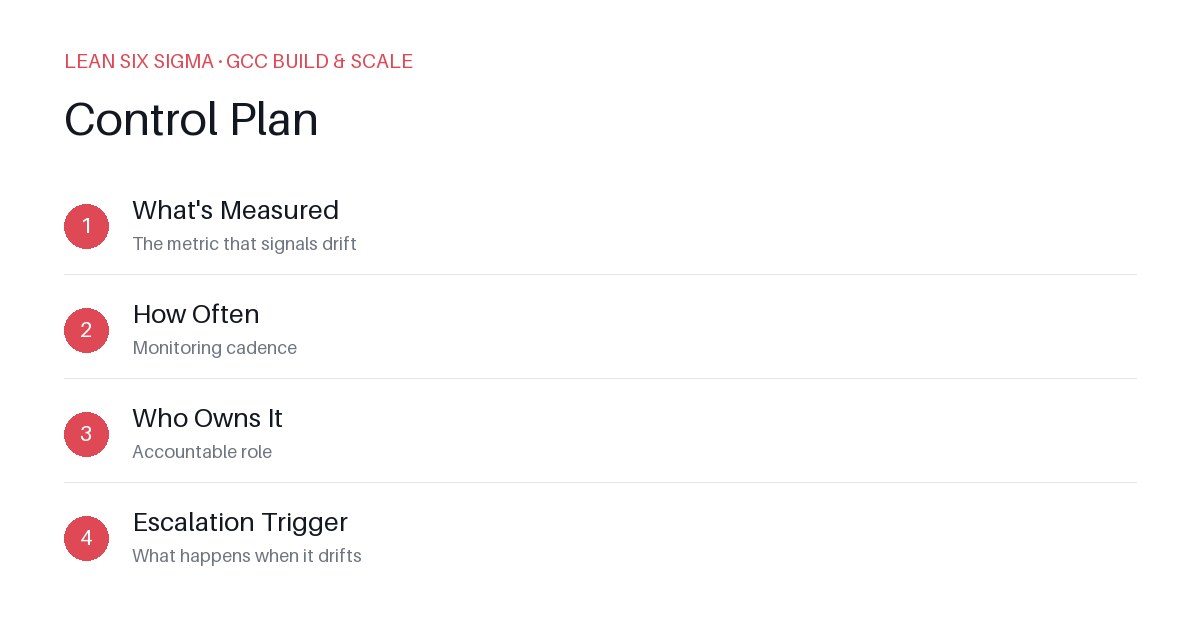
Downloadable templates
A practical walkthrough of applying Control Plan to real GCC build-and-scale work.
Control Plans for GCC Process Stability
Why Control Plan Matters for GCC Teams
Scaling a Global Capability Center means standardizing work across sites, handoffs, and teams that have never worked together before. Control Plan gives you a shared vocabulary and a repeatable sequence for doing that. Without it, you’re left with tribal knowledge, inconsistent monitoring, and reactive firefighting instead of proactive stability. A well-defined Control Plan transforms abstract “we need better quality” into concrete, actionable, and measurable practices that everyone can follow.
The Control Plan Sequence
-
What's Measured — The metric that signals drift
This isn’t just any KPI. It’s a leading or lagging indicator that directly reflects process health. For example, in a GCC handling software delivery, you might track “% of deployments with zero critical defects” or “average time to detect a production anomaly.” The key is that the metric must be observable, actionable, and tied to business outcomes. -
How Often — Monitoring cadence
Frequency should match the criticality of the metric. High-impact, fast-moving processes (like daily standups or sprint reviews) may require daily checks. Lower-frequency processes (like quarterly compliance audits) can be monitored monthly. The cadence must be sustainable and automated where possible to avoid alert fatigue. -
Who Owns It — Accountable role
Ambiguity in ownership is the #1 cause of Control Plan failure. Assign a single accountable person or team for each metric. This owner doesn’t necessarily do the work but is responsible for ensuring it’s done, interpreting results, and initiating corrective actions. -
Escalation Trigger — What happens when it drifts
Define clear thresholds and response protocols. For instance, if “deployment success rate” drops below 95% for two consecutive days, the owner must trigger a root cause analysis and notify the process governance board. Escalation paths should be documented, time-bound, and proportional to the severity.
Applying It
Start small: pick one recurring pain point your GCC team hits every week, and walk it through these 4 steps before rolling the approach out more broadly. Download the template below to run your first pass.
Building a Control Plan: A Practical Example
Consider a GCC responsible for customer support ticket routing. A common pain point is delayed response times during peak hours. Here’s how a Control Plan might look:
- What's Measured: Average first-response time for Tier 1 tickets
- How Often: Monitored hourly during business hours, aggregated daily
- Who Owns It: Support Operations Lead
- Escalation Trigger: If average response time exceeds 15 minutes for 3 consecutive hours, the lead must activate overflow staffing and notify the service delivery manager.
This simple structure turns a vague concern into a managed process. Over time, you can layer in additional metrics like “escalation rate to Tier 2” or “customer satisfaction score” and refine triggers based on historical data.
Scaling Control Plans Across Sites
Once you’ve proven the model on one process, replicate it across other GCC functions: development, QA, infrastructure, and training. Use a centralized repository to store all Control Plans, ensuring version control and accessibility. Conduct quarterly reviews to retire outdated metrics, adjust thresholds, and align with evolving business priorities.
Key Takeaways
- Control Plans are not bureaucracy; they’re operational clarity.
- Start with one metric, one owner, one trigger — then expand.
- Automation and documentation are force multipliers.
- Review and refine regularly to keep plans relevant and effective.
By embedding Control Plans into your GCC’s daily rhythm, you build resilience, reduce variability, and create a culture of accountability that scales with your organization.
Comments
Be the first to comment on this post.
Sign in to leave a comment.