Control Plans for GCC Process Stability
October 10, 2026
Like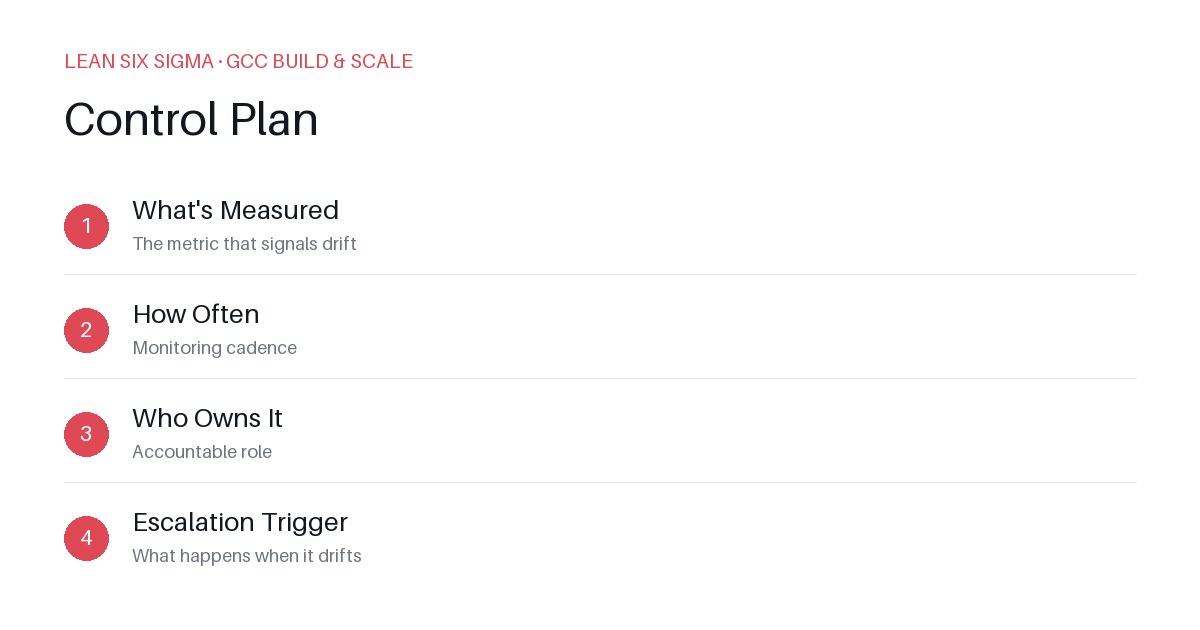
Downloadable templates
A practical walkthrough of applying Control Plan to real GCC build-and-scale work.
Why Control Plan Matters for GCC Teams
Scaling a Global Capability Center means standardizing work across sites, handoffs, and teams that have never worked together before. Without a shared framework, local teams default to tribal knowledge, inconsistent monitoring, and reactive firefighting. Control Plan gives you a shared vocabulary and a repeatable sequence for doing that. It turns ad-hoc troubleshooting into predictable governance, enabling GCC leaders to focus on strategic capability building rather than chasing the same operational fires week after week.
The Control Plan Sequence
-
What's Measured — The metric that signals drift
Choose a leading or lagging indicator tied to a specific process outcome. For example, in a GCC software delivery center, “average cycle time for defect resolution” or “first-time pass rate for code reviews” might serve as the signal. The metric must be objective, accessible to the owning team, and directly correlated with business impact. -
How Often — Monitoring cadence
Define the frequency at which the metric is reviewed. Daily standups may require daily checks, while quarterly capacity planning might only need weekly snapshots. The cadence should balance responsiveness with operational overhead—too frequent and teams burn out; too infrequent and drift goes unnoticed until it becomes a crisis. -
Who Owns It — Accountable role
Assign clear ownership to a specific role or team, not a vague “everyone.” In a GCC context, this might be the Center of Excellence lead, a process owner, or a site-based operations manager. Ownership includes the authority to act when triggers are met and the responsibility to report status upward. -
Escalation Trigger — What happens when it drifts
Establish predefined thresholds that activate predefined actions. For instance, if “average cycle time” exceeds 48 hours for three consecutive days, the trigger could be: notify the GCC director, pause non-critical deployments, and schedule a root-cause workshop. Escalation paths must be documented, time-bound, and aligned with business risk tolerance.
Applying It
Start small: pick one recurring pain point your GCC team hits every week, and walk it through these 4 steps before rolling the approach out more broadly. For example, if your GCC team struggles with inconsistent release quality across regions, define “release defect rate” as the measured metric, set a weekly review cadence, assign the Quality Assurance Lead as the owner, and define a trigger such as “if defect rate exceeds 5% for two consecutive releases, escalate to the Program Manager and halt the next release wave pending review.”
Download the template below to run your first pass. Use it to document your initial Control Plan, socialize it with cross-functional stakeholders, and iterate based on real-world feedback. As teams internalize the structure, you can expand it to cover additional processes, integrate it into existing governance rhythms, and measure improvements in predictability, accountability, and time-to-resolution. Over time, Control Plan becomes not just a monitoring tool but a cultural anchor for continuous improvement across your Global Capability Center.
Comments
Be the first to comment on this post.
Sign in to leave a comment.