Control Plans for GCC Process Stability
August 19, 2026
Like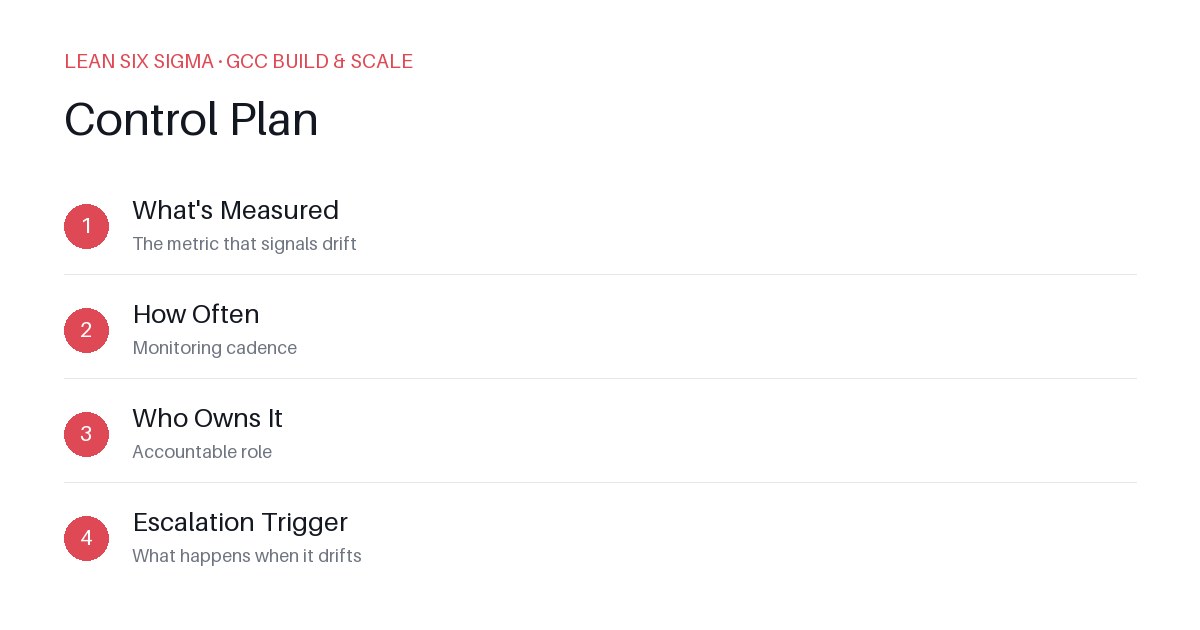
Downloadable templates
A practical walkthrough of applying Control Plan to real GCC build-and-scale work.
Control Plans for GCC Process Stability
Why Control Plan Matters for GCC Teams
Scaling a Global Capability Center means standardizing work across sites, handoffs, and teams that have never worked together before. In a distributed environment, assumptions break quickly. A developer in Mumbai might interpret “complete” differently than a QA engineer in São Paulo, while a product owner in New York might expect weekly updates while the delivery team operates on sprint cycles. Without a shared framework, these misalignments compound into delays, rework, and morale erosion.
Control Plan gives you a shared vocabulary and a repeatable sequence for doing that. It’s not about bureaucracy—it’s about clarity. By documenting what matters, how often you check it, who is responsible, and what happens when things go off track, you create a lightweight operating system that scales with your team. It turns tribal knowledge into institutional memory, making onboarding faster and handoffs smoother.
The Control Plan Sequence
-
What's Measured — The metric that signals drift
This isn’t just any KPI. It’s a leading indicator that tells you when a process is slipping before it becomes a crisis. For example, instead of tracking “number of bugs found,” track “time from code commit to first test execution.” The latter reveals bottlenecks in your feedback loop. -
How Often — Monitoring cadence
Frequency must match the speed of your workflow. Daily metrics need daily checks; weekly ones can be reviewed in stand-ups. Over-monitoring creates noise; under-monitoring creates surprises. Align cadence with decision velocity. -
Who Owns It — Accountable role
Ownership isn’t optional—it’s the linchpin of accountability. Assign a single named individual per metric, not a team or committee. If “build success rate” drops, we need to know who owns fixing it, not who “should” fix it. -
Escalation Trigger — What happens when it drifts
Define thresholds in advance. If deployment failure rate exceeds 15% for two consecutive days, trigger a post-mortem and pause non-critical releases. Pre-agreed triggers remove ambiguity during incidents and prevent blame games.
Applying It
Start small: pick one recurring pain point your GCC team hits every week, and walk it through these 4 steps before rolling the approach out more broadly. For instance, if handoff delays between design and development are causing sprint slippage, create a Control Plan for “time from approved design to dev start.” Measure it daily, assign the tech lead as owner, and set an escalation trigger at 48-hour variance.
Download the template below to run your first pass. Use it to document your top 3 process risks, assign owners, and schedule a 30-minute review in your next team sync. Within a month, you’ll see fewer surprises, faster resolution times, and a culture where process is treated as a tool—not a constraint.
The goal isn’t perfection. It’s predictability. And predictability is the foundation of scalable, stable, high-performing Global Capability Centers.
Comments
Be the first to comment on this post.
Sign in to leave a comment.