Control Plans for GCC Process Stability
October 13, 2026
Like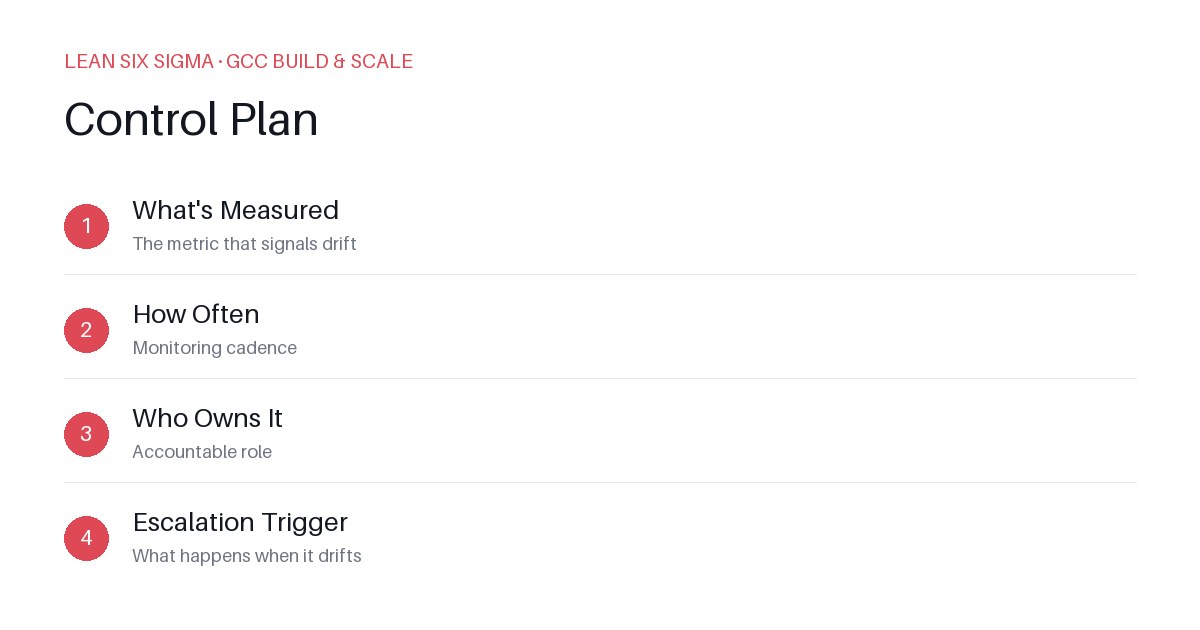
Downloadable templates
Use control plans to lock in GCC gains, detect drift early, and keep delivery quality predictable across global teams.
Why GCCs Lose Gains Without Control Plans
Lean Six Sigma builds capability, but capability fades without control. In a Global Capability Center, you might train 200 analysts on a new root-cause template, only to see execution drop by 40% in three months. That’s not training failure; that’s lack of control.
Control plans are your defense against drift. They turn one-time improvements into sustained performance.
What a Control Plan Actually Looks Like
A control plan isn’t a policy document. It’s a living operating manual for a specific process.
It should include:
- Process name and owner
- Process map or flow (current state, post-improvement)
- Critical to quality (CTQ) metrics with targets
- Standard work steps
- Control methods (poka-yoke, checklists, automation)
- Monitoring frequency and responsibility
- Escalation triggers and response steps
- Review cadence
Example: For a GCC handling software defect triage, the control plan might specify that all P1 defects must be triaged within 2 hours, with a checklist for severity validation, automated alerts at 90 minutes, and a weekly review by the process owner.
Building a Control Plan Step by Step
- Pick one high-impact process. Don’t boil the ocean. Start where defects, delays, or rework are highest.
- Map the process. Use value stream or process flow tools. Identify where variation occurs.
- Define CTQ metrics. What does good look like? Measure cycle time, error rate, first-pass yield, etc.
- Document standard work. Write steps so any trained team member can follow them.
- Design controls. Use poka-yoke where possible. Add checklists, automation, or peer reviews.
- Assign ownership. One person owns the process, not just the project.
- Set monitoring rhythm. Daily, weekly, or monthly? Match to process speed.
- Define escalation. What happens when metrics slip? Who acts, and how fast?
- Review and update. Control plans degrade. Schedule quarterly reviews.
Common Mistakes to Avoid
- Treating control plans as one-time deliverables. They’re living documents.
- Overcomplicating them. If the team can’t read it, they won’t use it.
- No owner. If no one is accountable, control fails.
- Ignoring feedback. If the process changes, the control plan must too.
Real Scenario: GCC Triage Process Stabilization
A GCC reduced defect resolution time by 30% using DMAIC. Six months later, time slipped back to baseline. Root cause? No control plan. Teams reverted to old habits.
The fix: Create a control plan for triage. Standardized steps, automated alerts, daily metrics dashboards, weekly reviews by a process owner. Within two months, resolution time stabilized at the improved level. No retraining needed.
Next Steps
Start with one process. Build a lean control plan. Assign an owner. Monitor. Adjust. Repeat.
Stability isn’t luck. It’s discipline. Control plans are your discipline.
Comments
Be the first to comment on this post.
Sign in to leave a comment.