Control Plans for GCC Process Stability
October 18, 2026
Like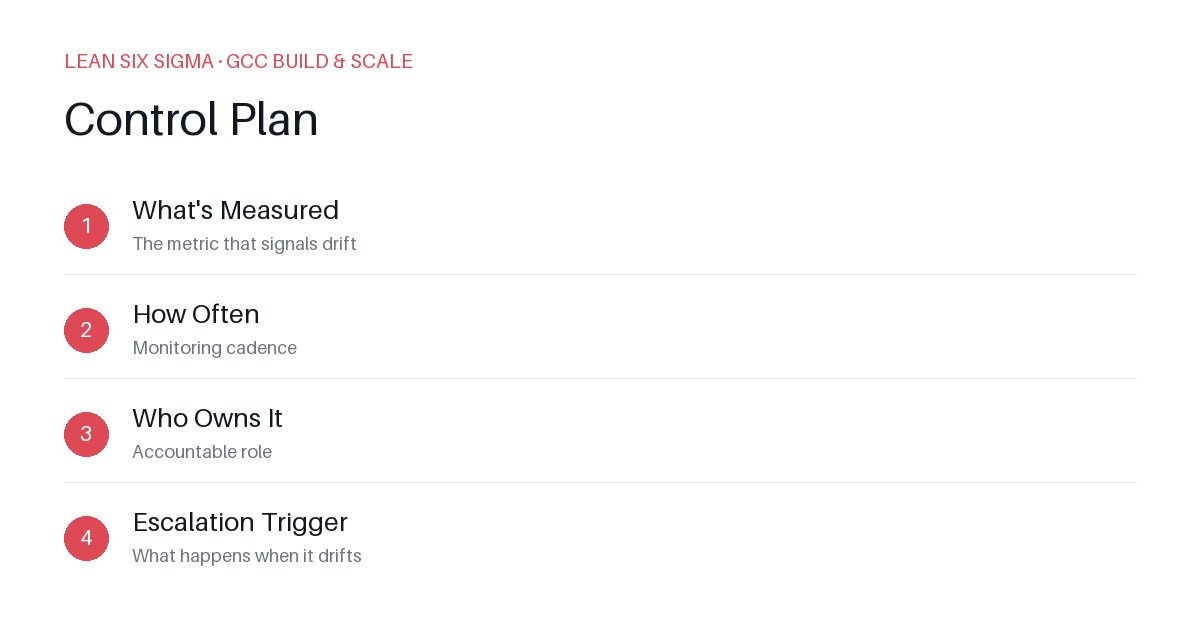
Downloadable templates
Stop guessing why defects spike. Build a Control Plan that locks process stability in your Global Capability Center with real metrics and clear actions.
Why Most GCC Control Plans Fail
Most Global Capability Centers (GCCs) treat Control Plans as a compliance checkbox. They sit in a binder, get signed by a manager, and disappear until the next audit. That doesn't stabilize processes. It just creates paperwork.
A working Control Plan is a living document. It tells you exactly what to measure, when to act, and how to fix drift before it becomes a crisis. Without it, your GCC is just a cost center, not a capability hub.
Define the Process Boundaries First
You can't control what you haven't defined. Start by mapping the end-to-end process your GCC supports. For example, if your GCC handles IT service request fulfillment, the process starts when a ticket is created and ends when the user confirms resolution.
Identify the critical steps. In IT service, those might be:
- Ticket routing
- First-response time
- Resolution accuracy
- Closure validation
Write these down clearly. Vague boundaries lead to vague metrics. Specific boundaries lead to actionable control plans.
Pick Metrics That Actually Matter
Don't track everything. Track what impacts your customers. Use the Pareto principle: 80% of your problems come from 20% of your metrics. Pick three to five KPIs that directly affect service quality.
For IT service, good metrics are:
- First Contact Resolution (FCR) rate
- Mean Time to Resolve (MTTR)
- Customer Satisfaction Score (CSAT)
- Defect rate in resolutions
Avoid vanity metrics. If a metric doesn't trigger an action when it changes, it's noise. Drop it.
Set Realistic Targets
targets that are too ambitious cause burnout. Targets that are too easy cause complacency. Base your targets on current performance and historical data.
Example: If your current FCR is 65%, setting a target of 85% in 90 days is aggressive but possible. Setting it to 95% is unrealistic and will demotivate your team.
Use historical data to set baseline targets. Then adjust quarterly based on actual results.
Build the Control Actions
The heart of your Control Plan is the action section. For each metric, define:
- What to measure
- How often to measure it
- Who owns it
- What happens when it drifts
- How to fix it
Example for FCR:
- Measure: % of tickets resolved on first contact
- Frequency: Weekly review
- Owner: GCC Process Lead
- Drift trigger: FCR drops below 70% for two weeks
- Fix: Root cause analysis, retraining, or workflow adjustment
Write these actions in plain language. No jargon. Your team needs to know exactly what to do.
Review and Adapt Weekly
A Control Plan that isn't reviewed is useless. Schedule a 30-minute weekly review with your GCC team. Look at the metrics. Discuss any drift. Decide on actions.
Keep it short. No long meetings. Just data, discussion, and decisions. If you can't act on the data, you're wasting time.
Document Everything
Keep your Control Plan in a shared location. Update it as you learn. If a process changes, update the plan. If a metric stops mattering, drop it.
Treat your Control Plan as a living document, not a static report. It should evolve with your GCC.
Start Small, Scale Fast
Don't try to control every process at once. Pick one critical process. Build its Control Plan. Implement it. Measure results. Then expand to the next process.
Start with a pilot. Learn. Adjust. Then roll out company-wide. That's how you build real stability, not just more paperwork.
Comments
Be the first to comment on this post.
Sign in to leave a comment.