Control Plans for GCC Process Stability
October 18, 2026
Like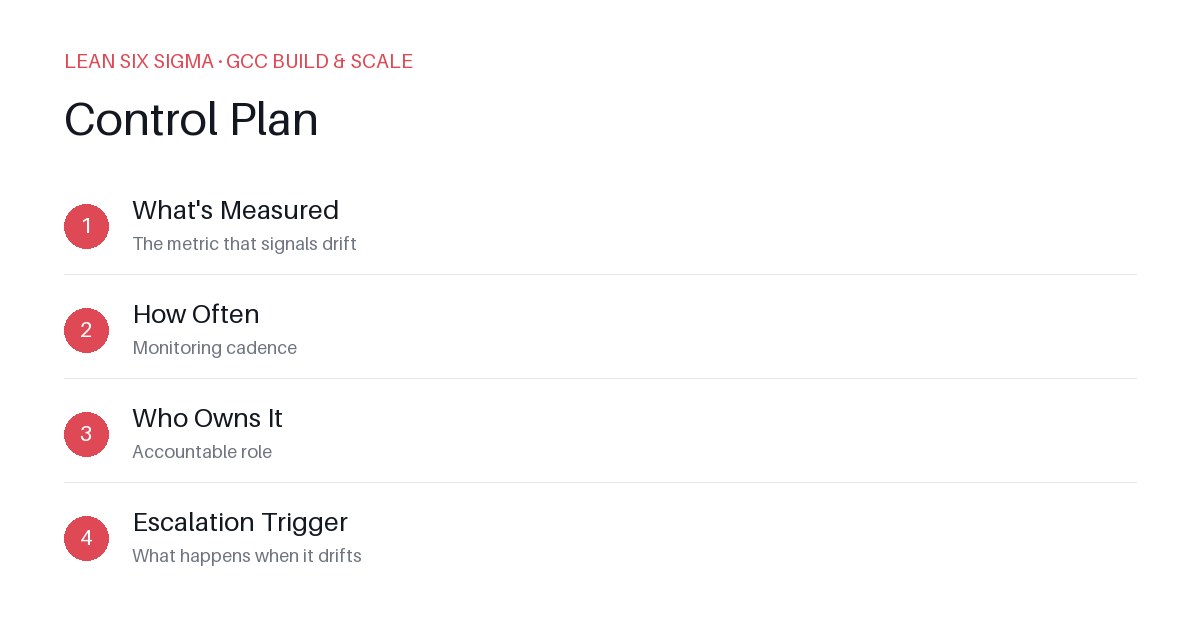
Downloadable templates
Use control plans to lock in GCC process stability and prevent performance drift after initial implementation.
What a Control Plan Actually Does
A control plan is the bridge between project completion and sustained operations. In a Global Capability Center (GCC), it ensures that standardized processes remain stable as teams scale, tools change, and personnel rotate. Without it, you risk performance decay—where initial gains erode over time.
Define Critical Process Elements
Identify the 3–5 processes that drive 80% of GCC output quality. Examples:
- Case triage and routing accuracy
- Defect resolution SLA adherence
- Knowledge base contribution rate
- Quality assurance pass rate
Document current state metrics, target thresholds, and acceptance criteria. This becomes your baseline for monitoring.
Build Monitoring Mechanisms
Embed real-time tracking into daily workflows:
- Use dashboards that pull data from your ticketing, QA, and collaboration tools
- Set up automated alerts when metrics breach control limits
- Assign ownership for each metric to a specific role (not just a team)
Example: If defect resolution SLA drops below 90% for two consecutive days, trigger a review meeting within 24 hours.
Establish Response Protocols
Pre-decide actions for common deviations:
- Minor drift: Coaching session + updated examples
- Persistent issue: Root cause analysis and process tweak
- Major breakdown: Temporary escalation to process owner with temporary workarounds
Document these protocols and train all GCC staff. Consistency in response prevents chaos when things go off track.
Review and Adapt
Schedule monthly control plan reviews:
- Assess metric trends and alert frequency
- Update thresholds if business needs shift
- Refine response protocols based on what worked or didn’t
- Share learnings across GCC locations
This keeps the plan alive and relevant, not just a document gathering dust.
Common Pitfalls to Avoid
- Overloading control plans with too many metrics—focus on what matters most
- Treating control plans as a one-time deliverable instead of a living system
- Failing to train staff on how to use and act on control data
- Ignoring early warning signs until they become major issues
Getting Started
Pick one critical process. Draft its control plan using the steps above. Pilot it for 30 days, then refine. Scale to other processes once you see the value. Stability isn’t accidental—it’s engineered through deliberate control.
Comments
Be the first to comment on this post.
Sign in to leave a comment.