Control Plans for GCC Process Stability
October 21, 2026
Like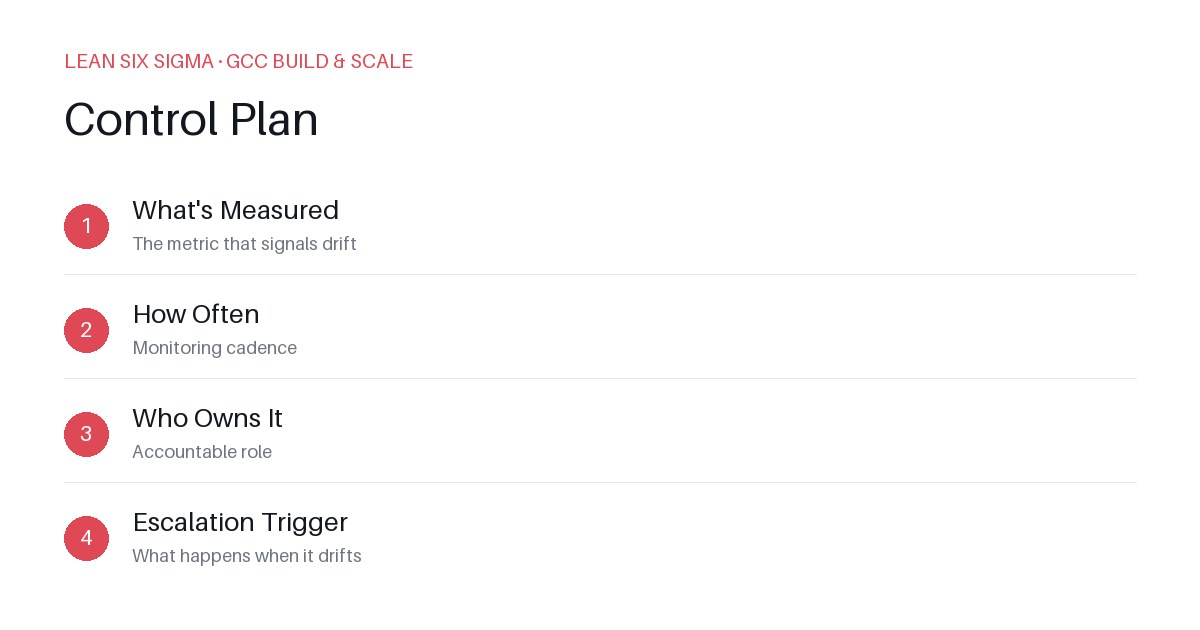
Downloadable templates
A practical walkthrough of applying Control Plan to real GCC build-and-scale work.
Control Plans for GCC Process Stability
Why Control Plan Matters for GCC Teams
Scaling a Global Capability Center (GCC) means standardizing work across sites, handoffs, and teams that have never worked together before. Without a shared framework, processes become fragmented, accountability blurs, and small inefficiencies compound into major delays. Control Plan gives you a shared vocabulary and a repeatable sequence for doing that. It transforms ad-hoc troubleshooting into systematic process governance. When every team member understands how a metric is measured, who owns it, and what happens when it drifts, you create a culture of proactive stability rather than reactive firefighting. This is especially critical in GCCs where teams operate across time zones, cultures, and tooling environments. A Control Plan ensures that no single point of failure can derail the entire workflow.
The Control Plan Sequence
-
What's Measured — The metric that signals drift
This isn’t just any KPI; it’s a leading indicator that reflects process health. For example, instead of tracking “number of tickets resolved,” you might measure “average time to first response” or “percentage of SLA breaches in handoff windows.” The metric must be objective, easily observable, and directly tied to process performance. -
How Often — Monitoring cadence
Frequency depends on the criticality and volatility of the process. High-impact, fast-moving workflows may require real-time dashboards or hourly checks. Stable, back-office processes might be reviewed weekly or monthly. The key is aligning cadence with risk tolerance and operational rhythm. -
Who Owns It — Accountable role
Ownership must be explicit, not assumed. Assign a named role (e.g., “GCC Process Lead,” “Site Coordinator,” or “Quality Owner”) who is empowered to act when thresholds are breached. Avoid collective ownership (“the team”), which often leads to diffusion of responsibility. -
Escalation Trigger — What happens when it drifts
Define clear, actionable steps for when the metric exceeds acceptable bounds. This could include: notifying the process owner, triggering a root-cause analysis session, pausing non-critical work, or escalating to GCC leadership. Escalation paths should be documented, rehearsed, and reviewed quarterly.
Applying It
Start small: pick one recurring pain point your GCC team hits every week, and walk it through these 4 steps before rolling the approach out more broadly. For instance, if cross-site handoffs consistently miss deadlines, define the metric (e.g., “% of handoffs completed within 24 hours”), set a monitoring cadence (daily review), assign an owner (Handoff Coordinator), and establish an escalation trigger (e.g., “If 3 consecutive days exceed 80% completion, escalate to GCC Director for resource reallocation”).
Download the template below to run your first pass. Use it to map your current process, identify gaps, and build consensus with stakeholders. Once validated, socialize the Control Plan across sites, integrate it into your team’s stand-ups or weekly reviews, and treat it as a living document—refine it as your GCC evolves.
Building Sustainability
A Control Plan is only as effective as its adoption. Embed it into your GCC’s operating rhythm: reference it in onboarding, include it in performance reviews, and celebrate teams that consistently meet thresholds. Over time, this creates a self-reinforcing loop where process stability becomes the norm, not the exception.
Comments
Be the first to comment on this post.
Sign in to leave a comment.