Control Plans for GCC Process Stability
October 24, 2026
Like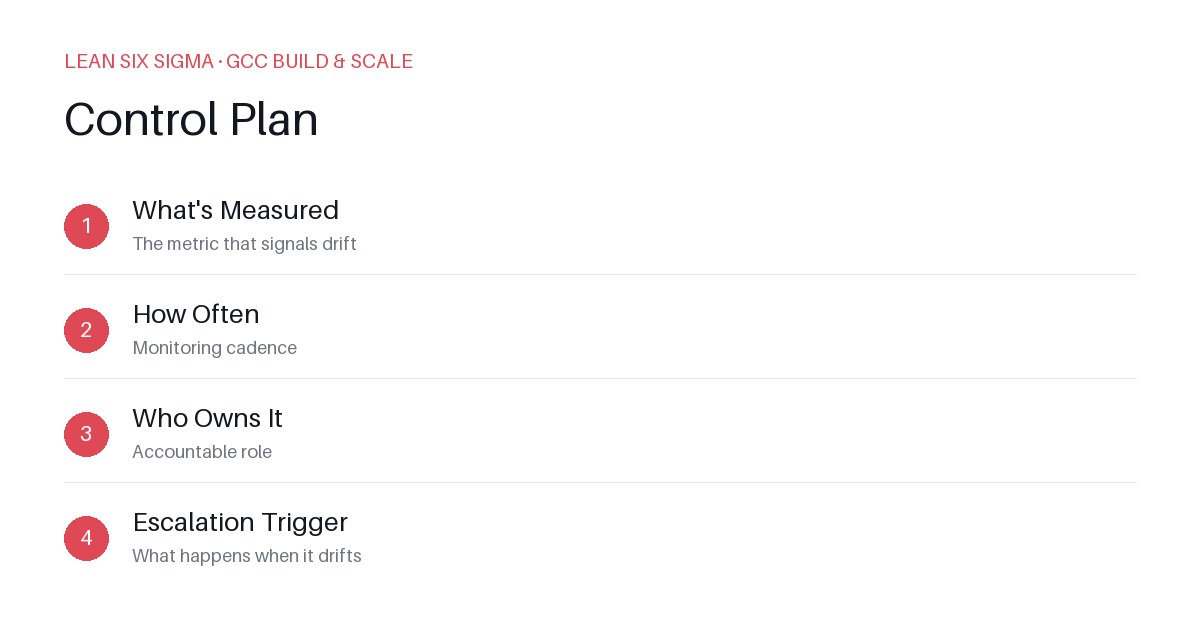
Downloadable templates
A practical walkthrough of applying Control Plan to real GCC build-and-scale work.
Control Plans for GCC Process Stability
Why Control Plan Matters for GCC Teams
Scaling a Global Capability Center (GCC) means standardizing work across sites, handoffs, and teams that have never worked together before. Without a shared framework, each location may develop its own interpretation of “good enough,” leading to inconsistent quality, delayed feedback, and repeated firefighting. A Control Plan gives you a shared vocabulary and a repeatable sequence for doing that. It turns ad-hoc troubleshooting into disciplined process management, enabling GCC teams to detect drift early, assign clear accountability, and resolve issues before they cascade into larger operational failures.
The Control Plan Sequence
A Control Plan is not a static document—it’s a living mechanism for maintaining process stability. It consists of four core components:
- What's Measured — The metric that signals drift. This should be a leading or lagging indicator that directly reflects process health. Examples include cycle time variance, error rate per batch, SLA breach frequency, or rework ratio. The metric must be objective, measurable, and tied to business outcomes.
- How Often — Monitoring cadence. Frequency depends on the criticality of the process. High-risk workflows may require real-time dashboards or daily reviews, while lower-impact processes might be assessed weekly or monthly. The cadence should balance visibility with operational efficiency.
- Who Owns It — Accountable role. Every control must have a single named owner responsible for interpreting the data, taking corrective action, and reporting status. This role is not necessarily the person executing the work—it’s the person with authority and accountability for process integrity.
- Escalation Trigger — What happens when it drifts. Predefined thresholds determine when a metric crosses into unacceptable territory. Escalation paths should be clear: e.g., if error rate exceeds 5% for two consecutive days, the process owner escalates to the GCC lead within 24 hours. This prevents small issues from becoming systemic failures.
Applying It
Start small: pick one recurring pain point your GCC team hits every week, and walk it through these 4 steps before rolling the approach out more broadly. For example, if document approval delays are consistently causing bottlenecks, define the metric (average approval time), set the cadence (daily review), assign an owner (Process Coordinator), and establish an escalation trigger (if average time exceeds 48 hours, escalate to Team Lead).
Download the template below to run your first pass. Use it to document your initial control plan, then refine it based on real-world data and team feedback. Over time, you’ll build a library of control plans that institutionalize best practices, reduce variability, and create a culture of continuous improvement across your GCC.
Building a Control Plan Culture
A single control plan is useful; a collection of them is transformative. Encourage teams to contribute metrics and thresholds, review them in regular process improvement sessions, and retire controls that no longer add value. Celebrate early detections and successful escalations to reinforce the behavior. When control plans become part of the team’s rhythm—not an administrative burden—they become a powerful engine for GCC stability and scalability.
Comments
Be the first to comment on this post.
Sign in to leave a comment.