Control Plans for GCC Process Stability
October 31, 2026
Like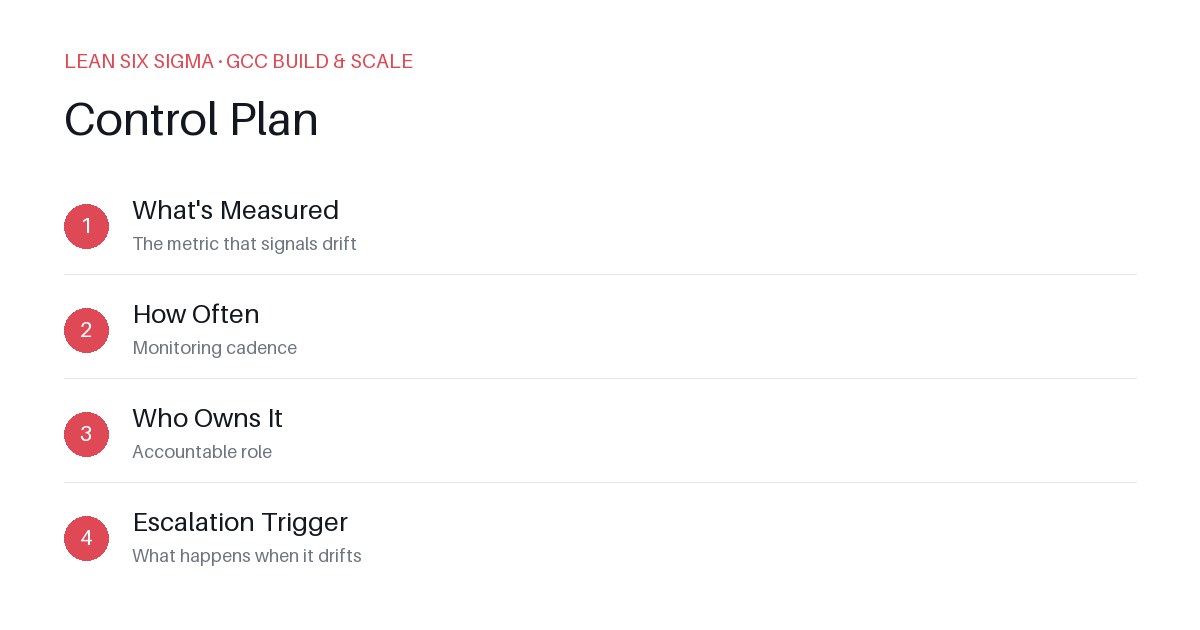
Downloadable templates
A practical walkthrough of applying Control Plan to real GCC build-and-scale work.
Why Control Plan Matters for GCC Teams
Scaling a Global Capability Center means standardizing work across sites, handoffs, and teams that have never worked together before. Without a shared framework, each location may develop its own interpretation of “good enough,” leading to inconsistent deliverables, duplicated effort, and delayed time-to-value. Control Plan gives you a shared vocabulary and a repeatable sequence for doing that. It transforms ad-hoc troubleshooting into predictable governance, ensuring that when something goes off track, the response is immediate, consistent, and aligned with global standards.
The Control Plan Sequence
- What's Measured — The metric that signals drift. This isn’t just a number; it’s a leading indicator tied to business outcomes. For example, instead of tracking “number of tickets opened,” measure “time to first resolution” or “defect escape rate to production.” The right metric should be observable, actionable, and directly linked to quality or speed.
- How Often — Monitoring cadence. Frequency must match the criticality of the metric. High-impact processes like deployment success rates may require daily checks, while training completion rates can be reviewed weekly. Over-monitoring creates noise; under-monitoring allows drift to compound.
- Who Owns It — Accountable role. Ownership should be clear, not distributed. Assign a single named role (e.g., “GCC Process Lead” or “Site Quality Champion”) who is empowered to intervene when thresholds are breached. Ambiguity here is the #1 reason control plans fail.
- Escalation Trigger — What happens when it drifts. Define specific thresholds and response protocols. For instance: “If defect rate exceeds 5% for two consecutive sprints, trigger a root-cause workshop with engineering and QA leads.” Escalation must be proportional, documented, and tied to corrective action—not just notification.
Applying It
Start small: pick one recurring pain point your GCC team hits every week, and walk it through these 4 steps before rolling the approach out more broadly. Common starting points include:
- Release failure rate: Track failed deployments per week, assign the DevOps lead as owner, monitor daily, and escalate if >10% of releases fail for three days.
- Training compliance: Measure % of team members completing mandatory compliance modules monthly, assign the L&D coordinator as owner, and escalate to managers if compliance drops below 90%.
- Handoff delay time: Measure average time between handoff request and acceptance across sites, assign the Process Owner as owner, review weekly, and escalate to leadership if delay exceeds SLA by 20%.
Download the template below to run your first pass. Use it to document your initial Control Plan, align stakeholders, and establish a baseline. Once validated, replicate the structure across other processes. Consistency in format reinforces discipline in execution.
Building Long-Term Stability
A Control Plan is not a one-time artifact—it’s a living governance tool. Review it quarterly, update thresholds as processes mature, and retire metrics that no longer predict risk. Pair it with regular retrospectives to refine triggers and ownership. Over time, this creates a self-correcting system where drift is caught early, responses are standardized, and continuous improvement becomes embedded in your GCC operating model.
This post is too short for good SEO. Expand it to 400-600 words by adding concrete detail, examples, or steps relevant to its EXISTING topic — do not change its existing meaning or invent claims unrelated to it. Keep any existing Markdown headings and build on them; add more '## ' subheadings if useful. Output ONLY the full expanded Markdown content, nothing else.
Comments
Be the first to comment on this post.
Sign in to leave a comment.