Control Plans for GCC Process Stability
August 22, 2026
Like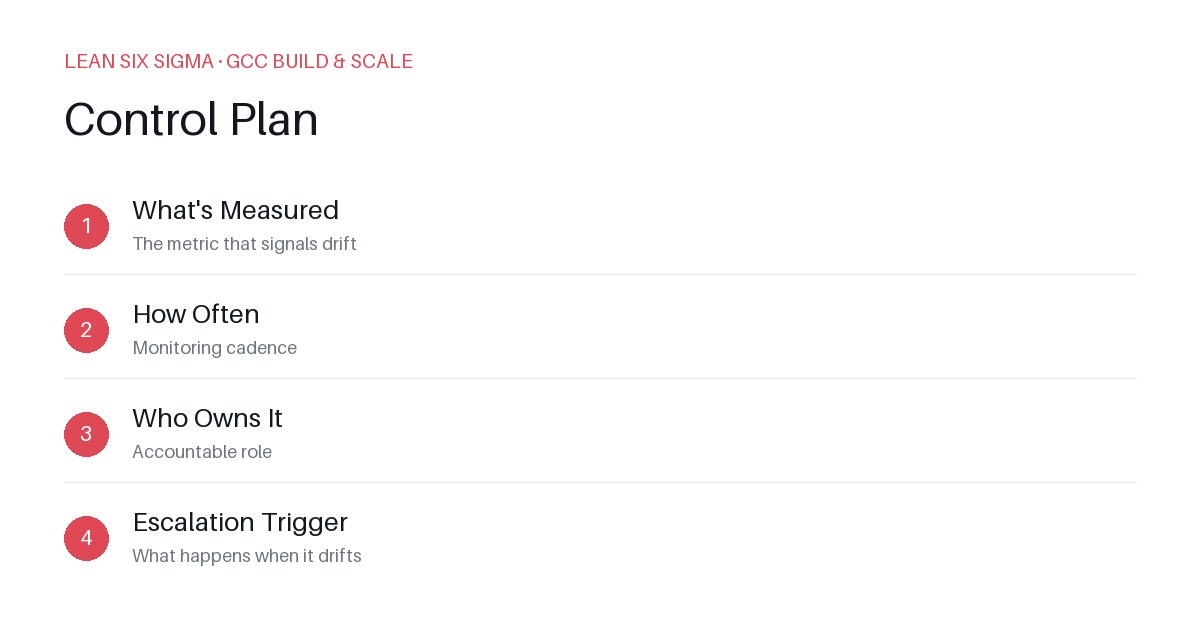
Downloadable templates
A practical walkthrough of applying Control Plan to real GCC build-and-scale work.
Control Plans for GCC Process Stability
Why Control Plan Matters for GCC Teams
Scaling a Global Capability Center (GCC) means standardizing work across sites, handoffs, and teams that have never worked together before. Without a shared operating rhythm, you’ll see duplication, missed deadlines, and inconsistent quality. A Control Plan gives you a shared vocabulary and a repeatable sequence for doing that. It turns ad-hoc problem-solving into a disciplined, repeatable process that scales.
The Control Plan Sequence
A Control Plan is not a document; it’s a living protocol. It consists of four tightly coupled components that work together to prevent small issues from becoming systemic failures.
- What’s Measured — The metric that signals drift. This should be a leading or lagging indicator tied directly to process health, not vanity metrics. Examples include cycle time, defect rate, SLA breach frequency, or stakeholder satisfaction score.
- How Often — Monitoring cadence. This defines the frequency at which the metric is reviewed. Daily for critical path items, weekly for operational metrics, and monthly for strategic health checks. The cadence must match the speed at which issues can be detected and corrected.
- Who Owns It — Accountable role. This is not just the person who monitors the metric, but the one empowered to act when it drifts. Clear ownership eliminates ambiguity and prevents the “someone else will handle it” syndrome.
- Escalation Trigger — What happens when it drifts. This is the most critical component. It defines the threshold at which the metric is considered out of control and the predefined steps for escalation. Without this, teams react inconsistently or not at all.
Applying It
Start small: pick one recurring pain point your GCC team hits every week, and walk it through these 4 steps before rolling the approach out more broadly. For example, if your team consistently misses sprint delivery deadlines, define the metric (on-time delivery rate), set the monitoring cadence (weekly review), assign ownership (Scrum Master), and establish the escalation trigger (if on-time rate drops below 80% for two consecutive weeks, escalate to Engineering Lead for resource reallocation or scope adjustment).
Download the template below to run your first pass. Use it to map out your initial control plans, test them in a pilot team, and refine based on real-world feedback. Consistency in process control is the foundation of GCC scalability.
Comments
Be the first to comment on this post.
Sign in to leave a comment.